
If you’ve been in DeFi for a while, you probably remember the "good old days." That meant spending your nights glued to the screen, hopping between protocols, and wrestling with complex spreadsheets just to chase a decent yield. It was a full-time job—a constant race against high gas fees and the nagging feeling you were always one step behind the best opportunity.
Today, AI yield optimization is changing the game completely. It takes that high-stress, manual grind and turns it into a smart, automated investment strategy.
Moving Past Manual Yield Farming

Before these automated tools came along, "yield farming" was a raw, hands-on battle. You had to be a detective, stitching together clues from dozens of dashboards, X (formerly Twitter) threads, and analytics platforms. The goal was simple enough—find the best return—but getting there was anything but.
This manual approach was riddled with problems. Let's be honest, it was a nightmare of inefficiencies and risks that made it tough for anyone but the most dedicated degen to succeed.
The Headaches of Doing It Yourself
Managing your yield manually wasn't just time-consuming; it was a huge barrier for most people. To do it well, you needed a rare mix of deep technical know-how, relentless market awareness, and a stomach for serious risk.
Here were some of the biggest pain points:
Information Overload: With thousands of liquidity pools and lending protocols popping up, just trying to compare opportunities felt like drinking from a firehose.
Constant Monitoring: DeFi yields can swing wildly in a matter of minutes. A killer APY one day could be obsolete the next, forcing you to check your positions around the clock.
High Gas Fees: Every time you shifted your funds to a new, better-yielding pool, you got hit with transaction costs. For smaller portfolios, those gas fees could wipe out your profits entirely.
Security Roulette: Telling a safe smart contract from a rug pull requires a very specific skill set. Manual farmers constantly risked their capital on unaudited or outright malicious protocols.
This juggling act is what kept so many people out of DeFi. You basically had to be a stock trader, financial analyst, and cybersecurity expert all rolled into one.
The Leap to Intelligent Automation
This is where AI yield optimization marks a massive shift. Instead of trying to navigate this chaotic landscape on your own, you can deploy an intelligent agent to do the heavy lifting for you. It’s like going from a clunky old flip phone to the latest smartphone—the core idea is the same, but the power, efficiency, and accessibility are on another planet.
Platforms like Yield Seeker were created to solve these exact problems. By using AI, they scan the entire DeFi ecosystem in real-time, making data-driven moves to find the best risk-adjusted returns available. This transforms yield farming from a stressful, hands-on chore into a passive, set-and-forget strategy, finally making it accessible for everyone.
What Is AI Yield Optimization
At its heart, AI yield optimization is like having an elite team of financial analysts working for you around the clock. This team never sleeps, never gets tired, and can process millions of data points every second to make the smartest possible decisions for your stablecoins. It moves far beyond the simple act of chasing the highest interest rate.
Instead, think of it as a dynamic system that continuously analyzes the entire Decentralized Finance (DeFi) landscape. This isn't just about numbers; it's about understanding the complex interplay between risk and reward in a market that changes by the minute.
More Than Just a High APY
A common mistake in DeFi is to just go for the highest Annual Percentage Yield (APY) you can find. An AI-driven system knows better. It digs deeper, evaluating a whole range of critical factors to determine the true quality of a yield source.
This multi-faceted analysis includes:
Protocol Health: How healthy is the protocol? It looks at things like total value locked (TVL), transaction volume, and the stability of a protocol over time.
Liquidity Pool Depth: Is there enough liquidity to get in and out of a position without causing a massive price swing?
Transaction Costs: What about gas fees and other costs? The AI calculates these to make sure they don’t eat away at your potential profits.
Security Audits and History: The system prioritizes protocols with a strong track record of security, multiple audits from reputable firms, and no history of major exploits.
By weighing all these variables, the AI builds a comprehensive risk profile for each opportunity. The goal isn't just the highest advertised number, but the best risk-adjusted return.
It's like a professional chef selecting ingredients. An amateur might just grab the shiniest apple, but the chef inspects it for bruises, checks its firmness, and even considers its origin. AI yield optimization applies that same level of detailed scrutiny to DeFi protocols.
The Brains Behind the Operation
So, how does this all actually work? Before diving into the specifics, it helps to understand the broader concept of AI automation, which is the technological backbone here. At its core, the system uses machine learning models to analyze data, spot patterns, and predict future market behavior.
This isn't just a finance thing, either. The global AI-enabled yield optimization market is seeing major growth in sectors like manufacturing, projected to hit $7.8 billion by 2034. In that field, AI cuts down on product defects and maximizes output by learning from changing production conditions. This same adaptive intelligence is now being put to work managing capital in DeFi.
From Data to Decisions
An AI yield optimization engine is constantly drinking from a firehose of information. It's looking at on-chain data, like transaction history and smart contract interactions, but it also scans off-chain sources like social media sentiment, news articles, and developer community discussions. We take a deeper look at this in our guide on AI in crypto investing.
This constant flow of information allows the AI to do several key things:
Spot Opportunities: It detects new, promising yield sources the moment they pop up.
Assess Risks: It flags potential red flags, like a wave of negative sentiment or weird on-chain activity.
Execute Strategies: It automatically moves funds around to keep an optimal balance between yield and safety.
Ultimately, this creates a system that is both proactive and reactive. It can seize fleeting opportunities that a human would miss while simultaneously protecting your capital from emerging threats—all without you having to lift a finger.
How AI Powers Smarter Yield Strategies
To really get what AI yield optimization is all about, we need to pop the hood and look inside. It’s not some magic black box; it's a mix of specific AI techniques working together to navigate the often chaotic DeFi market. Think of it like a world-class financial team, where each member is a specialist with a unique job.
You've got three core components working in sync. First, a predictive analyst whose job is to forecast the market weather. Next, an experienced trader who learns from every single move. And finally, a market sentiment analyst who's always listening to the global conversation. When they come together, you get a system that’s forward-looking, adaptive, and incredibly well-informed.
This diagram gives a great high-level view of how these AI components chew through data to strike the right balance between risk and reward.
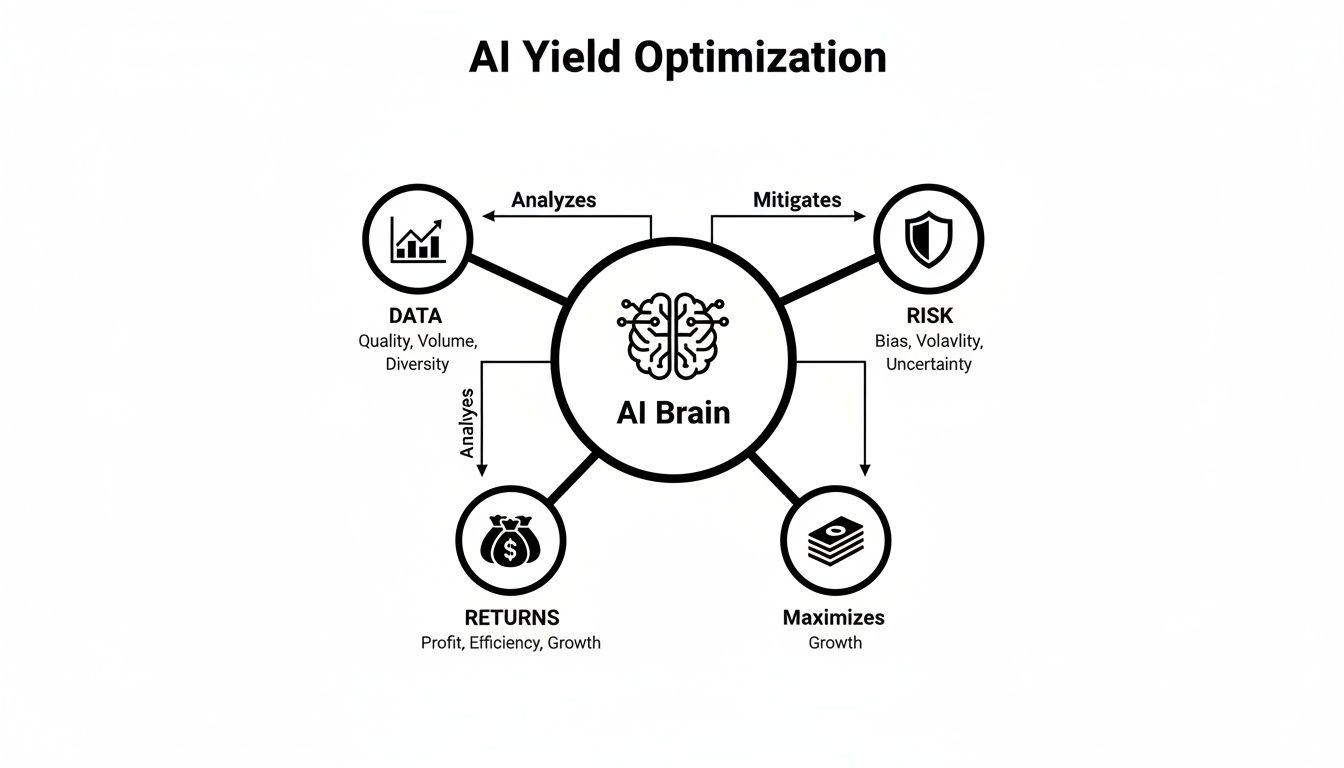
You can see the AI brain right at the center, constantly crunching incoming data to make smart calls on risk and potential returns. Let's break down the key technologies that make this happen.
To give you a clearer picture, here’s a quick breakdown of the core AI models, what they do in DeFi, and the data they feast on.
Key AI Techniques in DeFi Yield Optimization
AI Technique | Primary Function in DeFi | Data Inputs Analyzed |
|---|---|---|
Machine Learning (ML) | Forecasts Future Yields: Identifies historical patterns to predict where APYs are headed. | Historical APYs, transaction volumes, gas fees, Total Value Locked (TVL), protocol-specific metrics. |
Reinforcement Learning (RL) | Refines Strategy Through Experience: Learns from the outcomes of its actions, improving its decision-making over time. | Real-time profit/loss, slippage, gas costs, opportunity costs, risk-adjusted returns from past actions. |
Natural Language Processing (NLP) | Gauges Market Sentiment: Analyzes human language to detect early signs of risk or opportunity. | Social media posts (X, Reddit), news articles, developer forums (GitHub), community chats (Telegram). |
Each of these techniques brings something unique to the table, creating a system that's far more intelligent and responsive than any one model could be on its own.
Machine Learning: The DeFi Forecaster
Machine learning (ML) is the foundation of prediction in AI yield optimization. Its main gig is to sift through mountains of historical data—think past APYs, transaction volumes, and gas fees—to spot patterns and forecast what's likely to happen next. It's the system's "weather forecaster" for DeFi yields.
For instance, an ML model might notice that a specific liquidity pool's yield almost always dips after its Total Value Locked (TVL) hits a certain number. By catching this pattern, the AI can predict when the yield is about to fall and proactively shift funds before the drop, locking in the highest possible returns. We dive deeper into how these systems work in our piece on machine learning trading algorithms.
This predictive edge is a game-changer. It helps the system sidestep yields that are on the verge of collapsing and instead directs capital toward opportunities with more sustainable, predictable performance.
Reinforcement Learning: The Experienced Trader
While machine learning is busy analyzing the past, reinforcement learning (RL) is all about learning by doing. It's like a video game character that gets smarter every time it completes a level—it figures out which moves lead to high scores (rewards) and which ones lead to game over (penalties).
An AI yield agent operates on the exact same principle. It might execute a strategy, like allocating capital to a new lending protocol, and then it carefully measures the result.
Positive Reinforcement: If the strategy pays off with a strong risk-adjusted return, the AI gets a "reward." This teaches it that this type of move is a good one under similar market conditions.
Negative Reinforcement: If the protocol's APY tanks or gas fees eat up the profits, the AI receives a "penalty," learning to steer clear of that strategy in the future.
Through millions of these trial-and-error simulations, the AI starts to build an almost intuitive grasp of the market. It’s essentially creating a playbook of what works and what doesn't, allowing it to fine-tune its behavior on the fly as the market shifts.
AI models often use advanced methods like Monte Carlo backtesting trading strategies to stress-test their approaches against all sorts of market scenarios. This ensures the strategies are both robust and efficient.
This continuous learning cycle is what makes the AI so effective. It isn't just following a static rulebook; it’s constantly evolving its game plan.
Natural Language Processing: The Sentiment Gauge
The DeFi market isn't just about on-chain data; it's hugely influenced by human emotion and chatter. This is where Natural Language Processing (NLP) steps in. NLP is the AI’s ability to read, interpret, and understand human language from all corners of the internet.
The NLP engine acts like a sentiment gauge, scanning millions of sources for whispers and shouts related to different DeFi protocols.
Social Media: It keeps an eye on conversations on X (formerly Twitter), Reddit, and Telegram to see how the community is feeling.
News Articles: It monitors crypto news sites for big announcements, security alerts, or partnership news.
Developer Forums: It scours platforms like GitHub for technical discussions that might hint at upcoming upgrades or potential problems.
If an NLP model detects a sudden surge in negative chatter about a protocol—maybe rumors of a bug or worries about the team—it flags this as a potential risk. This signal gets combined with the hard data from machine learning and the strategic lessons from reinforcement learning. This 360-degree view allows the AI to make a much more informed decision, potentially pulling funds from a protocol long before bad news hits the mainstream.
Let's move from theory to reality. What does using AI yield optimization actually do for you? It's not just about a small boost over doing things by hand; it fundamentally changes how you can grow your capital. The advantages show up in your efficiency, returns, risk management, and even in just being able to access this stuff in the first place.
The core idea is simple: get better results with less work and less risk. Instead of spending hours chasing opportunities yourself, you set up an intelligent system that works for you 24/7. This is the real game-changer—moving from being an active trader to a passive overseer.
Free Up Your Time with Automated Efficiency
Your time is your most valuable asset. Anyone who's tried manual yield farming knows it's a massive time sink. You're constantly monitoring, researching, and moving funds around. An AI-powered system just automates that whole process, letting you focus on other things.
Think about it. Could you track hundreds of DeFi protocols across multiple blockchains at the same time? It’s impossible for a human. An AI, though, can process all that information in milliseconds, executing trades way faster and more efficiently than you ever could.
That means no more late nights staring at dashboards or weekends wasted in spreadsheets. The system handles the grind, turning a high-stress activity into a hands-off investment.
Amplify Returns with Enhanced Performance
One of the most exciting benefits is the very real potential for enhanced returns. The DeFi market moves incredibly fast. Great yield opportunities can pop up and disappear in minutes. An AI is built to thrive in this chaos.
Because it’s always on, an AI can spot and grab those fleeting chances that a human investor would almost always miss—like a brand new, high-quality liquidity pool that opens up overnight. It can also run complex math on the fly to figure out the perfect moment to get in or out of a position, squeezing out extra profit and avoiding slippage.
By constantly analyzing market data, an AI agent compounds gains more effectively. It’s not just about finding one good opportunity; it’s about stringing together hundreds of small, smart decisions that lead to better long-term results.
Implement Dynamic Risk Management
High returns don't mean much if you can't protect your capital. This is where AI yield optimization really shines, adding a dynamic layer of security that manual strategies just can't match. The AI isn't just chasing high APYs; it's constantly checking if a protocol is safe.
It keeps an eye on a whole range of risk factors:
Smart Contract Audits: It prefers protocols with multiple, solid security audits from reputable firms.
On-Chain Activity: It watches for weird transaction patterns that could be a red flag for an exploit.
Market Sentiment: It uses natural language processing to pick up on negative chatter or FUD before it causes a bank run.
Protocol Health Metrics: It tracks sudden drops in TVL or liquidity that might signal trouble.
If the AI senses a growing threat—like news of a new vulnerability in a protocol you're in—it can instantly and automatically move your funds to a safer, pre-approved alternative. This kind of proactive defense is critical in a space where things can go wrong in a flash.
Improve Accessibility for Everyone
Not long ago, advanced DeFi strategies were only for a small club of super technical users. The learning curve was steep, and the risks were high, which kept most people out. AI yield optimization is tearing down those walls and making DeFi easier for everyone to get into.
Platforms like Yield Seeker offer a super simple user experience. You don't need to be a smart contract wizard or a financial analyst to get started. The AI handles all the complicated stuff on the backend, letting you tap into sophisticated strategies through a clean, simple interface.
This is a big deal for the industry's growth. The DeFi lending market is becoming a core piece of financial infrastructure, with some projecting its total lending volume to hit $41 billion by Q3 2025. As stablecoins continue to grow, AI-driven tools will be key to helping more people safely access these opportunities. You can find more DeFi lending trends on sqmagazine.co.uk.
Understanding and Managing the Risks
While AI yield optimization brings some powerful advantages to the table, we need to be clear-eyed about the risks. Let's be honest: no investment in DeFi is a sure thing. A smart strategy isn't about eliminating risk—that's impossible—but about understanding and actively managing the potential downsides. The real goal is to build a risk-aware system that puts capital preservation first.
The world of digital assets has its own unique set of challenges. We're talking about things like vulnerabilities in smart contracts, the wild volatility of crypto markets, and a more subtle issue known as "model risk."
Let’s break down what these actually mean and, more importantly, how a well-designed AI platform can tackle them head-on.
Smart Contract and Market Risks
The entire foundation of DeFi is built on smart contracts, which are just pieces of code running on a blockchain. If that code has a bug or a flaw, it can be exploited, putting user funds in danger. This is easily the most talked-about risk in the space, and for good reason.
On top of that, the broader crypto market is famously volatile. Sudden market crashes or a "de-pegging" event—where a stablecoin loses its dollar value—can wreck even the safest-looking yield strategies. Any effective AI yield optimization system has to account for both of these realities.
To fight back, the best platforms use a defense-in-depth approach:
Rigorous Auditing: The AI is programmed to heavily favor protocols that have gone through multiple security audits from reputable firms. This is the first line of defense, and it's non-negotiable.
Built-in Diversification: The system never puts all its eggs in one basket. By automatically spreading capital across a curated list of vetted protocols, it minimizes the damage if any single one fails.
Real-time Monitoring: The AI is constantly watching for on-chain red flags, like strange withdrawal patterns or governance attacks, and can automatically pull funds away from a protocol that looks compromised.
The Challenge of Model Risk
Model risk is a trickier but equally important problem. This is the risk that the AI itself might make a bad call. An AI learns from data, but if that data is flawed or doesn't prepare it for a sudden, out-of-the-blue market event (a "black swan"), its predictions can go sideways.
Think of it like a weather app forecasting a sunny day based on a decade of historical data, only for a freak hurricane to appear out of nowhere. The model wasn't technically wrong; it was just unprepared for something completely outside its training.
The core principle of mitigating model risk is continuous improvement. An AI's decision-making framework is never "finished." It must be constantly backtested, refined, and updated to adapt to an ever-changing market landscape.
This is where relentless testing comes in. Developers are always backtesting the AI models against historical market data, running simulations of past crashes and crises to see how the system would have reacted. It's a process that helps identify weaknesses and harden the AI's logic, making it more resilient over time. You can learn more by exploring some of the best practices for risk management in this fast-moving environment.
By combining strict protocol vetting, smart diversification, and a commitment to continuous model improvement, AI yield optimization becomes a much more robust way to navigate the DeFi ecosystem. It's an honest approach that acknowledges the risks and actively works to keep them in check.
Seeing AI Yield Optimization in Action
All the theory is great, but nothing makes it click quite like seeing how a system like this actually works. Let's walk through what it's like to use a platform like Yield Seeker and connect the dots. This shows just how simple AI yield optimization can be, turning a mountain of market analysis into just a few clicks.
It all starts with a simple deposit of a stablecoin like USDC. No need to spend hours researching hundreds of protocols or squinting at spreadsheets comparing APYs. You just connect your wallet, decide how much to put to work, and hit deposit. From that point on, your AI agent takes over as your personal DeFi strategist.
This is the kind of clean, intuitive dashboard you’d see, where you can watch your AI agent's performance in real-time.
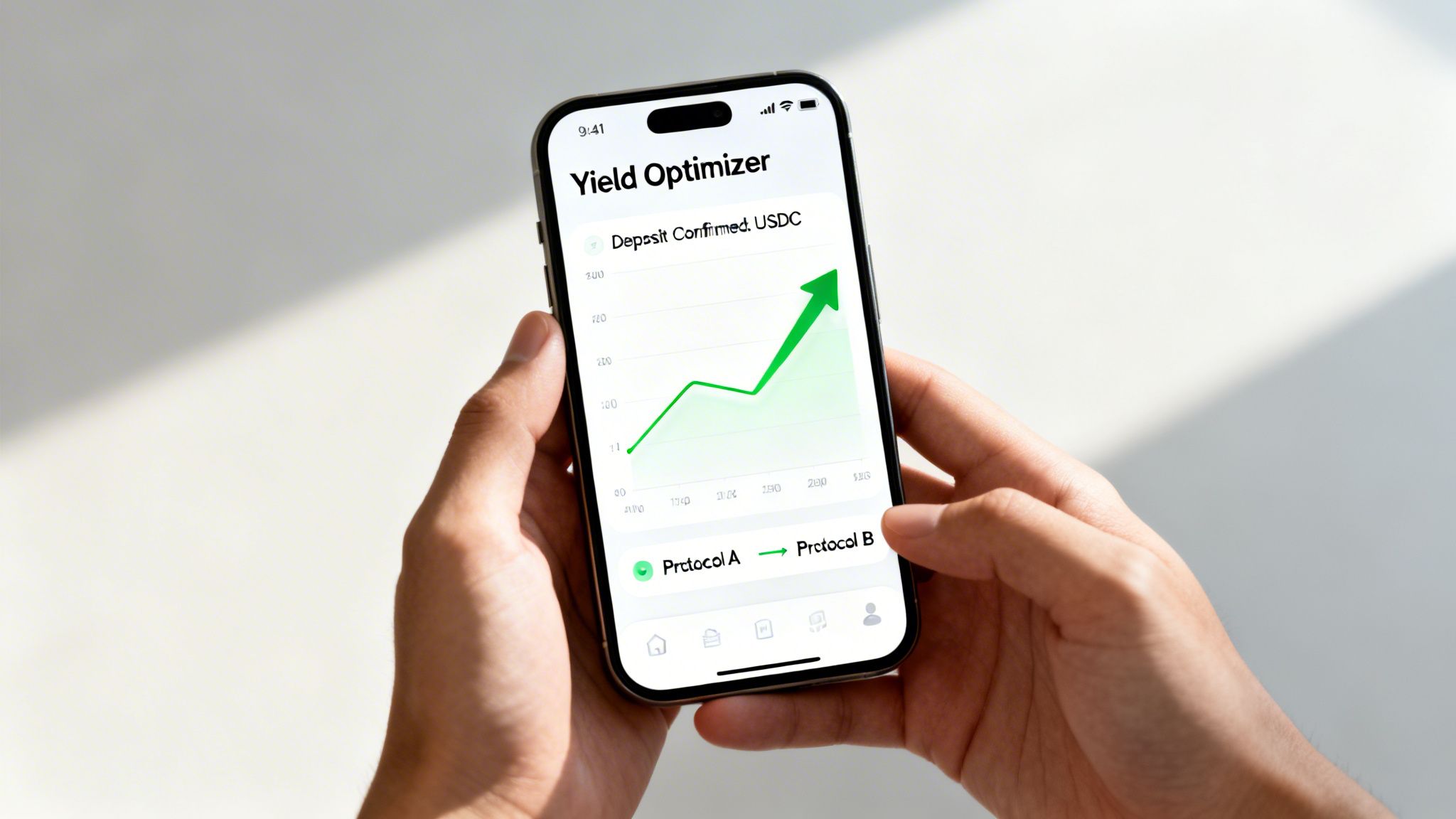
The goal here is clarity and control. You get a single, clear view of your total balance, your recent earnings, and the overall performance trend, cutting through the usual analysis paralysis of DeFi.
The AI Agent at Work
Once you've deposited your funds, the AI agent kicks off its continuous cycle of analysis and execution. Your capital isn't just parked in one spot; it's being actively managed to chase down the best risk-adjusted returns across the entire DeFi landscape.
Here’s a quick, behind-the-scenes look at what could be happening:
Initial Allocation: The AI scans its pre-vetted list of audited protocols. It finds a lending platform, "Protocol A," offering a solid 5.2% APY with a low-risk profile and allocates a chunk of your USDC there.
Constant Monitoring: While your funds are earning in Protocol A, the AI is constantly monitoring its health and scanning the market for new, better opportunities. It soon notices the yield on Protocol A is starting to dip as more people pile in.
A New Opportunity Emerges: At the same time, its machine learning models flag a newly launched liquidity pool, "Protocol B," that just passed a tough security audit. The AI's forecast? A sustainable 6.5% APY with a similar risk level.
Autonomous Rebalancing: Before the yield on Protocol A drops much further, the AI automatically and efficiently moves your funds over to Protocol B to lock in that higher return. You didn't have to lift a finger.
This dynamic rebalancing is the real magic of AI-powered yield strategies. We're seeing a massive leap from basic trading bots to genuinely sophisticated yield farming. This shift from manual hunting to intelligent, automated capital allocation has created institutional-grade tools that now attract over two-thirds of investment managers who use AI. You can dig deeper into this trend and its impact on the growth of automated DeFi strategies.
Key Features in Your Control
Even though the AI is running the show, you're always in the driver's seat. A well-designed platform gives you both transparency and total flexibility.
A core principle of modern DeFi tools is "automation without abstraction." The AI handles the complex tasks, but you retain ultimate control and visibility over your assets.
This means you get a user-friendly experience with features built for peace of mind.
Real-Time Performance Tracking: Your dashboard shows up-to-the-second data on your earnings, so you know exactly how your capital is performing at any moment.
Strategy Insights: Good platforms will even give you a peek into why the AI made certain moves, helping you learn more about DeFi while you earn.
Flexible Withdrawals: This is crucial. Your funds are never locked up. You can pull your stablecoins out at any time, with no penalties or weird fees, giving you complete liquidity.
This user-first approach takes the mystery out of the process, making AI yield optimization a practical and accessible tool for anyone looking to put their stablecoins to work a lot more intelligently.
Common Questions About AI Yield Optimization
Diving into AI-powered DeFi is exciting, but it’s totally normal to have a few questions. It’s a big leap from clicking buttons yourself, so let's run through some of the things people often ask.
Is This Approach Safe for Beginners?
Yes, absolutely. In fact, you could argue it’s safer for beginners.
Platforms like Yield Seeker are built to do the heavy lifting for you—the endless research, the constant risk checks, and all the technical busywork. You get the upside of sophisticated DeFi strategies without needing to be a smart contract wizard or a market analyst.
The AI is also programmed to stick to audited, reputable protocols. This helps you sidestep the sketchy projects and scams that so often trap newcomers, making it a much smoother entry into decentralized finance.
How Does the AI Choose Which Protocol to Use?
This is where the magic happens. The AI is constantly running a deep, multi-factor analysis that goes way beyond just chasing the highest advertised APY. It's scanning hundreds of protocols and weighing them against a whole checklist of critical metrics.
This includes things like:
Current and historical APY to see if a yield is actually sustainable.
Total Value Locked (TVL) as a gut check on a protocol's health and community trust.
Transaction costs to make sure gas fees don't chew up all your profits.
Security audit scores from well-known cybersecurity firms.
Broader market sentiment pulled from social media and crypto forums.
It takes this complete picture and then allocates your capital to the spots with the best risk-adjusted return. And this isn't a one-and-done decision; the AI is re-evaluating and rebalancing 24/7 as the market shifts.
Do I Lose Control of My Crypto?
Not at all. This is a huge point. With any well-designed AI yield optimization platform, you always keep self-custody of your assets. The platform's smart contracts and your AI agent are just acting on your instructions to find and secure yield.
You're giving the AI permission to execute a strategy, not ownership of your funds. You can pull your crypto out whenever you want.
Top-tier platforms make this a priority, offering no lockup periods or sneaky withdrawal fees. Your capital is always liquid and accessible, keeping you firmly in the driver's seat.
Why Not Just Pick the Protocol with the Highest APY?
Chasing the highest APY is probably one of the riskiest moves in DeFi. Those eye-popping numbers are often a red flag for extreme risk—maybe it's a brand new, unaudited smart contract or an unsustainable token rewards scheme that’s doomed to implode.
An AI-driven system doesn’t fall for that trap. It's built to look past the shiny number and perform a real risk analysis. The goal is sustainable, risk-adjusted returns, not chasing short-lived, high-risk gambles. It’s just a smarter, more resilient way to grow your capital for the long haul.
Ready to stop chasing yields and start earning smarter? With Yield Seeker, you can deploy your own AI agent in minutes and put your stablecoins to work 24/7. Start your journey with Yield Seeker today.