

You deposit USDC into a vault that advertises a comfortable yield, split your funds across a couple of pools, and go to sleep assuming “stablecoin” means “stable risk.” By morning, one pool has paused withdrawals after an oracle incident. The token itself hasn't necessarily failed, but the contract controlling your position has stopped behaving like the product you thought you bought.
That situation captures the central mistake in DeFi yield hunting. APY describes the reward when the system works. Contract risk management determines whether the system can keep working, whether you can exit, and whether the rules can change while your capital is inside. I learned that distinction the expensive way. A clean interface and a familiar asset can hide upgrade keys, fragile price feeds, poorly bounded permissions, or dependencies that fail together under stress.
Traditional contract teams already understand the financial cost of weak oversight. World Commerce & Contracting benchmarks estimate that poor contract management destroys about $2 trillion in global economic value each year, while the average business loses 9.2% of annual revenue through contract mismanagement. The same source reports that best-in-class organizations limit value leakage to about 3%, while weaker performers can lose 15–20% of contract value. DeFi changes the mechanics, not the principle. Missed obligations become failed invariants, liability clauses become admin permissions, and counterparties become oracles, bridges, and composable protocols.
Why Stablecoin Yield Is Really a Contract Risk Problem
Suppose you have $5,000 in USDC. You place part of it in a familiar lending market, another part in a higher-yield vault, and leave the rest in a second pool that looks conservative. The dashboard shows healthy balances. The assets are all denominated in a stablecoin, and the yield difference makes the higher-paying vault look like the rational choice.
Then an oracle reports a distorted price. The protocol's risk controls detect an abnormal state and pause withdrawals. Your balance may still appear on the front end, but access to the underlying funds depends on the contract's pause logic, the oracle's recovery, the administrators' response, and the liquidity available in connected markets. A stablecoin holder can lose money without the stablecoin itself becoming worthless.
That is why I don't begin diligence with APY. I begin with the question, “What contract conditions must remain true for my principal to remain reachable?”
Yield is the output of a risk system
A vault's return can come from lending interest, trading fees, incentives, or a combination of integrated strategies. Each source introduces a different failure mode. A reward token can lose value, a lending market can freeze, a strategy can misprice collateral, or a vault can route funds through a protocol whose permissions are broader than its marketing suggests.
The yield is therefore conditional. It exists only while the strategy executes correctly, the dependencies remain available, the administrators act within acceptable limits, and the exit path remains open. A higher APY may compensate you for taking more risk, but the displayed rate rarely tells you which risk you're underwriting.
Practical rule: Treat every yield rate as payment for a bundle of contract assumptions. Name those assumptions before you compare returns.
Commercial contract management faced a similar scaling problem as agreements moved from paper-heavy administration toward digital lifecycle oversight. A history of contract management software describes the rise of commercial lifecycle tools in the 1980s, alongside later benchmarks showing portfolios of more than 20,000 contracts and an average negotiation time of about 3.4 days. The lesson transfers well to DeFi: once exposure spans many protocols and strategies, memory and manual checking stop being reliable controls.
The right comparison
Instead of asking which pool pays the most, compare:
Exit authority: Can you withdraw immediately, or can an administrator pause, gate, or delay withdrawals?
Rule stability: Can an upgrade alter fees, collateral treatment, allocation logic, or withdrawal conditions?
Dependency exposure: Does the strategy rely on an oracle, bridge, lending market, or external reward contract?
Loss containment: Are deposits capped, isolated, diversified, or concentrated in one underlying system?
Evidence quality: Can you inspect the code, audit scope, deployment history, permissions, and incident record?
This mental model doesn't eliminate risk. It turns vague confidence into a contract risk management process that can be reviewed, monitored, and changed when the facts change.
The Four Faces of Contract Risk in DeFi
A stablecoin strategy can expose you to several risk categories at once. Naming them matters because each category needs a different control. An audit may help with code defects, but it won't remove a compromised upgrade key. Diversification may reduce dependence on one money market, but it won't protect every position from a common oracle provider.
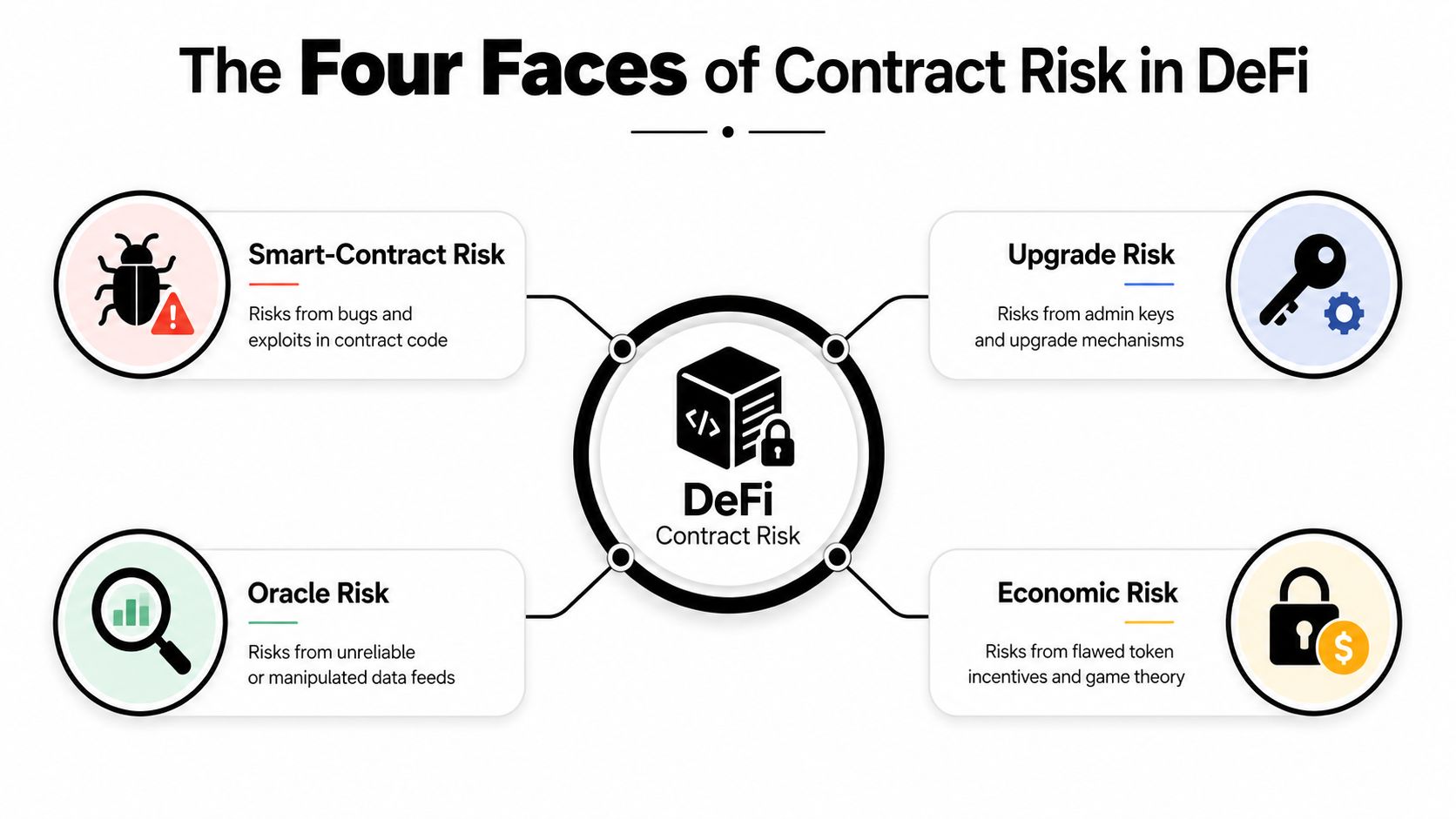
Smart-contract risk
This is the familiar category, bugs and logic flaws in the code that holds or moves assets. A reward switch might be unaudited, a rounding path might calculate debt incorrectly, or a withdrawal function might make assumptions that fail under an unusual token behavior. Economic exploits belong here when an attacker uses valid contract functions to extract value in a way the designers didn't anticipate.
The key question is not whether a protocol has an audit. Ask what the audit covered, whether the deployed bytecode matches the reviewed code, whether later changes were reviewed, and how the team handles vulnerabilities after launch.
Upgrade risk
Upgradeable contracts can be useful because teams can repair defects and adapt parameters. They also create a live administrative surface. A proxy administrator, upgrade multisig, or governance executor may be able to replace core logic after you deposit.
An anonymized pattern is a multisig upgrade that changes collateral factors overnight. Users didn't interact with a new deposit flow, but the new implementation changed the conditions around their position. Review who controls the upgrade path, whether actions have a timelock, and whether users can exit before a change takes effect.
Governance risk
Governance distributes control, but token voting doesn't automatically create safe control. Token concentration, low participation, weak quorum, or rushed proposals can allow a small group to change asset listings, fees, risk parameters, or approved integrations.
A typical failure pattern begins with a vote to whitelist a risky asset because it offers attractive activity or incentives. The proposal may follow the formal process and still create a new loss path for lenders or liquidity providers. Governance is a contract risk surface, not just a community feature.
Composability and oracle risk
DeFi protocols call other protocols. A yield aggregator may deposit into a money market, rely on an oracle, route through a bridge, and account for a receipt token. If the underlying market freezes, the aggregator may be unable to honor withdrawals even when its own code behaves correctly.
Oracle failures deserve separate attention because a correct contract can execute a bad price perfectly. Review the data sources, update mechanics, fallback behavior, and whether a thin or manipulable market can influence valuation.
For a broader lifecycle view, the stages of risk management by Escrow Consulting provides a useful traditional framework for identifying, assessing, responding to, and reviewing risk. The DeFi adaptation is straightforward: replace static contract clauses with code paths, permissions, dependencies, and on-chain state.
A Practical Risk Assessment Framework
The most useful risk register I've used is deliberately simple. For each threat, record likelihood, impact, evidence, owner, and the action that reduces exposure. You don't need false precision. A low, medium, or high rating is enough if the reasoning is explicit and consistent.
Traditional legal-operations teams use the same logic at clause level. They flag uncapped liability, broad indemnities, automatic renewals, unusual governing law, missing data-processing terms, weak termination rights, exclusivity, audit restrictions, and approval exceptions. Legal-ops guidance on contract metrics recommends measuring those provisions by contract type and business area, alongside cycle time, renewal deadlines, missing owners, and template deviations.
The DeFi equivalent is a protocol-level register with clause-like granularity.
Build the register by threat
Threat area | What to inspect | Evidence to record |
|---|---|---|
Smart-contract defects | Audit scope, code age, bug bounty, deployment history, incident response | Audit reports, verified code, disclosed fixes |
Upgrade authority | Proxy pattern, admin holders, timelock, multisig history | On-chain permissions and executed transactions |
Governance changes | Token distribution, quorum, proposal process, recent votes | Governance forum and voting records |
Oracle and dependency failure | Price sources, collateral assets, bridges, integrated markets | Oracle configuration and dependency map |
Economic exploits | Incentive design, liquidity depth, leverage, withdrawal assumptions | Contract parameters and stress scenarios |
Don't treat an audit count as a safety score. Multiple reports can still miss a flaw, especially if the deployment changed afterward. Code age can provide context, but older code isn't automatically safer, and newer code isn't automatically dangerous. Evidence beats reputation.
Score impact before probability
A low-probability loss with catastrophic impact deserves attention before a frequent but recoverable inconvenience. A short withdrawal delay may be tolerable for a personal wallet and unacceptable for a treasury that needs same-day liquidity. Your score must reflect the actual holder, not an abstract protocol user.
Track the variables that change over time. TVL trajectory, large liquidity movements, new integrations, admin actions, governance proposals, oracle updates, and incident disclosures can all change a previous assessment. The risk assessment guidance from Sift AI is useful background for thinking about emerging signals rather than relying only on a static review.
For a DeFi-specific starting point, use Yield Seeker's smart contract risk scoring guide, then add your own position size, liquidity needs, and exit assumptions.
Risk register entry: “Oracle dependency, medium likelihood, high impact. Evidence: external price feed and collateral valuation rely on the same market. Mitigation: cap allocation, monitor deviation, maintain an independent exit route.”
Keep the register beside the allocation decision. A protocol can move from acceptable to unacceptable when governance changes a parameter or when a new dependency enters the strategy.
Layered Mitigation Tactics That Actually Work
No single control is strong enough for a capital-bearing DeFi position. Audits miss bugs. Monitoring misses fast exploits. Diversification fails when supposedly separate protocols share the same oracle, bridge, asset, or governance dependency. Defense in depth means assuming each layer can fail and limiting the damage when it does.
Start with selection, then reduce concentration
Protocol selection is the first filter. Review the team's public track record, deployed contracts, documentation, audit scope, permission model, real usage, and response behavior. This doesn't prove safety. It helps reject strategies where the available evidence is too thin to justify exposure.
Audits and formal verification belong next. They can identify known classes of defects and force clearer reasoning about invariants, but an audit is not insurance and doesn't certify future upgrades. My preference is to read the findings, not merely count audit logos. The Yield Seeker smart contract security audit guide offers a practical way to examine what an audit does and doesn't establish.
Diversification should target uncorrelated failure modes, not just multiple pools. Splitting funds between two vaults that both deposit into the same lending market creates the appearance of diversification while preserving the underlying dependency. Set a maximum allocation per protocol, per chain, and per shared dependency.
Traditional contract teams use standard templates to reduce clause variance. Kons Law's guide to business contract management makes the same broader point about approved language, review workflows, and obligation tracking. In DeFi, the parallel is a repeatable strategy policy that limits improvisation during a yield chase.
Add controls that absorb failure
Insurance: Check exclusions, covered events, claim authority, underwriting capacity, and the actual claims process. Coverage that excludes the failure mode you fear isn't protection.
Monitoring: Alert on governance proposals, admin transactions, oracle deviations, withdrawal pauses, and sharp liquidity changes. A dashboard is useful only if someone can act on the alert.
Exit planning: Decide in advance which asset, chain, bridge, and destination market you'll use. An exit path that depends on the same failing system isn't a real fallback.
Incident response: Define who can pause deposits, reduce exposure, communicate with stakeholders, and document decisions. Speed matters, but rushed transactions can create a second loss.
The cost of these layers is attention, tooling, and sometimes lower yield. That trade-off is acceptable when the alternative is discovering that your entire risk model was one audit badge and a green interface.
How Yield Seeker Maps to Each Risk Layer
Yield Seeker's design choices can be evaluated as controls in the framework above, not as a substitute for personal diligence. The relevant question is whether each choice addresses a particular failure mode and what it leaves unresolved.
Mapping product behavior to exposure
No lockups reduce the time you remain trapped behind a strategy or governance decision. Yield Seeker states that funds remain accessible, with no lockups or withdrawal fees. That doesn't guarantee withdrawals during an exploit, a chain outage, or a protocol pause, but it removes a deliberate illiquidity constraint that can worsen those events.
Protocol vetting addresses the research burden before capital is allocated. The platform's published risk guidance emphasizes independent security audits, protocol TVL, and team reputation. Those inputs correspond to code assurance, adoption context, and operational credibility. They are filters, not proof that a protocol cannot fail.
Diversified allocation can reduce concentration in one protocol when the underlying strategies differ. It won't eliminate shared oracle, bridge, stablecoin, or chain exposure, so the dependency map still matters. A user should ask not only where funds are split, but what common systems connect those destinations.
Allocation transparency helps with unknown risk. In traditional contract portfolios, industry coverage of legacy agreement concerns reports that 62% of teams worry about unknown risks in legacy contracts. The DeFi analogy is capital sitting inside strategies whose current dependencies and permissions aren't visible. Showing where capital goes makes that exposure inspectable, though transparency doesn't repair a risky dependency.
AI-driven monitoring adds continuous oversight for users who can't manually follow every proposal, admin action, and allocation change. AI also introduces its own governance questions, including opacity, hallucination, confidentiality, bias, and responsibility for an incorrect recommendation. Human review and explicit limits remain necessary.
The product's independent security documentation says its smart contracts were audited by Nethermind, with review covering core contract logic, agent execution flows, and fund management mechanisms. Read the scope and limitations rather than converting that statement into a guarantee.
Use the mapping honestly: A platform can reduce research and monitoring friction. You still own the decision about acceptable loss, liquidity, and concentration.
Here's a closer look at how the monitoring layer fits into the operating model:
A Pre-Deposit Checklist for Holders and Treasuries
Run this checklist before every new allocation. It should be short enough to use under time pressure, but specific enough to stop an APY-driven decision from bypassing diligence.
Personal holder checks
Market history: Has the protocol operated through a stressed market, and can you verify how it handled withdrawals, liquidations, and incidents?
Audit relevance: Are the audits independent, recent enough for the deployed code, and clear about unresolved findings and scope?
Admin control: Who holds upgrade and pause permissions? Is there a timelock, and can you exit before an approved change executes?
Dependency map: Which oracle, bridge, lending market, receipt token, and stablecoin does the strategy rely on?
Exposure cap: What is the maximum share of your stablecoin holdings that may sit in this protocol? Write the limit before depositing.
Exit route: Can you identify the exact withdrawal function, destination wallet, chain, bridge, and liquid market you would use during stress?
Coverage reality: If insurance exists, does it cover the failure you fear, and who decides whether a claim is valid?
Alerts: Which notifications would tell you that governance, permissions, oracle behavior, liquidity, or withdrawals have changed?
A failed answer isn't always an automatic rejection. It is a reason to reduce size, demand better evidence, or choose a simpler strategy. The important part is that the decision becomes deliberate.
Treasury controls
Treasuries need separation between research, approval, execution, and reconciliation. One person shouldn't discover a strategy, approve the allocation, sign the transaction, and report the balance without independent review. Set approval thresholds, record permitted protocols and chains, and require a written reason for exceptions.
Report allocations, realized yield, permissions, incidents, and pending governance actions on a fixed cadence. Reconcile wallet balances against strategy reports, and keep an emergency signer and communication list available. A treasury policy should also define who can exit without waiting for a full committee when a pre-agreed trigger fires.
Pass condition: You can explain the allocation, the permission model, the shared dependencies, and the exit path to another decision-maker without opening the marketing page.
Monitoring and Incident Response When Things Break
Risk management continues after the deposit. The position is now exposed to new votes, upgrades, oracle updates, liquidity shifts, dependency failures, and changes in team communication. A monitoring system turns those events into prompts for action instead of surprises discovered after the fact.
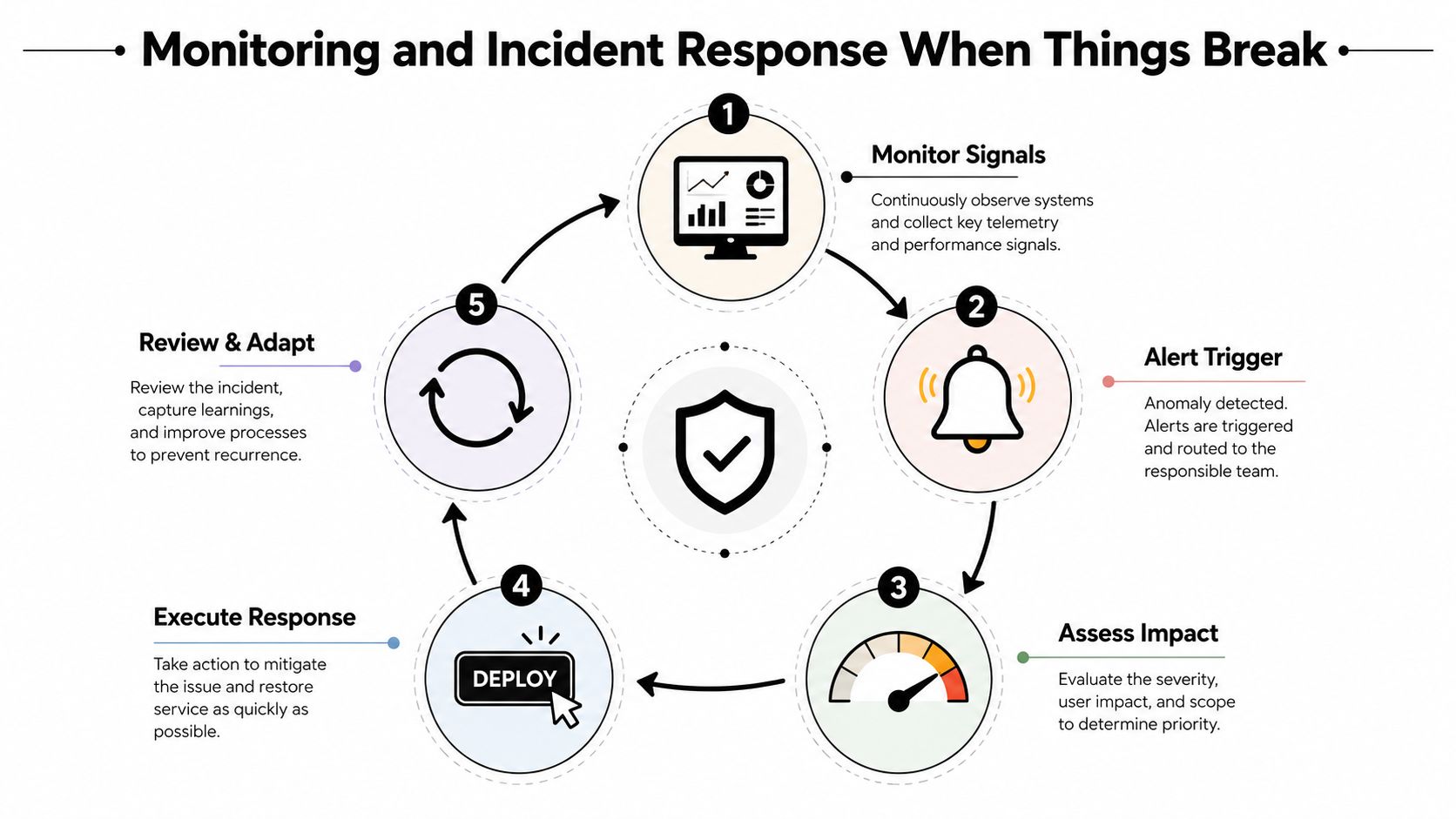
The first response window
When an alert fires, don't add capital. Confirm whether the signal is real by checking the relevant transaction, contract state, protocol status page, and official team channels. Test a small withdrawal only when doing so won't increase exposure or interact with a potentially compromised function.
During the first 30 minutes, focus on facts:
Identify the affected contract, asset, chain, and dependency.
Check whether deposits, withdrawals, redemptions, or upgrades are paused.
Compare the displayed balance with the on-chain position.
Record transaction hashes, timestamps, alerts, and official statements.
Notify the designated treasury or portfolio decision-maker.
Avoid revenge transactions. An attacker, compromised front end, or manipulated oracle can make familiar actions dangerous. Use a verified contract address and a known interface, and don't approve new spending permissions while the incident remains unclear.
Decide, document, and learn
Within the first 24 hours, choose among staying, reducing, or exiting based on the evidence. A contained interface outage differs from an active exploit, but both require a documented decision. For treasuries, notify internal stakeholders, auditors, counterparties, and signers according to the incident policy.
The Yield Seeker smart contract monitoring guide can help organize the signals worth watching. Your own system should attach each alert to an action, an owner, and a fallback. “Monitor oracle risk” isn't a runbook. “If the feed deviates beyond the approved tolerance, stop new deposits, verify the source, and escalate to the signer group” is.
After resolution, preserve the incident record and update the risk register. Note what triggered the alert, which control worked, which assumption failed, and whether allocation limits or protocol eligibility should change.
Key Takeaways and Where to Go Next
Stablecoin yield is compensation for identifiable contract risks, not free income. Good contract risk management names each exposure, sizes its impact, and reduces it through permissions review, diversification, monitoring, limits, and rehearsed exits. Read independent audits, governance forums, coverage terms, and deployment history before depositing. No framework can guarantee that the next exploit won't happen, which is why risk management is an operating discipline rather than a one-time setup.
Yield Seeker helps stablecoin holders automate allocation across vetted DeFi opportunities while keeping funds accessible and making strategy activity easier to monitor. Visit Yield Seeker to review how its no-lockup, AI-assisted approach fits your own contract risk limits before you deposit.