
Decentralized Finance (DeFi) has come a long way. What started as a high-risk, experimental playground is quickly becoming a trusted arena for serious institutional capital.
This shift is all thanks to the rise of institutional-grade DeFi tools—platforms built from the ground up for reliability, security, and compliance at a scale that serious players demand. Getting your head around this evolution is the first step to safely tapping into the future of finance.
The Evolution of DeFi: From Risky Experiment to Trusted Arena
Think of early DeFi as a rickety rope bridge. It was exciting, brimming with potential, but you wouldn't want to carry your life savings across it. The scene was dominated by unaudited smart contracts, insanely volatile assets, and a general "wild west" vibe.
While groundbreaking, this environment lacked the basic safeguards needed to attract cautious capital. Large funds, corporate treasuries, and risk-averse individuals all stayed on the sidelines, and for good reason.
Today, that landscape is almost unrecognizable. The new wave of institutional-grade DeFi platforms are less like rope bridges and more like modern steel suspension bridges. They’ve been meticulously engineered for heavy traffic and are trusted to handle critical commerce, all built on a foundation of hardcore security, predictable performance, and transparent operations.
From Speculation to Stability
A huge piece of this maturation puzzle was the rise of reliable assets like the Stable Coin. These assets tamed the wild volatility and built a foundational layer of trust.
This newfound stability, combined with professional-grade infrastructure, created an environment where DeFi is no longer just about speculative moonshots. It’s about building sustainable, real-world financial services that meet the core needs of institutions:
Risk Mitigation: Anonymous dev teams are out; publicly vetted developers are in. Unaudited code has been replaced with contracts that undergo multiple, rigorous third-party security audits.
Regulatory Alignment: Compliance is no longer an afterthought. Frameworks for Know Your Customer (KYC) and Anti-Money Laundering (AML) are being integrated where it makes sense.
Operational Integrity: Institutions get the features they can't live without, like immutable audit trails, clear governance structures, and enterprise-level custody solutions.
This isn't just a passing trend. It's a fundamental rewiring of the DeFi ecosystem to meet the stringent demands of fiduciaries and large-scale asset managers, making DeFi a truly viable option for serious financial operations.
Before we dive deeper, let's look at how these two worlds stack up.
Comparing Traditional Finance and Institutional-Grade DeFi
The table below offers a snapshot of how traditional finance (TradFi) compares to the new breed of institutional DeFi, highlighting where they differ and, increasingly, where they're starting to align.
Feature | Traditional Finance (TradFi) | Institutional-Grade DeFi |
|---|---|---|
Intermediaries | Relies on banks, brokers, and clearinghouses. | Minimizes intermediaries using smart contracts for direct peer-to-peer transactions. |
Transparency | Opaque; operations are internal to institutions. | Radically transparent; all transactions are recorded on a public, immutable blockchain. |
Operating Hours | Typically restricted to business hours (e.g., 9-5, Mon-Fri). | Always on; markets operate 24/7/365 without downtime. |
Settlement Time | Can take days (T+2) for transactions to settle. | Near-instantaneous; settlement occurs in minutes or seconds. |
Compliance & KYC/AML | Highly regulated with mandatory, well-established procedures. | Evolving; platforms are integrating permissioned pools and KYC/AML checks to meet regulatory demands. |
Custody | Centralized custody providers (banks, custodians). | Offers both self-custody and regulated, third-party custody solutions designed for digital assets. |
Audit & Reporting | Relies on internal and external financial auditors. | Combines smart contract audits with real-time, on-chain audit trails that are accessible to anyone. |
Accessibility | Geographically and economically restricted. | Globally accessible to anyone with an internet connection, though some platforms are permissioned. |
While TradFi's strength lies in its established regulatory frameworks, institutional DeFi is rapidly closing the gap by offering unparalleled efficiency, transparency, and accessibility, all while building out the compliance layers needed for mainstream adoption.
The Institutional Surge
This growing trust isn't just talk; the numbers back it up. While retail users held a 62.12% market share in 2025, institutional investors are closing in fast.
The institutional segment is projected to grow at a blistering 32.55% CAGR through 2031, easily outpacing the rest of the market. This flood of capital is a direct result of new, regulated wrappers, better custody solutions, and bank-aligned trust structures that finally allow DeFi to slot into existing financial frameworks. If you want to dig into the numbers, you can explore the full analysis of this market shift on Mordor Intelligence.
This guide will walk you through the essential features that define these robust platforms, giving you a clear roadmap for navigating this new financial frontier.
Decoding the Core Features of Institutional-Grade Platforms
Alright, let's move past the buzzwords and get into what actually makes a DeFi tool "institutional-grade." These aren't just nice-to-haves; they are the absolute non-negotiables that separate a risky, speculative protocol from a reliable financial instrument.
Think of it like building a bridge. You wouldn't drive a truck full of money over a rickety rope bridge, right? Each of these features is a critical steel beam or concrete pillar, ensuring the whole structure can handle serious capital safely.
The journey from the early, experimental days of DeFi to now is exactly like that—moving from precarious, hand-built infrastructure to robust systems engineered for trust.
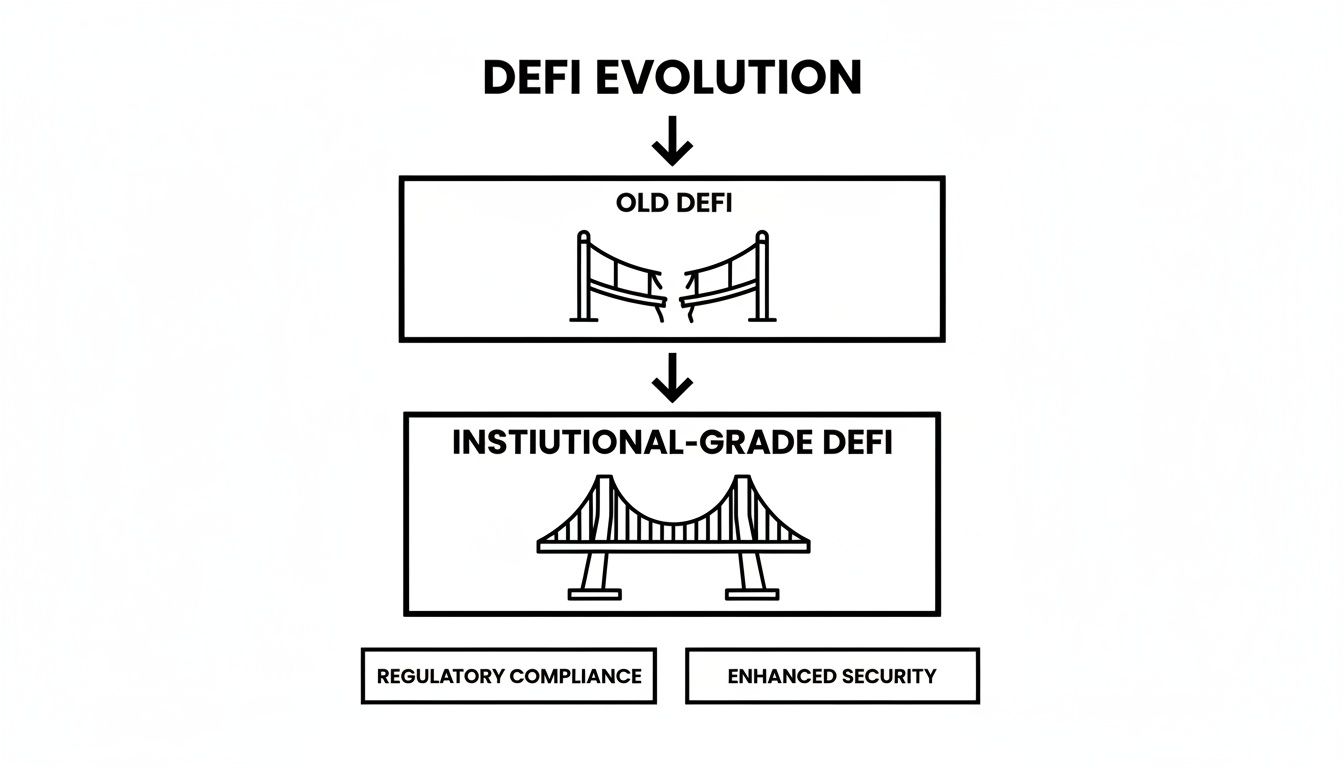
This image nails it. We've gone from DeFi's "rickety bridge" phase to a "modern bridge" era, where things like security, compliance, and professional-grade custody create a foundation solid enough to build on.
Comprehensive Security Audits
The absolute bedrock of trust in DeFi is comprehensive security audits. This isn't a simple spell-check. We're talking about hiring teams of elite security firms to attack a platform's smart contracts from every conceivable angle, trying to break in before anyone puts a dollar at risk. It’s the digital equivalent of stress-testing a bank vault.
A platform that's serious about institutional business will have multiple audits from different, reputable firms, and they'll post the reports publicly for everyone to see. This transparency lets you see what vulnerabilities were found, how the team fixed them, and what the overall security looks like. Anything less is just asking you to invest blind.
Enterprise-Level Custody and Key Management
How assets are stored and who can move them is another massive piece of the puzzle. For a fund or a corporate treasury, a single hardware wallet just won't cut it—the operational risk is way too high. That's where enterprise-level custody solutions come in.
Many of these platforms use Multi-Party Computation (MPC). Instead of one private key, the key is split into multiple shards held by different people or systems. To sign off on a transaction, a certain number of those shards have to come together. Think of it like a missile launch system that needs multiple keys turned at the same time. It builds in a powerful safeguard against rogue actions or single points of failure. If you want to dive deeper into how this works, checking out guides on https://www.yieldseeker.xyz/blog/due-diligence-vault is a great place to start.
Robust Compliance Frameworks
DeFi is famous for being "permissionless," but for institutions, that's often a bug, not a feature. They have to play by real-world rules, which means platforms need to integrate serious compliance frameworks for Know Your Customer (KYC) and Anti-Money Laundering (AML).
These frameworks are essential for ensuring a platform isn't being used for illicit finance—a deal-breaker for any company with fiduciary responsibilities. This is usually done through permissioned pools or on-chain identity tools that verify participants without killing the core efficiency of DeFi.
Immutable Audit Trails and SLAs
Finally, institutions demand accountability and reliability. An immutable audit trail is something blockchains do incredibly well. Every single transaction is recorded forever and can be verified by anyone. This gives you a level of transparency that traditional finance can only dream of.
But that's not enough on its own. Service-Level Agreements (SLAs) are the other half of the equation. While not always common in pure, decentralized protocols, platforms built for institutions provide SLAs that guarantee uptime, support response times, and performance. This turns the relationship from a simple code-based interaction into a professional one with real operational commitments. It also means actively managing technical debt in risk control to ensure the platform stays secure and reliable for the long haul.
When you put all these pieces together, you get a system where trust is built not just on clever code, but on transparent operations, a verifiable history, and professional guarantees.
Your Practical Checklist for Vetting DeFi Tools
Knowing the theory is one thing, but putting it into practice is what really counts. When you've got serious capital on the line, you need a repeatable process for due diligence. Think of this checklist as a framework for kicking the tires on any DeFi platform, helping you tell the genuinely institutional-grade DeFi tools apart from the riskier pretenders.
This process is a bit like a pilot's pre-flight inspection. They don't just glance at the wings and hope for the best. Instead, they run through a rigorous, step-by-step procedure to make sure every critical system is sound. Your approach to vetting a DeFi platform should be just as methodical.
Foundational Trust and Team Background
Before you even look at a single line of code, you need to look at the people who wrote it. Anonymous teams might have been a quirky feature of early, speculative DeFi, but for any serious operation, it's a massive red flag.
Start by asking the simple, fundamental questions:
Who are the developers? You’re looking for a public team with real names, professional profiles (like LinkedIn or GitHub), and a track record you can actually verify in tech or finance.
What's their history? Have they built and shipped successful products before? A team with a history of delivering secure, reliable projects is always a better bet.
How do they communicate? A professional team will have clear, well-maintained documentation, a responsive support channel, and a transparent history of communicating updates—both the good and the bad.
Security and Smart Contract Integrity
Once you've vetted the team, it's time to get under the hood and scrutinize the technology. This is where a platform’s real commitment to security becomes crystal clear. Smart contracts are the engine of any DeFi tool, and their integrity is completely non-negotiable.
A platform's approach to smart contract security is the single most important technical indicator of its quality. Lax security practices are an open invitation for exploits that can lead to a total loss of funds.
Here’s what to hunt for:
Public Security Audits: Have the smart contracts been audited by multiple, independent, and top-tier security firms? Think names like Trail of Bits, OpenZeppelin, or ConsenSys Diligence. Crucially, the full audit reports should be public for anyone to read.
Vulnerability Remediation: Does the team show you exactly how they fixed the issues found during audits? A perfectly clean audit is rare; a transparent process for patching vulnerabilities is the sign of a mature, responsible team.
Ongoing Security Measures: Does the platform run a bug bounty program to incentivize white-hat hackers to find flaws before the bad guys do? Do they have real-time monitoring to spot unusual activity? Taking the time to understand a platform's approach to smart contract risk scoring will also give you much deeper insight into their overall security posture.
Financial Health and Risk Management
Finally, an institutional-grade tool must prove it's financially sound and has clear risk management protocols in place. A platform can have perfect code and a world-class team but still collapse if its economic model is wonky or its liquidity is paper-thin.
This is more important than ever as the DeFi market continues its explosive growth. Projections show the market value rocketing from USD 26.94 billion in 2025 to an astounding USD 1,417.65 billion by 2033. This growth isn't random; it's being driven by users who are flocking to trusted, battle-tested protocols that prove their reliability day in and day out. You can dig into more data on DeFi's institutional adoption from Grand View Research.
Assess a platform's financial stability by digging into these areas:
Liquidity Sources: Where is the platform's liquidity coming from? Is it all concentrated in a few big wallets, or is it nicely diversified? Deep, stable liquidity is the lifeblood of smooth operations.
Stress Testing: Has the platform published any models or results showing how it would perform under extreme market stress, like a major asset de-pegging or a sudden flash crash?
Risk Parameters: Are the platform’s risk management policies clearly defined and easy to find? This should cover everything from collateralization ratios and liquidation procedures to any automated safeguards designed to protect user funds when volatility spikes.
To bring this all together, here’s a simple scorecard you can use. It's a practical way to systematically walk through the key evaluation criteria for any DeFi tool you're considering.
Institutional DeFi Evaluation Scorecard
Evaluation Criteria | Key Questions to Ask | Ideal Answer or Red Flag |
|---|---|---|
Team & Reputation | Is the team public with verifiable experience? Do they communicate transparently? | Ideal: Public team, strong track record, clear communication. Red Flag: Anonymous founders, poor documentation. |
Security Audits | Are there multiple, public audits from reputable firms? Were findings addressed? | Ideal: Public reports from 2+ top firms, clear remediation proof. Red Flag: No audits or audits from unknown firms. |
Ongoing Security | Do they have a bug bounty program and real-time monitoring systems? | Ideal: Active bug bounty, 24/7 monitoring. Red Flag: Security is treated as a one-time event. |
Liquidity & Solvency | Where does liquidity come from? Is it deep and diversified? | Ideal: Diversified sources, high TVL. Red Flag: Liquidity concentrated in a few wallets. |
Risk Management | Are risk parameters (liquidation, collateral) clear? Is there stress test data? | Ideal: Public policies, transparent risk models. Red Flag: Vague or non-existent risk management info. |
Governance | How are protocol changes made? Is there a clear, decentralized process? | Ideal: On-chain voting with community involvement. Red Flag: Centralized control by a single entity. |
By walking through these questions, you move beyond marketing hype and start evaluating platforms based on what really matters: trust, security, and financial resilience. It’s a disciplined approach, but it’s the only way to operate safely in the world of institutional DeFi.
Where the Rubber Meets the Road: Real-World DeFi Applications
Checklists and theory are great, but the real test is seeing how institutional-grade DeFi tools solve actual problems. These platforms aren't just abstract ideas; they're practical solutions for putting serious capital to work, securely and efficiently. Let's walk through a couple of common scenarios to see how these tools are making a real impact.

We'll follow a couple of hypothetical users to show how these platforms work in the wild, turning complex financial strategies into something you can actually manage day-to-day.
Web3 Treasury Management for Companies
Picture "Nexus Labs," a growing Web3 company with a big chunk of its treasury sitting in USDC. Until now, those funds were just parked in a multi-sig wallet, earning absolutely nothing. That’s a huge missed opportunity, especially as inflation quietly eats away at their capital.
The CFO at Nexus Labs wants to generate a stable, low-risk return on these reserves, but she's staring down a few major hurdles:
The Operational Grind: Manually researching protocols, vetting them, and moving funds around is a full-time job that demands deep expertise.
Security Nightmares: The thought of a smart contract exploit or a protocol getting hacked is enough to keep any treasury manager up at night.
Compliance Headaches: They need perfect audit trails and clear reporting for their accountants and to stay on the right side of any potential regulations.
This is exactly where an institutional-grade yield platform comes in. Nexus Labs can deposit its USDC into one secure interface that handles everything. The platform, which has been through rigorous security audits and operates with transparent risk policies, automatically spreads their capital across a diversified portfolio of vetted lending protocols and liquidity pools.
The result? A hands-off, automated system that puts their treasury to work. Nexus Labs now earns a competitive yield, has a complete on-chain record for easy auditing, and has dramatically cut the operational risk of trying to do this all manually.
Automated Yield Farming for Individuals
Now let's meet "Maria," a professional who's bullish on crypto but just doesn't have the time to be a full-time DeFi degen. She’s built up a personal stash of stablecoins and wants to earn some passive income, but the sheer complexity and the need for constant monitoring are intimidating.
Maria's goal is simple: get better returns than a savings account without becoming a DeFi analyst. If she tried to do this herself, she’d be constantly tracking interest rates, judging protocol risks, and burning cash on gas fees to chase the best yields. It’s time-consuming and easy to mess up.
This is where institutional-grade tools are becoming a game-changer for individuals, too. Maria can use an automated yield platform to tap into the same sophisticated strategies the big players use. She makes a simple deposit, and the platform’s engine takes over:
Continuous Optimization: It constantly scans the market for the best risk-adjusted yields, moving her capital automatically as opportunities change.
Risk Diversification: Instead of putting all her eggs in one basket, the platform spreads her funds across multiple vetted protocols, so a single point of failure won't wipe her out.
Gas Fee Efficiency: By batching transactions with other users, the platform slashes the network fees she’d pay for every single move.
This kind of infrastructure has matured in a big way. Just look at the explosive growth of onchain perpetuals markets, where weekly trading volume rocketed from $50 billion in 2024 to a staggering $250-300 billion in 2025. This professionalization allows automated strategies to perform reliably on the back of deep, stable liquidity. You can read more in the State of DeFi in 2025 research from DL News.
For Maria, it means she can finally earn passive income safely and efficiently. She gets institutional-level security and strategy without the institutional-level workload, letting her confidently participate in DeFi.
How AI Sharpens DeFi Security and Performance
The core pillars of any serious DeFi tool—security, compliance, and raw performance—are getting a massive boost from Artificial Intelligence. Think of AI as a force multiplier here. It automates incredibly complex tasks that are simply impossible for a human team to handle at the speed and scale DeFi demands. This isn't just an incremental update; it's a huge leap forward, turning solid platforms into intelligent, self-correcting systems.
A good way to picture this is to imagine a traditional DeFi platform as a high-performance race car. It's powerful, sure, but it needs an expert driver to handle every curve and changing road condition. An AI-powered platform is that same car, but now it's fitted with an advanced driver-assistance system that scans the road ahead, predicts hazards, and optimizes the route in real-time.

This AI layer doesn’t replace the fundamental building blocks. It strengthens them, making the entire ecosystem safer and more efficient for everyone, from massive funds down to individual users.
AI for Proactive Security and Risk Monitoring
One of AI's most powerful roles in DeFi is security. Smart contract audits are non-negotiable for spotting bugs before launch, but AI provides a continuous shield once a platform is live and handling real money. It's like having a sleepless security guard who never blinks.
AI models can be trained on mountains of on-chain data to learn what "normal" looks like. Once they have that baseline, they can instantly flag any strange behavior that might signal an attack. This includes things like:
Threat Detection: Spotting weird transaction patterns, like a sudden flood of high-volume withdrawals from a liquidity pool, which is often the first sign of an exploit.
Protocol Health Monitoring: Keeping a constant eye on the risk parameters of every protocol it touches—for instance, tracking collateral ratios in lending markets to get ahead of potential liquidation cascades.
By automating this kind of vigilance, AI can spot and react to threats in milliseconds. That's a speed no human team can ever match. This proactive defense is a huge part of what makes a modern DeFi platform truly institutional-grade.
This capability is absolutely crucial for building trust. As you dive deeper into this world, getting a handle on AI crypto investing offers great context for how these technologies are shaping what's possible in finance.
AI for Dynamic Performance and Yield Optimization
Beyond playing defense, AI is a serious offensive weapon—especially when it comes to finding the best risk-adjusted returns. The DeFi landscape moves at a blistering pace, with yields changing every single second across hundreds of protocols. Trying to track all of this manually is a recipe for failure.
This is where AI shines. A system driven by AI can:
Analyze Vast Datasets: It can process an incredible amount of real-time data, from transaction volumes and liquidity depths to fluctuating interest rates across the entire DeFi ecosystem.
Execute Quantitative Strategies: Using that analysis, the AI can automatically shift capital to chase the best yields while sticking to strict, pre-defined risk rules. It’s the same kind of sophisticated quant strategy used in traditional finance, but executed with the instant precision of smart contracts.
At its core, the AI is constantly on the hunt for the sweet spot between risk and reward. It ensures capital is never sitting idle or stuck in an underperforming position. This relentless optimization doesn't just pump up returns; it also reinforces the platform's stability by steering clear of new risks as they appear, making institutional-grade DeFi tools more powerful than ever.
The Future of Finance and Your Place In It
DeFi is growing up. The chaotic, 'Wild West' days of high-risk experiments are slowly fading, making way for robust, reliable systems built for serious capital. Armed with a clear framework for what "institutional-grade" actually means, you can now confidently tell the difference between a professional platform and a risky gamble.
The core principles aren't some secret handshake anymore. They’re grounded in things that make sense in any financial system: rock-solid security proven by extensive audits, transparent operations you can track with clear audit trails, and professional-grade risk management. These aren't just fancy features for hedge funds; they're essential safeguards that make DeFi a safer, more accessible space for everyone.
What's Next on the Horizon for DeFi?
But this evolution is far from complete. The next major leap for DeFi will likely be about blurring the lines between the on-chain and off-chain worlds, with a couple of key trends leading the pack:
Tokenization of Real-World Assets (RWAs): Just imagine earning yield on tokenized real estate, private credit, or even U.S. Treasuries, all from within a DeFi protocol. This is about connecting the stability of traditional assets with the speed and efficiency of the blockchain.
Deeper TradFi Integration: As the rules of the road become clearer, you can bet we'll see more established financial institutions jumping into DeFi, both as users and builders. This will bring even more stability and liquidity to the whole ecosystem.
At the end of the day, the rise of institutional-grade DeFi is about one thing: empowerment. It gives you the tools to step into this new financial frontier with confidence, knowing your capital is being managed by platforms that put safety first.
The future of finance isn't some distant dream; it's being built, block by block, right now. And it's more open than ever before. By focusing on due diligence, security, and transparency, you can put your assets to work responsibly. The true promise of decentralized finance is only realized when everyone has access to tools they can actually trust.
Got Questions?
Diving into institutional-grade DeFi can feel like exploring new territory, and it's natural for questions to pop up. Let's tackle some of the most common ones to give you a clearer picture and help you move forward with confidence.
Are "Institutional-Grade" DeFi Tools Only for Big Companies?
Not at all. While the name comes from the high standards that institutions demand, these platforms are for everyone. The beefed-up security, reliability, and transparency make DeFi safer for individual crypto holders, family offices, and smaller Web3 teams.
Think of "institutional-grade" less as an exclusive VIP club and more as a seal of quality. Anyone putting real capital to work in DeFi deserves the peace of mind that comes from proper audits, clear governance, and predictable results.
How Can I Actually Check if a DeFi Tool Is Legit?
Good question. You've got to do your own homework and not just trust the marketing slick. A genuine institutional-grade platform won't hide the important stuff.
First up, look for public smart contract audits from well-known security shops like Trail of Bits or OpenZeppelin. Then, do a little digging on the team. Who are they? What have they built before? A team with a public track record is always a good sign.
A platform that's truly built for serious users is an open book. If you're struggling to find audit reports, team info, or their risk policies, that's a massive red flag.
Finally, check for clear documentation on how they handle risk and custody. The evaluation checklist we went over earlier is the perfect place to start this process.
What's Still the Biggest Risk in Institutional DeFi?
Even with all the bells and whistles, it's crucial to remember that risk is managed, not erased. No investment is ever 100% risk-free. The main things to keep an eye on are still the classics.
Smart Contract Bugs: Even with multiple audits, complex code can have hidden vulnerabilities. This remains the most common tech risk in DeFi.
Crazy Market Events: A major stablecoin de-pegging or a sudden "black swan" event can put even the most robust protocols under extreme stress.
Regulatory Surprises: The rulebook for DeFi is still being written around the world. Future regulations could change how certain protocols are allowed to operate.
These tools are all about minimizing those risks with heavy-duty testing, smart diversification, and a compliance-first mindset. But the golden rule of investing still applies: never put in more than you can afford to lose. The goal of institutional-grade DeFi tools is to build a much safer, more predictable playground—not to remove risk from the game entirely. It's about giving you a framework to manage risk like a pro.
Ready to put your stablecoins to work with institutional-grade security and AI-driven performance? Discover how Yield Seeker makes it simple.