

You deposit USDC into a DeFi app, click confirm in your wallet, and watch the balance change. For many, that's where the understanding stops. Money goes in, yield appears, and the machinery in the middle feels like a black box.
That black box is the smart contract.
If you hold stablecoins and want passive income, smart contracts aren't background plumbing. They are the rules, the cashier, the vault door, and the settlement layer. They decide where funds can move, when rewards get paid, who can change parameters, and what happens when something goes wrong. If you're yield farming without understanding that, you're trusting code you haven't evaluated.
Beyond the Buzzword Why Smart Contracts Matter
A practical way to think about smart contracts is this. They are software that holds and moves value according to prewritten rules. In DeFi, that means your deposit doesn't go to a person. It goes to code running on a blockchain.
Say you deposit stablecoins into a yield strategy. You're not handing funds to a portfolio manager who checks your account and manually reallocates capital. A smart contract receives the funds, checks conditions, updates balances, and routes assets based on whatever logic the protocol supports. That's why DeFi can run all day, every day, without a central operations desk.
Why this stopped being a niche tool
Smart contracts are no longer experimental infrastructure; the global smart contracts market was valued at USD 3.69 billion in 2025 and is projected to reach USD 6.71 billion in 2026, expanding at a CAGR of 76.25% through 2035, according to Precedence Research's smart contracts market analysis.
That number matters less as a headline than as a signal. Capital, tooling, and serious product development are moving into this layer. Smart contracts now sit underneath lending markets, exchanges, tokenized assets, and automated yield systems.
Practical rule: If a product promises passive on-chain yield, smart contracts are the engine doing the work and the risk surface you're exposed to.
What investors usually miss
Busy professionals often evaluate DeFi the way they'd evaluate an app. Clean interface, easy deposit flow, maybe a few social proofs. That's backward. In DeFi, the interface is the wrapper. The contract is the product.
A good front end can still point to weak contract architecture. A polished dashboard can still sit on top of fragile permissions, bad oracle design, or unsafe upgrade controls. On-chain yield only makes sense when the automation underneath is understandable enough to trust, and constrained enough to survive stress.
This is why smart contracts matter. Not because of their novelty. Rather, they are the layer that turns your stablecoins into cashflow, or into someone else's postmortem.
From Code to Cashflow How Smart Contracts Execute
The best analogy is still the digital vending machine. You insert the right input, press a button, and the machine follows preset logic. If the conditions match, it dispenses the item. If they don't, nothing happens.
Smart contracts work the same way, except the “item” might be a token transfer, a lending position, a swap, or a yield rebalance across protocols.
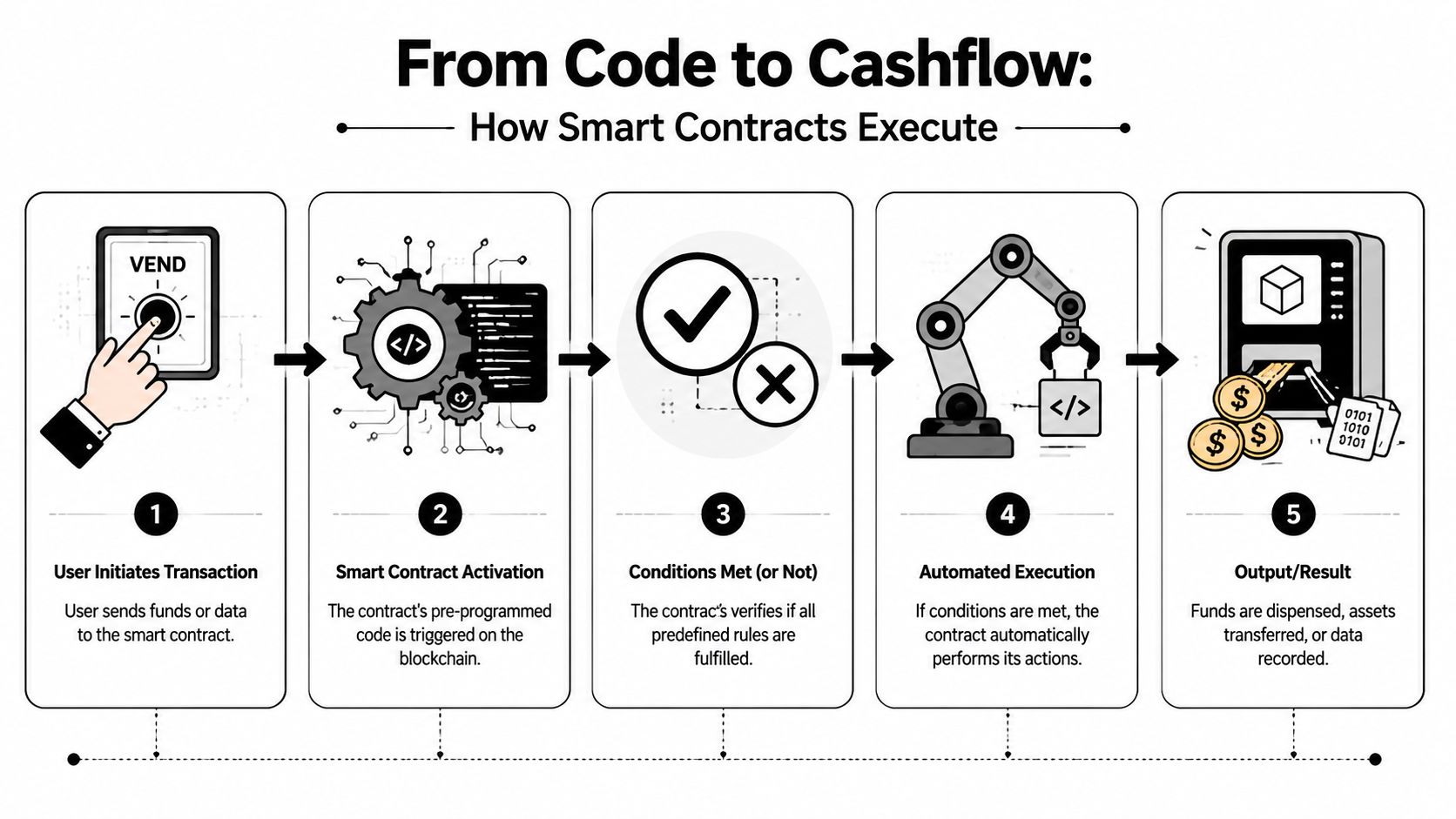
What actually happens after you click confirm
On an EVM-compatible chain such as Base, the contract code already lives on-chain. Your wallet interaction doesn't upload new logic. It sends a transaction that calls a function inside code that's already deployed.
A simplified flow looks like this:
You initiate a transaction.
You approve a token spend, deposit USDC, claim rewards, or trigger a withdrawal.The network reads the contract call.
The blockchain sees which function you're trying to execute and with what inputs.The contract checks its rules.
Does your wallet have enough balance? Did you grant approval? Are the strategy conditions valid? Is the market active?Computation happens across the network.
Nodes process the logic and agree on the result.State changes become part of the ledger.
Balances update, positions open or close, and the resulting record becomes part of the chain history.
That final step is why DeFi interactions feel different from app clicks. You're not changing a company database entry. You're changing on-chain state.
Why gas exists
Every operation inside an EVM smart contract has a cost. The chain charges you for computation because the network has to process and validate the work.
According to Visartech's introduction to smart contracts, a simple transfer costs about 21,000 gas units, while a complex yield reallocation can exceed 200,000 units. That difference matters in yield farming, because strategy logic isn't free. The more moving parts a contract touches, the more execution costs can eat into returns.
Cheap-looking yield can become mediocre yield if the strategy needs frequent, expensive on-chain actions to maintain it.
That's one reason good protocol design favors simple, dependable actions over overly clever automation. A strategy that rebalances constantly may look complex but still underperform after costs.
Where builders learn the pattern
If you want a concrete view of how this logic gets assembled, Domino's guide on creating smart contracts for NFT projects is useful because it shows the same basic pattern in another context. The asset changes, but the model doesn't. A contract defines rules, users call functions, and the blockchain enforces the result.
For DeFi investors, you don't need to write Solidity to benefit from this. But you do need the mental model. Once you understand that every yield action is just contract code being triggered, the trade-offs become much clearer: cost, finality, transparency, and failure modes all live in the execution path.
The DeFi LEGOs Common Smart Contract Patterns
DeFi isn't one giant contract. It's a stack of reusable patterns that protocols combine in different ways. That's why builders call them DeFi LEGOs. One contract handles deposits, another prices assets, another manages permissions, and another executes a strategy.
When stablecoin investors use a yield platform, they're usually touching several of these pieces at once, even if the interface hides the complexity.

Four patterns worth recognizing
Pattern | Analogy | Primary Function |
|---|---|---|
Pool | Shared pot of money | Combines user assets so traders, borrowers, or other participants can interact with that liquidity |
Vault | Safe with built-in instructions | Accepts deposits and follows a predefined strategy for earning yield |
Oracle | Messenger with market data | Brings off-chain or cross-market information, such as asset prices, into contract logic |
Multisig | Vault with several keys | Requires multiple approvals before sensitive administrative actions can happen |
A lending protocol might use all four. Users deposit into a pool. A vault strategy routes funds. Oracles inform collateral values. A multisig controls emergency or administrative functions.
How these pieces interact in practice
Pools are the simplest to grasp. Many users put assets into a shared contract, and the protocol uses that collective liquidity for swaps, borrowing, or market making. Your yield often comes from fees or borrower demand.
Vaults add another layer. Instead of just sitting in a pool, your deposit enters a contract that follows a strategy. That strategy might move funds between lending venues, harvest rewards, or hold a position until conditions change.
Oracles are where many non-technical investors underestimate the risk. Smart contracts can't natively know whether ETH or USDC is priced correctly in the outside world. They need external data feeds. If the oracle design is weak, a protocol can make perfectly consistent decisions using bad information.
A smart contract can be flawlessly coded and still fail economically if the data feeding it is wrong.
Multisigs matter because not every protocol is fully hands-off. Someone may still control upgrades, parameter changes, or emergency actions. A multisig reduces the chance that one compromised key can take over the whole system.
Why this matters for stablecoin yield
Most yield strategies are just combinations of these building blocks. Once you spot the pattern, protocol analysis gets easier. You stop asking, “Is this app legit?” and start asking better questions.
Where does my deposit reside? In a pool, a vault, or a wallet contract?
Who controls upgrades or pause functions? A multisig, a single signer, or no one?
What external data drives decisions? Price feeds, utilization data, or strategy signals?
How many contracts are involved? More composability can create more surface area.
That's the core value of the LEGO frame. It turns DeFi from “magic internet yield” into a set of understandable contract patterns.
The Immutable Dilemma Smart Contract Risks and Safeguards
The biggest strength of smart contracts is also the thing that makes them dangerous. Once deployed, they're hard to change.
That immutability is why users trust them. The rules can't be edited after you deposit. But it also means bugs don't behave like normal software bugs. You usually can't patch them on a Friday and move on.

Why immutability cuts both ways
According to iTransition's smart contract applications overview, 70% of 2023's DeFi hacks, totaling $1.7B in losses, were traced to unpatched vulnerabilities like reentrancy or oracle manipulation. That's the part many investors learn too late. In traditional software, teams can often fix issues server-side. In smart contracts, updates frequently require new deployments or upgrade systems that introduce their own trust assumptions.
Reentrancy is the classic example. In plain English, the contract sends funds out before it finishes updating internal balances, and the attacker uses that timing gap to call back into the contract again. Oracle manipulation is different but just as dangerous. The contract reads a distorted price and executes a decision that should never have happened.
What audits do, and what they don't
An audit is a specialized code review. It can catch logic mistakes, unsafe assumptions, and known vulnerability classes. It cannot guarantee a contract is safe.
That's why newer approaches such as AI-powered smart contract security auditing are interesting. They can help teams review more code paths and surface patterns humans might miss. But investors should treat any audit, AI-assisted or not, as one input. Not a verdict.
Here's a more useful framing:
Audits reduce known implementation risk
They do not remove economic risk
They do not remove governance risk
They do not remove integration risk
A contract can pass review and still break because a dependency fails, an oracle misbehaves, or privileged roles are too concentrated.
The part most teams underbuild
Good security isn't only about preventing the first bug. It's also about surviving mistakes after deployment.
Trail of Bits argues in its discussion of maturing smart contracts beyond private key risk that resilient designs use layered access controls like high-threshold multisigs and timelocks to reduce the impact of compromise. That point matters for yield systems, where strategy contracts may need operational controls but shouldn't make it easy for one key compromise to become a total loss event.
For a practical investor's lens, this means looking beyond “audited” and asking:
Can admins act instantly, or is there a timelock?
Are critical permissions split across roles?
Can the system pause risky actions in an emergency?
Is there any monitoring around queued admin changes?
A deeper walkthrough on this lives in Yield Seeker's piece on on-chain risk management.
One short explainer is worth watching before you trust any large deposit to contract logic:
Smart contract risk isn't only “can this code be hacked?” It's also “what happens if the people or systems around this code fail?”
That's the immutable dilemma. The same property that removes discretionary interference also removes easy rescue options.
How to Safely Interact with DeFi Contracts
The final line of defense is you. Not the audit firm, not the protocol's social account, not the polished UI.
Most losses in DeFi don't come from users misunderstanding the concept of a smart contract. They come from users skipping basic verification before signing transactions.
What to check before you connect a wallet
Start with the contract itself. If the protocol won't clearly show what contracts you're interacting with, that's already a problem.
Use this checklist:
Verified contract code: Look up the contract on a block explorer such as Basescan or Etherscan. If the source code isn't verified, you're trusting an opaque binary.
Public documentation: Read how deposits, withdrawals, rewards, and admin controls work. If the docs stay vague around custody or execution flow, assume the complexity is worse than it looks.
Audit availability: Read the report, not just the badge. Focus on unresolved issues, privileged roles, and assumptions the auditors made.
Admin design: Check whether sensitive actions sit behind multisigs and timelocks instead of a single signer.
Community behavior: Look for active developer responses, transparent incident handling, and users asking hard questions in public channels.
Operational monitoring: Favor teams that discuss alerts, pause procedures, and post-deployment oversight.
What resilience looks like
Trail of Bits makes a useful point in its article on post-deployment smart contract resilience. Even after audits, vulnerabilities can persist, so mature systems use layered access controls like high-threshold multisigs and timelocks to reduce the blast radius of a compromise.
That gives you a better standard than “audited.” You're looking for a protocol designed to absorb stress, not just avoid criticism.
If a protocol can't explain who can change what, when they can change it, and how users would know, don't deposit just because the APY looks good.
A simple decision filter
If you're short on time, ask three questions:
Can I identify the contracts and permissions clearly?
Can I understand how my funds move in and out?
Can the team explain its failure modes without hand-waving?
If the answer to any of those is no, pass.
There will always be another opportunity on-chain. Capital preservation beats chasing yield you don't understand. Smart contracts reward users who treat signing a transaction like signing a financial agreement, because that's exactly what it is.
How Yield Seeker Automates DeFi with Smart Contracts
Those seeking DeFi yield often prefer not to babysit dashboards, compare protocols all day, or manually rebalance stablecoins across fragmented venues. That's where smart contracts become useful in a practical way. They let automation happen without giving up on-chain execution.
In a setup like Yield Seeker, the important distinction is between decision-making and execution. Strategy logic can happen off-chain, while asset movement and settlement still happen on-chain through smart contracts.
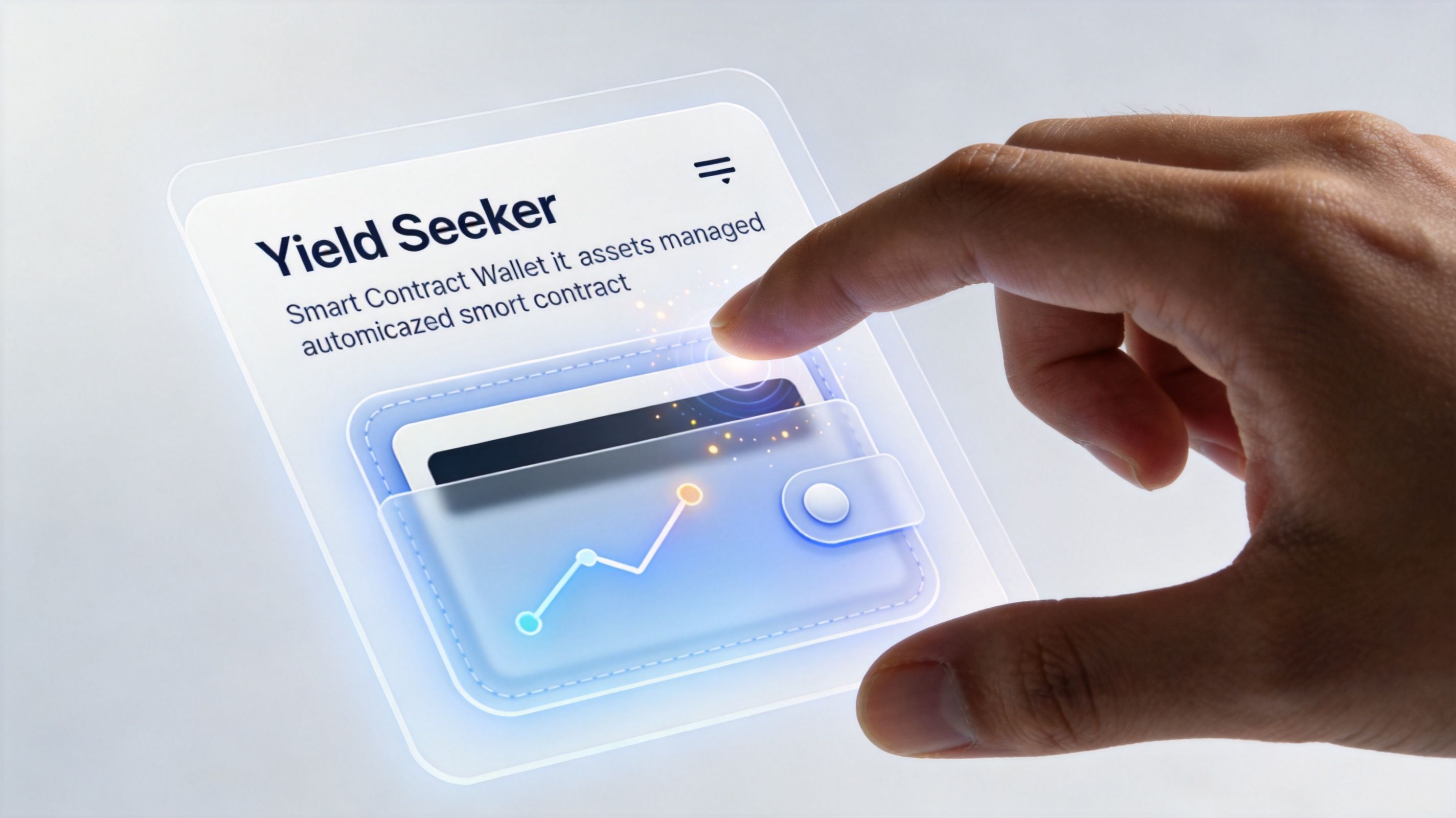
What the user experience hides
From the user side, it feels simple. Deposit USDC, review your balance, and let the system monitor opportunities. Under the hood, the workflow is more structured.
A practical model looks like this:
Your funds sit in a smart contract wallet structure rather than a human-managed account
An off-chain agent evaluates opportunities across DeFi venues
The on-chain layer executes transactions against pools, vaults, and other protocol contracts
Results remain visible on-chain, so actions are inspectable rather than hidden in an internal database
That matters because it preserves a useful property of DeFi. Automation doesn't have to mean black-box custody.
Why this model keeps gaining traction
According to Mordor Intelligence's smart contracts market report, large organizations command 68.20% of the smart contracts market, but small and medium enterprises are growing at a 27.3% CAGR. The same report notes that this growth is being supported by simpler ways to interact with contract systems, including Application Logic Contracts with 41.45% revenue share and DAOs growing at a 30.24% CAGR.
That trend shows up in products that reduce protocol complexity for the end user. The value isn't just automation for its own sake. It's turning a messy multi-protocol workflow into something a busy professional can effectively use without becoming a full-time on-chain analyst.
Where smart contracts help, and where they don't
Smart contracts are excellent at deterministic execution. If the conditions are met, they move funds, update positions, and enforce rules exactly as written.
They are not good at judgment. They don't decide whether a market regime changed in a nuanced way, whether a yield source is deteriorating, or whether a protocol team is becoming less trustworthy. That's why the off-chain intelligence layer matters in automated yield systems.
For readers who want that architecture explained in more detail, Yield Seeker has a useful breakdown of smart contract yield automation.
The strongest DeFi automation stacks use smart contracts for execution and constraints, then use other systems for analysis and routing.
That's the right division of labor. Let code enforce money movement. Let monitoring and strategy systems evaluate where that money should go next. For stablecoin investors, that combination can remove a lot of manual work while keeping the final settlement layer transparent.
The Future of Automated Agreements
Smart contracts matter because they replace manual trust with visible rules. In DeFi, that changes yield generation from a service you hope is being run correctly into a system you can inspect, test, and challenge.
That doesn't make the system safe by default. It makes the trade-offs clearer. You get transparency, automation, and nonstop execution. You also inherit code risk, dependency risk, and the consequences of bad architecture.
For stablecoin investors, the useful mindset is simple. Treat every smart contract as both an opportunity engine and a liability surface. Understand how it executes. Understand who controls it. Understand what happens when assumptions fail.
The next stage of DeFi won't be built by adding more dashboards. It will come from tighter smart contract design, better monitoring, and cleaner coordination between on-chain execution and off-chain intelligence. That combination is what makes automated finance practical for people who don't have time to manage every position manually.
Smart contracts started as a blockchain curiosity. Now they're becoming the operating system for digital financial products. If you want to earn yield on-chain with any seriousness, learning how they work is no longer optional.
If you want a practical way to put these ideas to work, Yield Seeker is one option for automating stablecoin yield on Base through an AI-guided workflow that keeps on-chain execution visible and user funds accessible. It's designed for people who want DeFi exposure without manually tracking every protocol, every rebalance, and every contract interaction themselves.