
In the world of Decentralized Finance (DeFi), you’ll hear the term Total Value Locked, or TVL, thrown around a lot. So, what is it?
Simply put, TVL measures the total value of all crypto assets users have deposited into a DeFi protocol. Think of it as the collective pool of capital that people have locked into a platform's smart contracts to do things like provide liquidity for trades, earn interest, or take out loans. A higher TVL is often a good sign—it can point to strong user trust, deep liquidity, and a healthy, active platform.
Understanding TVL in Crypto: A Simple Analogy
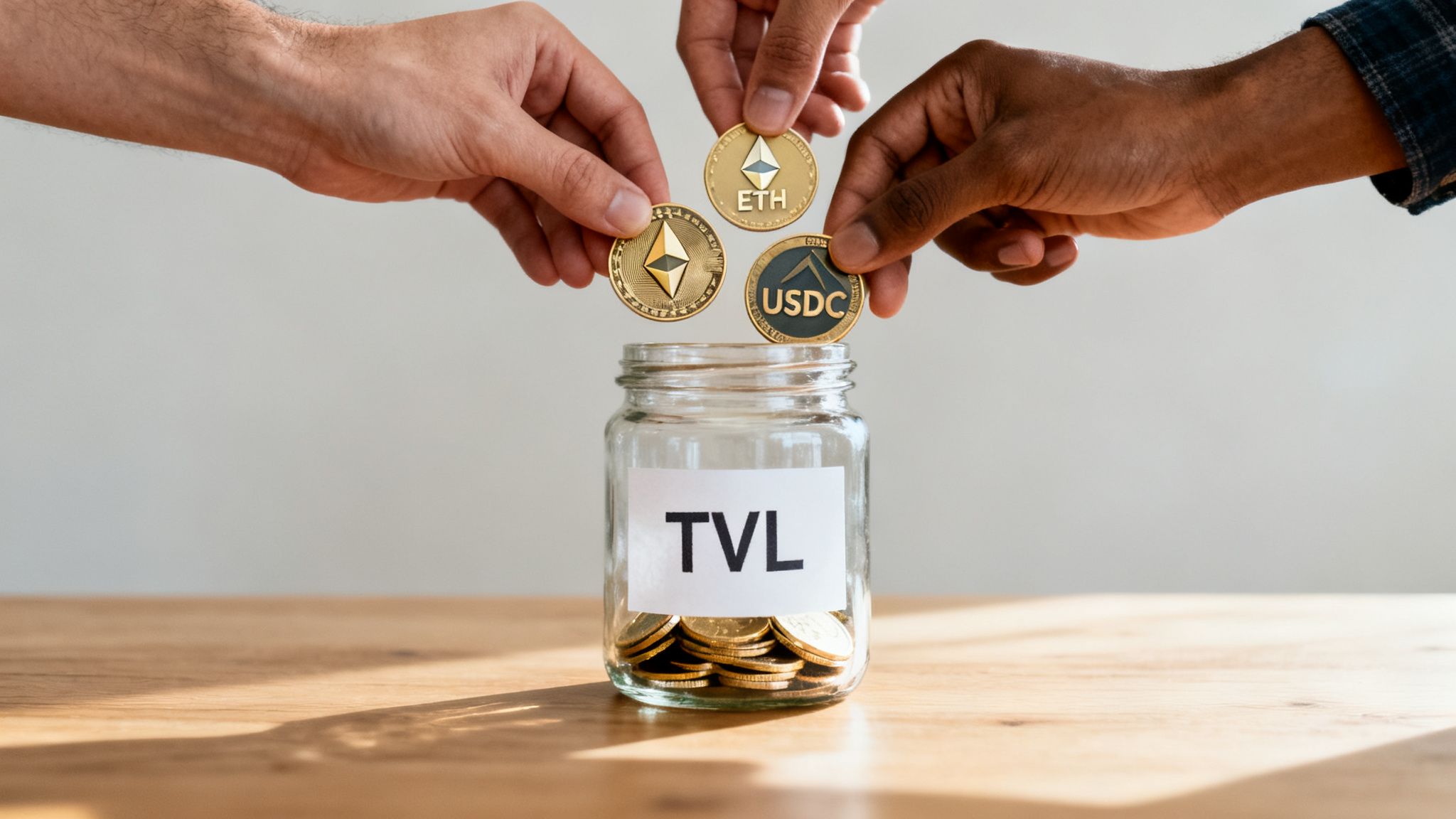
To really get what TVL means, let’s imagine a brand new, digital-only bank pops up in town. The bank’s TVL would be the total amount of money all its customers have put into their checking, savings, and investment accounts combined. It’s a straightforward measure of how much capital the bank is managing.
In DeFi, protocols like lending platforms or decentralized exchanges act like these digital banks. The "deposits" are crypto assets—like ETH, SOL, or stablecoins such as USDC—that users lock into their smart contracts. This pool of locked funds is the lifeblood of the protocol, powering all its financial activities.
Why TVL Is a Core DeFi Metric
A rising TVL sends a powerful message. It suggests that more and more people are comfortable trusting this "digital bank" with their funds. This signals a few important things about the protocol:
User Confidence: When TVL grows, it shows that users believe the platform is secure, reliable, and delivering on its promises. People vote with their wallets, and a high TVL is a vote of confidence.
Deep Liquidity: More locked assets mean there’s more capital available for trades and loans. This is crucial because it leads to a smoother, more efficient experience for everyone, with less price slippage on swaps.
Overall Health: At its core, TVL is a foundational measure of a platform’s scale and adoption. It helps us gauge its importance within the massive, interconnected DeFi ecosystem.
This metric boils down to the total dollar value of every asset staked, lent, or deposited into a protocol. For instance, if a lending protocol has $100 million worth of ETH and $50 million in USDT locked in its liquidity pools, its TVL is simply $150 million. Data aggregators like CoinGecko are great resources for tracking this across the entire DeFi space.
In essence, TVL is the first health check savvy investors perform. It offers a real-time snapshot of the capital committed to a DeFi protocol, making it an indispensable tool for evaluating risk and opportunity.
For a platform like Yield Seeker, understanding TVL is absolutely critical. Our AI agents constantly analyze this data to pinpoint robust protocols that can offer competitive and sustainable yields on your stablecoins. This ensures your capital is put to work on platforms with proven user trust and significant economic activity.
To break it down even further, here’s a quick rundown of the key concepts behind TVL.
TVL At a Glance: Key Concepts
This simple table summarizes the fundamental ideas we've covered about Total Value Locked.
Concept | Simple Explanation | Why It Matters for Investors |
|---|---|---|
Locked Assets | Crypto (like ETH, USDC) deposited into a DeFi protocol’s smart contracts. | This is the raw capital fueling the protocol's financial activities. |
USD Value | The total value of all locked assets, converted to a common currency (usually USD). | Gives you a standardized way to compare protocols of different sizes. |
Protocol Health | A higher TVL often indicates strong user trust, deep liquidity, and stability. | A high TVL suggests the platform is less risky and more reliable for earning yield. |
Market Share | The percentage of the total DeFi TVL that a single protocol commands. | Helps you see which platforms are leaders in their specific niche (e.g., lending, DEXs). |
Hopefully, this gives you a clearer picture of why TVL isn't just another crypto buzzword—it's a vital sign for the health of any DeFi protocol.
How Total Value Locked Is Calculated
Figuring out a protocol's Total Value Locked isn't like checking a single bank account. It’s more like adding up a whole portfolio of different digital assets, each with its own constantly changing price, to get one single, clear number.
At its heart, the calculation is a two-step dance. First, you add up the total amount of every single crypto asset locked away in a protocol's smart contracts. Then, you convert that entire sum into a standard currency, which is almost always the US dollar.
This conversion isn't guesswork; it relies on real-time price feeds. Special data sources called oracles provide up-to-the-minute price information for each asset. This ensures the final TVL number is a true reflection of the current market value of everything the protocol is holding.
What Assets Count Towards TVL
To really get the calculation, you need to know what's actually being counted. The TVL figure is a broad measure of all the capital being put to work inside a protocol.
This usually includes a few key categories:
Assets in Liquidity Pools: A huge chunk of TVL often comes from tokens that users have supplied to decentralized exchanges. If you want to go deeper, check out our guide on how liquidity pools work.
Collateral in Lending Protocols: When you deposit assets like ETH or WBTC to take out a loan, that collateral gets locked up and adds to the platform's TVL.
Staked Tokens: Any assets that are staked to earn rewards, help secure a network, or let you vote on governance proposals are also a key part of the total value.
It's also crucial to remember that a single protocol can operate on several blockchains at once, so calculating TVL means looking across the entire multi-chain crypto ecosystem.
A Practical Calculation Example
Let's make this real. Imagine a fictional DeFi lending protocol we'll call "LendFi." To get its TVL, we'd need to tally up all the assets users have deposited into its smart contracts.
Let's say LendFi is holding:
1,000 ETH, with each ETH currently worth $3,500
5,000,000 USDC, a stablecoin pegged to the dollar
The math from here is pretty simple:
Value of ETH = 1,000 ETH * $3,500/ETH = $3,500,000
Value of USDC = 5,000,000 USDC * $1/USDC = $5,000,000
Add those two together, and LendFi’s total TVL would be $8,500,000.
This example brings up a super important point: TVL is always moving. If the price of ETH suddenly dropped by 10%, LendFi's TVL would also fall, even if not a single user pulled their money out.
Thankfully, you don't have to do these calculations yourself. That's the job of data aggregators. Platforms like DeFiLlama are indispensable here, tracking assets across thousands of protocols and chains, crunching the numbers 24/7, and serving up the data in a clean, easy-to-digest format for investors like us.
How to Interpret TVL for Smarter Investing
Once you get the hang of it, Total Value Locked stops being just a number and turns into a powerful tool for reading the market. A TVL that's steadily climbing is a great sign. It usually points to growing user trust and wider adoption—basically, a healthy, thriving protocol. Think of it as a vote of confidence, backed by real capital.
On the flip side, a sudden, sharp drop in TVL can be a major red flag. This could signal anything from a security scare to dwindling rewards that are pushing users to leave. It might even suggest a broader loss of faith in the project's future. Keeping an eye on these shifts is a core part of managing risk in DeFi.
But it’s not just about the absolute number. The rate of TVL growth is just as important. It gives you a feel for a project's momentum and its power to pull in new money. A protocol with a fast-climbing TVL could be an emerging leader worth watching.
Reading the Flow of Capital
By tracking how TVL moves around, you can spot big trends before they hit the mainstream. The flow of capital between different blockchain ecosystems is a perfect example. A few years back, you'd see a new blockchain launch and its TVL would just skyrocket as users bridged assets over to chase fresh yield opportunities.
This simple visualization shows how a protocol's TVL is calculated—all the locked assets are added up and converted into a single USD value.
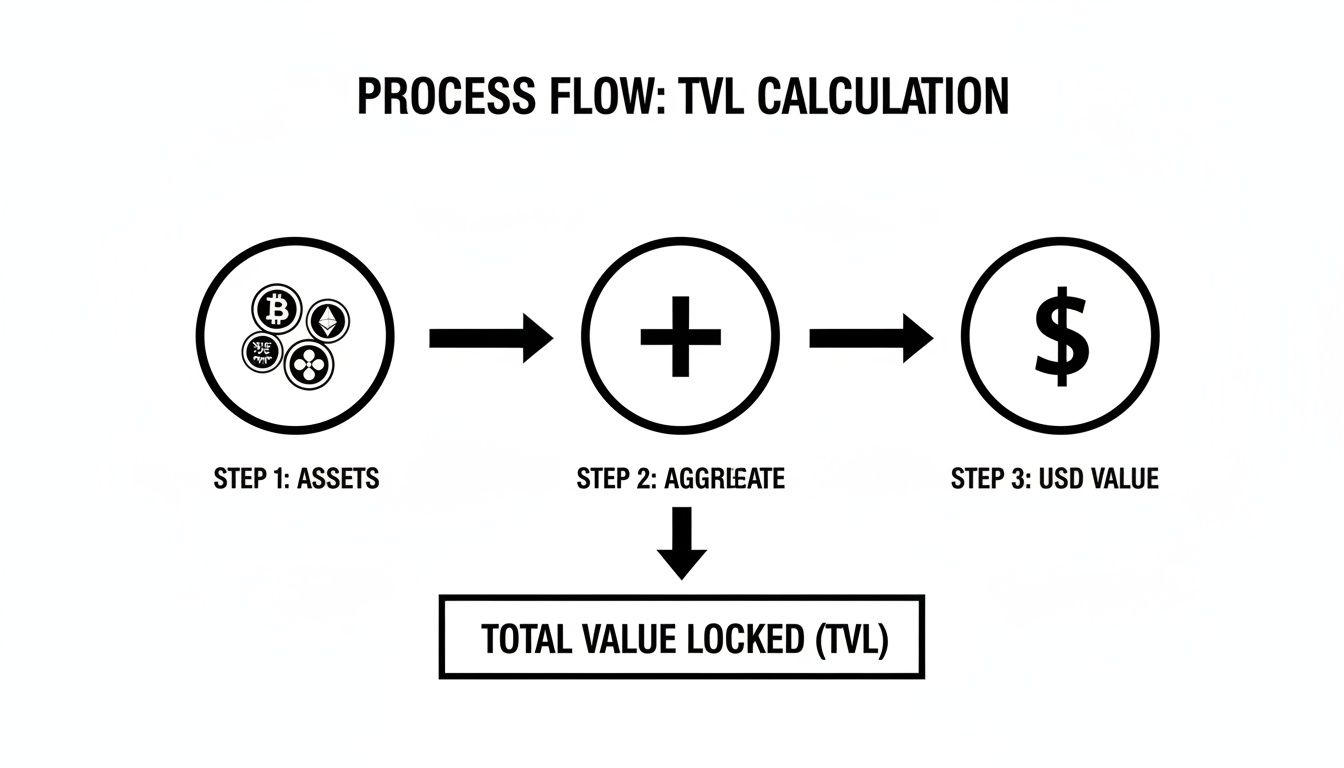
Getting this process is key because it shows that TVL is sensitive not just to new deposits, but also to the price swings of the assets locked inside.
These capital shifts have totally reshaped the crypto market. Ethereum's dominance, which was near 97% of all TVL back in 2020, dropped to under 60% as money migrated to competitors like Solana and Binance Smart Chain. Solana’s TVL, for instance, exploded by over 670% from $1.2 billion to $9.2 billion in just over a year, powered by its super-fast decentralized exchanges. For users of a platform like Yield Seeker, this matters because our AI agents are built to thrive in these high-TVL ecosystems where the best opportunities are found. You can learn more about these ideas in this piece on TVL analysis and DeFi protocol performance.
Beyond the Numbers: Context is Everything
While TVL is a great starting point, you have to look at the bigger picture to interpret it correctly. A high TVL doesn't automatically make a project a safe bet, just like a low TVL doesn't mean it's a bad one.
Here are a few other things to think about when you look at TVL:
Where is the TVL coming from? Is the growth organic, with thousands of individual users chipping in? Or is it propped up by a few "whales" who could pull their funds at any moment and cause a massive crash?
What kind of protocol is it? A lending protocol with $100 million in TVL is a completely different beast from a new decentralized exchange with the same amount. Always compare TVL against direct competitors in the same niche.
Are there crazy token incentives? Is the protocol offering unsustainably high rewards just to temporarily pump its TVL? High yields can attract "mercenary capital" that will vanish the second the rewards dry up.
The best way to use TVL isn't as a single source of truth, but as a starting point for a deeper dive. Use it to build a shortlist of interesting protocols, then roll up your sleeves and investigate their security, user activity, and long-term vision.
By understanding these dynamics, you can start making smarter, more proactive decisions in the wild world of DeFi.
TVL vs Market Cap: What Is the Difference?
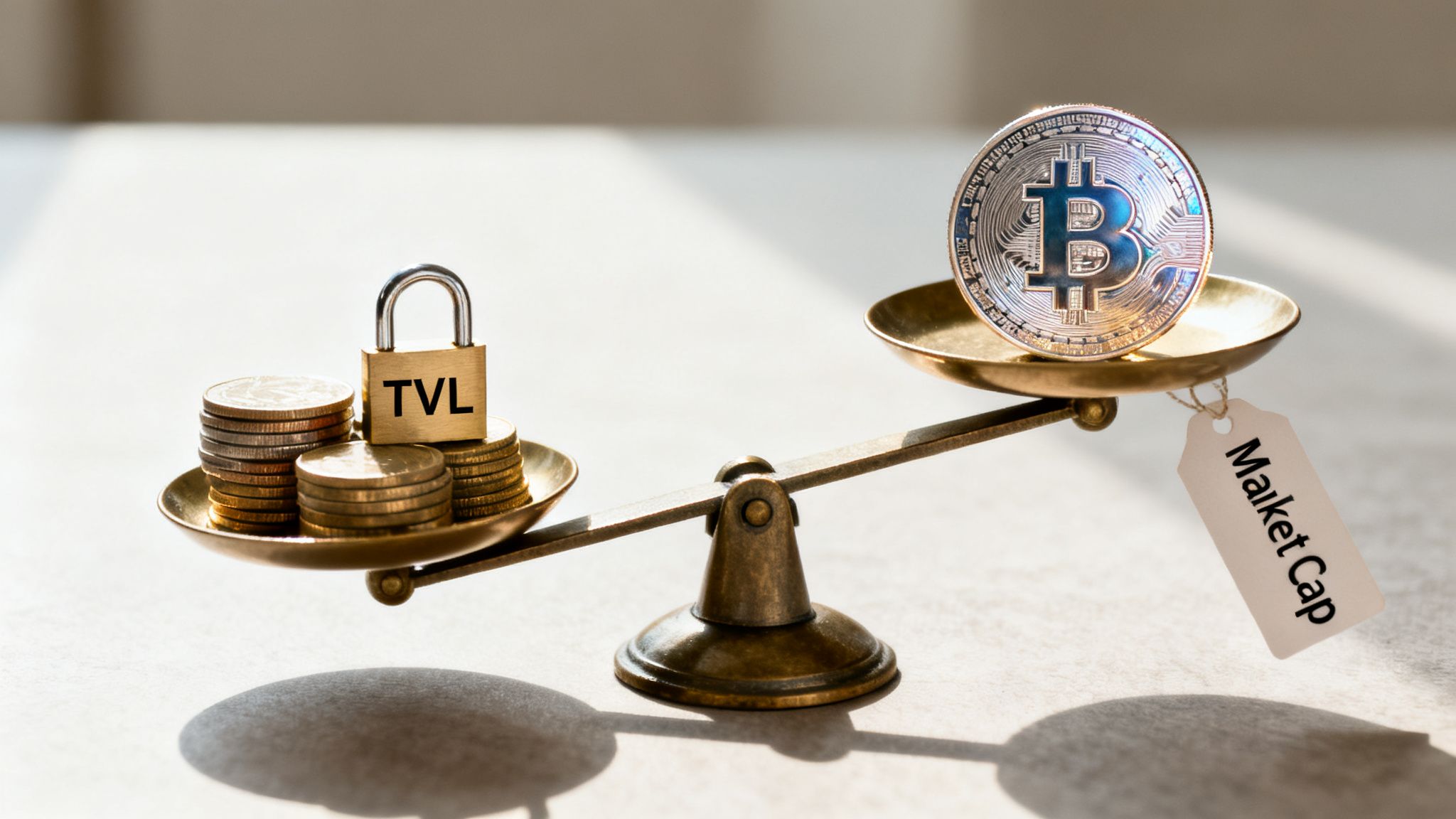
When you're digging into DeFi, it's incredibly easy to mix up Total Value Locked (TVL) and market cap. They sound similar, but they tell you completely different stories about a project. Getting this right is absolutely vital for making smart decisions, especially when you're hunting for yield.
Let's break it down with a simple real-world analogy. Think of market cap like a company's stock valuation. It's the market's best guess—a mix of speculation, hype, and investor confidence—about what that company's shares are worth today, based on its future potential.
TVL, on the other hand, is like the total cash and assets that company is actively managing for its customers right now. It's not about potential; it's about proven, real-world utility and trust. A high TVL means a ton of capital is actually being put to work inside the protocol.
Valuing Utility Over Speculation
While both numbers are useful, one is grounded in today's reality and the other is a bet on tomorrow.
Market Capitalization: This is all about future expectations and speculation. It’s a simple calculation: the current price of a project's token multiplied by the number of tokens in circulation. We cover this in more detail in our guide to understanding crypto market cap.
Total Value Locked (TVL): This metric is all about the here and now. It shows the real, tangible value of the assets that users have deposited into a protocol to lend, borrow, or provide liquidity. It’s a direct measure of trust and usage.
This is a critical distinction. You can have a project with a massive market cap fueled by pure hype, but a tiny TVL. This is a huge red flag—it suggests very few people are actually using the product.
On the flip side, you might find a protocol with a modest market cap but a surprisingly large and growing TVL. That’s often a sign of strong, organic user adoption that the wider market hasn't caught onto yet.
TVL tells you how much capital is actively being used in a DeFi protocol. Market cap tells you what the market thinks the protocol's token is worth. One measures current utility, the other measures future expectation.
To make this distinction crystal clear, here's a quick comparison.
TVL vs Market Cap Key Distinctions
Metric | What It Measures | What It Signifies | Example Analogy |
|---|---|---|---|
TVL | The total value of assets deposited in a DeFi protocol. | Current utility, user trust, and real economic activity. | The total assets a bank is managing for its customers. |
Market Cap | The total value of a project's circulating tokens. | Speculation, investor sentiment, and perceived future potential. | A company's total stock market valuation. |
Seeing them side-by-side really highlights how TVL focuses on the present-day health of the ecosystem, while market cap is more of a speculative bet on the future.
The TVL to Market Cap Ratio
Now we get to the really powerful part: combining these two metrics. The TVL-to-Market Cap ratio is a fantastic tool for spotting potentially undervalued or overvalued projects at a glance.
The formula couldn't be simpler: TVL / Market Cap.
If a project's ratio is below 1.0, it might be a sign that its token is overvalued compared to the actual capital it has attracted. But if the ratio is well above 1.0, it could signal that the protocol is heavily used and its token might be undervalued—a potential gem for savvy investors.
For example, imagine a project with $100 million in TVL and a market cap of $50 million. Its ratio would be a healthy 2.0. This suggests its utility is far outpacing its current valuation.
By looking beyond single numbers and comparing these two critical metrics, you start to build a much richer, more complete picture of a protocol’s real health and investment potential.
The Hidden Risks of Relying Only on TVL
While Total Value Locked is a great starting point, treating it as the ultimate seal of approval for a protocol can be a costly mistake. A high TVL looks impressive on the surface, but it doesn't always tell the whole story. To be a smart DeFi investor, you need to understand its limitations just as well as what it represents.
One of the biggest issues is that TVL can be juiced up. A protocol can easily boost its numbers by offering massive incentives for users to deposit its own native token. This creates a dangerous feedback loop: as more of the native token is deposited, the TVL goes up, which can pump the token's price, which in turn makes the TVL look even bigger. This creates a mirage of organic growth when it’s anything but.
Double Counting and Phantom Liquidity
Another major problem is something called "double counting." This happens when the same pot of money gets counted multiple times as it snakes its way through interconnected DeFi protocols.
Think about it this way: a user might deposit ETH into a liquid staking protocol to get stETH. Then, they take that stETH and deposit it into a lending platform to use as collateral. In this scenario, the value of the original ETH has now been counted twice, bloating the overall DeFi TVL without any new capital actually entering the system.
This creates phantom liquidity that isn't nearly as solid as it appears on paper. You can learn more about the dangers that lurk in these complex DeFi interactions in our article on understanding liquidity pool risks.
TVL shows you where funds are parked, but not how they move, who moves them, or how they create real value. Relying on it alone is like judging a company's health solely by the amount of cash in its vault, without checking its debts or cash flow.
Vulnerability to Market Volatility
TVL is also a slave to market price swings. Since a protocol’s TVL is calculated in USD, a sharp drop in the price of a major asset like ETH can absolutely decimate its TVL overnight. And this can happen even if not a single user has pulled their funds out.
This means a plunging TVL isn't always a sign of people fleeing a protocol; it might just be the tide of a broader market downturn going out. On the flip side, a rising TVL could just be the result of a bull market lifting all boats, not a signal of genuine new adoption.
Because of these hidden traps, you need a more complete picture. Savvy investors look past the headline TVL number and dig into other vital signs of a protocol’s health.
Active Users: How many unique wallets are actually interacting with the protocol daily? This shows real, sticky engagement.
Transaction Volume: What is the actual economic activity happening on the platform? High volume points to genuine utility, not just parked cash.
Security Audits: Has the protocol been battle-tested by reputable security firms? For us, this is completely non-negotiable.
Ultimately, TVL is just one piece of the puzzle, not the whole picture. For platforms like Yield Seeker, our AI agents are built to analyze these deeper metrics—user activity, protocol security, and sustainable yield sources. This ensures we're allocating capital based on a true understanding of a protocol's strength, not just a flashy number.
Got Questions About TVL?
It's a huge number in DeFi, but what does it really tell you? Let's clear up a couple of the most common questions people have when looking at Total Value Locked.
Does a High TVL Mean a Protocol Is Safe?
Not at all. This is a big one to get right.
While a big TVL suggests users trust the protocol and it has plenty of liquidity, it is absolutely not a guarantee of security. A protocol with billions locked up can still have a critical bug in its smart contracts waiting to be found.
Think of a high TVL as a good sign, but it's just one piece of the puzzle. Always weigh it against independent security audits, the reputation of the team behind it, and the project's track record.
Why Does TVL Swing Around So Much?
TVL is always moving, and it's usually down to two things.
First, the obvious one: users are constantly depositing and withdrawing assets. Second, and just as important, the market price of the assets locked in the protocol changes.
For example, if a protocol holds a ton of ETH and the price of ETH pumps 10%, the platform's TVL will jump up to match, even if not a single new dollar was deposited.
TVL isn't a crystal ball for predicting token prices. But, if you see a platform's TVL growing steadily and organically over time, it's often a strong signal that more people are using it, which can be a bullish sign for its native token.
At Yield Seeker, our AI agents look past simple metrics like TVL. They dig deep into a protocol's health, its security, and real user activity to find and manage the most competitive stablecoin yields out there for you. Start earning smarter today.