
Imagine a savings account that pays top-tier interest but never ties your hands—that’s withdrawal-flexible DeFi in action. You park your crypto, watch it grow, and pull it out the moment you spot a new opportunity or need cash. No countdown clock. No penalty fees.
Understanding Withdrawal-Flexible DeFi
Traditional DeFi farming often feels like locking your funds into a fixed-term deposit. You agree to leave your capital untouched for weeks or months, all for the promise of higher yields. Pull out early and you pay the price with steep penalties.
Withdrawal-flexible DeFi turns that script around. It behaves more like a high-yield savings account: deposit anytime, earn interest right away, and withdraw on demand. There’s no waiting period, no surprise fees—just constant access to your money while it works for you.
Flexible DeFi vs Locked DeFi at a Glance
Before diving deeper, let’s line up the two approaches side by side for a quick comparison.
Feature | Withdrawal-Flexible DeFi | Traditional Locked DeFi |
|---|---|---|
Liquidity | Immediate | Locked Until Maturity |
Access | On-Demand Withdrawals | Scheduled Unlock Dates |
Yield Commitment | Variable, Market-Driven | Fixed for the Term |
Withdrawal Penalties | None | Yes—Often 1–10% of Principal |
Ideal For | Agile Capital Management | Long-Term, Predictable Returns |
This snapshot underscores how each strategy balances liquidity against yield certainty. Pick the one that fits your timing and risk appetite.
Why Immediate Access Matters
There’s comfort in knowing your funds aren’t stuck when the market shifts or an unexpected bill arrives. In a flash, you can redeploy capital to chase fresh opportunities or cover expenses.
For those just stepping into DeFi, this openness builds trust. It bridges the gap between curiosity and action, inviting newcomers to explore without fear of being trapped. To see how all this sprang from Bitcoin’s early days, check out the historical context and origins of Bitcoin.
Key Takeaway: Withdrawal-flexible DeFi hands you control plus competitive yields. Think of it as the best of DeFi’s interest rates wrapped in the liquidity of your everyday bank account.
Here’s who benefits most:
Newcomers get peace of mind, managing cash flow without lockups.
Seasoned investors stay nimble, shifting funds as markets evolve.
Any holder of stablecoins earns passive income without giving up control.
At its core, this model strips away a major hurdle for first-timers in decentralized finance. To build on these ideas, our complete guide on what is Decentralized Finance lays out all the basics.
The Relationship Between Liquidity and Yield
In the world of DeFi, there’s a simple truth you can't escape: the highest returns usually ask you to give something up. Most of the time, that "something" is your freedom.
This creates a constant tug-of-war between liquidity—how quickly you can get your hands on your money—and yield, the return you're earning. Nailing the right balance between these two is the secret sauce for any good withdrawal-flexible DeFi strategy.
So why are protocols willing to pay you more to lock up your funds? It boils down to one word: stability. When they know your capital is staying put for a set period, they can confidently lend it out or use it to support trading pairs. This predictability lowers their risk, and they share a piece of that benefit with you in the form of higher yield.
For a protocol, locked funds are like a long-term business loan—stable, predictable, and easier to plan around. Flexible funds are more like a line of credit—useful but less certain.
This map lays out the core ideas behind both flexible and locked DeFi.
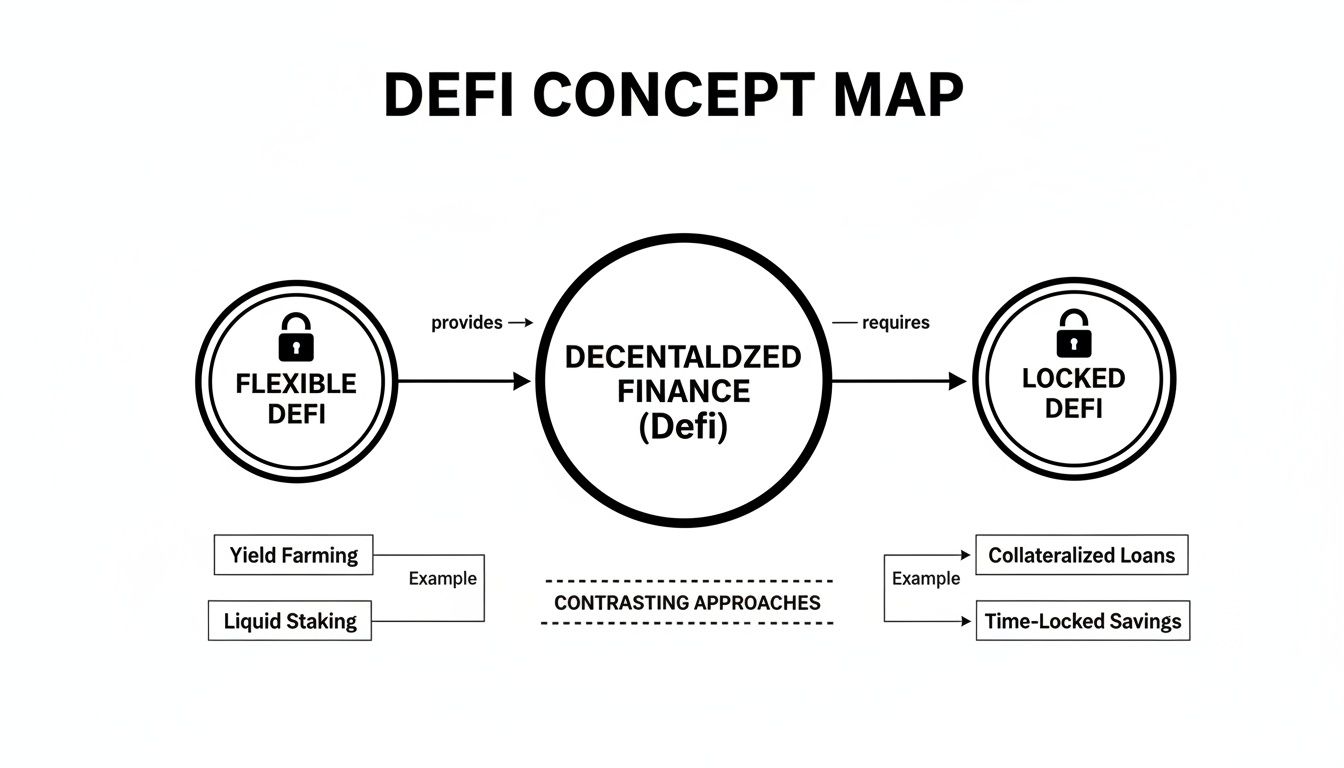
You can see the trade-off right away. Locked strategies go all-in on yield by sacrificing access, while flexible strategies prioritize keeping your funds on-demand without completely giving up on competitive returns.
How Flexible Protocols Compete
Alright, so if locking funds gets better rates, how do these withdrawal-flexible protocols even stand a chance? The answer is smart, automated strategies that are constantly hunting for the best deals in the most liquid parts of the market.
Think of it like a savvy shopper who checks prices at five different stores in real-time to always get the best deal. Instead of parking your money in one spot, these platforms are always on the move, shifting capital between multiple high-quality protocols to capture the best rates. It's a continuous balancing act, all handled by algorithms.
Here’s a look under the hood at what they’re doing:
Dynamic Allocation: Your funds are automatically shuffled to the protocols offering the best risk-adjusted returns at any given moment. No manual work needed.
Liquidity Monitoring: They stick to deep liquidity pools, making sure there's always plenty of cash available to handle withdrawals without a hitch.
Risk Management: By spreading funds across several vetted protocols, they avoid putting all their eggs in one basket. This minimizes the fallout if any single protocol runs into trouble.
This approach gives you the best of both worlds. It captures strong yields by actively playing the market, but it also gives you the instant access we all value. Flexibility isn't magic—it's just smart automation working behind the scenes to balance risk, return, and your need for on-demand liquidity. You get to have your cake and eat it too: competitive earnings and total control over your funds.
How to Evaluate DeFi Protocols for Safety

Not all DeFi protocols are created equal, especially when you need to know you can get your funds out at a moment’s notice. While the allure of high APYs is hard to ignore, a truly safe and withdrawal-flexible DeFi experience hinges on what’s happening under the hood. Vetting a platform is a bit like inspecting a bridge before you drive over it—you absolutely need to check its foundations.
To keep your capital safe, it helps to evaluate protocols using four key pillars. This simple framework lets you cut through the marketing noise and focus on what really counts for security and liquidity. As you go through them, it’s also useful to frame your thinking around understanding risk-adjusted return, which is all about balancing potential rewards with the risks you’re taking on.
Pillar 1: Liquidity Pool Depth
For any flexible protocol, the most critical question is simple: can it handle a bank run? A platform’s ability to process withdrawal requests instantly comes down to the size and health of its liquidity pools. Think of these as the cash reserves ready for users to claim.
A shallow pool can run dry in a heartbeat during a market panic, leaving you stuck and unable to access your funds when you need them most. That’s a massive red flag.
Key Takeaway: Deep liquidity is the bedrock of flexible DeFi. Look for platforms that plug into large, established protocols known for their massive asset reserves. This is your best guarantee that even large-scale withdrawals can be handled without breaking a sweat.
The DeFi space has exploded in recent years, with the total value locked reaching an incredible $100.3 billion USD as of February 25, 2025. This sheer scale means there’s more than enough liquidity to support robust, institutional-grade strategies while still giving individual users the flexibility they need.
Pillar 2: Counterparty and Fee Risks
When you deposit your funds, the protocol usually lends them out to generate yield. The borrowers on the other end of that transaction are your counterparty risk. You have to trust that the protocol has its act together with strict lending standards to prevent defaults that could put your capital on the line.
At the same time, keep a close eye on the fees. High transaction costs, hidden performance fees, or unexpected withdrawal charges can quietly nibble away at your returns, making the advertised APY a lot less attractive in reality.
Pillar 3: Smart Contract Security
Smart contracts are the code that runs the whole show in a DeFi protocol. They’re the engine, but a single bug in that code can be catastrophic, opening the door for hackers to drain funds. This is, without a doubt, one of the biggest risks in the entire DeFi ecosystem.
A reputable protocol will prove its commitment to security through independent, third-party audits.
Security Audits: Look for public audit reports from top-tier security firms like Trail of Bits or OpenZeppelin. This shows they've had experts try to break their code.
Time-Tested Code: Protocols that have been running securely for years without a major incident have proven their resilience. Brand new, unaudited contracts are a much riskier bet.
If you want to go deeper, you can learn more about what goes into a smart contract security audit in our detailed guide.
Ultimately, prioritizing platforms with a proven track record and transparent security practices is non-negotiable. By focusing on these pillars, you can confidently navigate the DeFi space and find platforms that truly deliver on the promise of safe, flexible yield.
Stablecoin Strategies for Flexible Returns
When you want on-demand access to your funds, not all crypto assets are built the same. The real key to a solid withdrawal-flexible DeFi strategy is dodging volatility. That’s exactly where stablecoins come in. They give you a steady foundation to earn yield without the wild price swings you see elsewhere in crypto.
Stablecoins have become a huge deal in DeFi. The total value of dollar-pegged tokens has shot past $300 billion, and this growth has been a game-changer for flexible strategies. It means you can deposit an asset you trust without constantly worrying about its price crashing. Check out more on this trend and its DeFi impact over at dlnews.com.
This stability lets you zero in on what really matters: the mechanics of how you’re earning that yield. So, let's look at some of the most popular ways to put your stablecoins to work.
Proven Methods for Earning Stablecoin Yield
The DeFi world has a few well-trodden paths for earning on stablecoins, each with its own flavor of risk and reward. Doing this all by hand takes a lot of time and digging, but you’ve got to understand the basic playbook first.
Here are three common approaches:
Supplying to Lending Markets: You can deposit stablecoins like USDC or USDT into blue-chip lending protocols. These platforms lend your money to borrowers, and you get a cut of the interest they pay back. It’s one of the oldest and most battle-tested models in DeFi.
Providing Liquidity for Trading Pairs: Another popular move is adding your stables to liquidity pools, especially those for stable-to-stable trades (like a USDC/DAI pool). You earn fees from every swap. This setup neatly avoids the dreaded impermanent loss you’d face with volatile crypto pairs.
Using Automated Yield Aggregators: Think of these platforms as smart portfolio managers for your crypto. They automatically sniff out the best yield opportunities across different protocols and shift your funds to maximize returns. It saves you the headache of manually "yield farming."
Key Insight: While all these strategies work, they often demand active management to make sure you’re actually getting the best rates. The DeFi market moves incredibly fast. A great opportunity yesterday might be just average today.
If you're looking to simplify things, our guide on how to earn interest on stablecoins breaks down these methods in more detail.
The Power of Automated Strategy Management
Let’s be honest, manually chasing the best yields feels like a full-time job. This is where modern platforms like Yield Seeker step in, using slick algorithms to handle the entire process for you. Instead of you having to compare lending rates or monitor trading fees, an AI-powered system does all the heavy lifting.
This automated approach is constantly scanning the market, pinpointing the best risk-adjusted opportunities as they appear. It then allocates your capital to the right places, making sure your funds are always working as hard as possible without you needing to check in constantly. Using a managed solution cuts through the noise and frees up the time and mental space that manual DeFi management eats up.
Right, so you understand the theory, but how do you actually put your money to work? Getting started with withdrawal-flexible DeFi is way easier than it sounds, especially if you use a platform that cuts through the noise. Let's walk through how simple it can be to start earning.
The whole point is to make it straightforward, skipping the scary, complex steps that turn most people off DeFi. You don't need a PhD in crypto to start earning on your stablecoins. It all begins with a quick setup and deposit.
Setting Up Your Account
First things first, you'll need an account on a platform like Yield Seeker. This usually just means connecting your Web3 wallet, which is your secure key to the decentralized world. Once you connect it, your account is pretty much ready to go, and you'll land on a dashboard to see and manage everything.
Think of the dashboard as your command center. It gives you an instant, clean look at your balance, how much you've earned, and your current APY. The goal is total transparency, so you always know how your money is doing without having to sift through messy transaction histories.
Making Your First Deposit
Okay, your account is live. Now it's time to add some stablecoins. Most of these platforms run on networks designed to keep transaction fees super low, which is a huge plus. You can just deposit a stablecoin like USDC directly into the platform.
The process is designed to be intuitive:
Connect Your Wallet: Make sure your wallet is linked up to the platform.
Pick an Amount: Decide how much you want to put in—many platforms let you start with as little as $10.
Confirm the Transaction: Just approve the deposit in your wallet, and boom, the funds show up on your dashboard almost instantly.
As soon as your funds are in, they get put to work. You start earning yield immediately—no waiting around, no confusing staking steps.
The Core Promise: This is what withdrawal-flexible DeFi is all about. Your funds are never locked up. You can pull them out anytime, any amount, with no penalties. That on-demand access is the killer feature.
From this point on, you just watch your earnings pile up in real-time. The platform handles all the complicated yield-chasing in the background, so you can just sit back and enjoy the benefits. It’s a streamlined experience that makes it possible for anyone to jump in and start earning with confidence.
Got Questions?
It's smart to have questions before you put your money to work. Even with a clear plan, you want to be sure you understand the moving parts. Let's tackle some of the most common ones about withdrawal-flexible DeFi so you can move forward feeling confident.
Are Yields from Flexible Protocols Lower Than Locked Protocols?
Often, but it's not a hard and fast rule. While locking up your funds can sometimes bag you a higher base APY on paper, the top-tier flexible protocols can easily keep pace and sometimes even pull ahead. The real difference is the strategy.
Some of the more advanced platforms are constantly rebalancing, shifting capital to the best risk-adjusted opportunities as they pop up in real-time. This kind of active management can actually outperform a static, locked position, especially when the market is moving quickly. The way to think about it is the "net" benefit. A slightly lower yield that's completely liquid is often way more valuable than a fractionally higher yield that ties your hands for months.
What Are the Main Risks of Withdrawal-Flexible DeFi?
The risks here are pretty much the same as you'd find anywhere else in DeFi, but with a sharper focus on liquidity. It’s absolutely crucial to get your head around these before you jump in.
Here are the main ones to watch out for:
Smart Contract Risk: This is the big one. It's the risk that a hacker finds a weak spot in the protocol's code and exploits it, which could lead to a loss of funds.
Counterparty Risk: This comes into play when a protocol lends your funds to borrowers. If those borrowers default on their loans, it can hit the platform's ability to give you your capital back.
Liquidity Risk: This is the chance that a huge, sudden rush of withdrawals all at once could temporarily drain the available capital, causing delays. This is exactly why picking protocols with deep, diversified liquidity sources isn't just a suggestion—it's a must for a withdrawal-flexible strategy.
Expert Insight: A well-built flexible protocol is designed to handle market stress. It does this by deliberately avoiding illiquid strategies and spreading capital across multiple blue-chip protocols. This ensures there are always plenty of ways for users to get their funds out when they need them.
How Do Platforms Ensure Funds Remain Accessible?
The platforms that really nail flexible yield don't just hope for liquidity; they engineer their entire system around it from day one. It’s a multi-layered approach that’s all about actively managing and monitoring access to funds.
They start by only putting capital into highly liquid, proven protocols with a ton of assets under management. Think of these as the superhighways of DeFi—they have enough traffic and capacity to handle huge volumes without getting jammed up. Their systems are constantly watching liquidity levels as a key risk metric, automatically steering clear of any strategy that might trap funds. By spreading money across several deep liquidity pools, they build in redundancy, making sure your funds are ready for withdrawal whenever you are.
Ready to put your stablecoins to work without giving up control? Yield Seeker uses AI to find competitive, risk-aware yields for you, all while keeping your funds fully liquid. Get started in minutes. Start Earning on Yield Seeker