

Back to Blog
How Does DeFi Work A Guide to Decentralized Finance
Curious how does DeFi work? This guide explains smart contracts, liquidity pools, and yield farming in simple terms to help you navigate the world of DeFi.
Oct 29, 2025
generated
Decentralized Finance, better known as DeFi, is a whole new financial system being built on top of blockchains. It works by using automated programs called smart contracts to offer things like loans and trades, but without any of the usual middlemen. Instead of going through a bank or a brokerage, you're interacting directly with code that handles everything automatically.
This creates a financial system that’s open, global, and doesn’t ask for permission. All you need is an internet connection to tap in.
Why DeFi Matters
We’ve all grown up with traditional finance, or TradFi—the world of banks, stockbrokers, and insurance giants. It’s familiar, sure, but it’s also full of frustrating roadblocks. Transactions can drag on for days, fees are everywhere you look, and getting access often depends on where you live or how much you have.
It's a closed-off system where gatekeepers take a slice of every transaction, and you rarely get a clear look at what's happening behind the curtain.
DeFi was built from the ground up to fix these problems. It isn't just a slick new banking app; it's a completely different set of rails for how money moves.
The Power of Permissionless Finance
The real game-changer with DeFi is its permissionless nature. You don't have to fill out an application, sit down with a manager, or wait for approval. Got a crypto wallet? You're in. You can access lending, borrowing, trading, and earning opportunities from anywhere on the planet.
This is a massive deal, especially for the 1.4 billion adults around the world who don't have access to a traditional bank account.
This open-door policy has sparked an explosion of innovation. The global DeFi market, already valued around USD 20.5 billion, is on track to hit over USD 231.2 billion by 2030. Why? Because it cuts out the expensive middlemen and opens the doors for everyone. We're already seeing this play out, with over 32% of financial transactions in some African countries happening through DeFi. If you want to dive deeper, you can read the full research about DeFi's market growth.
At its heart, DeFi gives you something traditional finance rarely does: full control. You hold your own assets in your personal wallet, and only you can authorize transactions. This concept of self-custody is a cornerstone of the entire ecosystem.
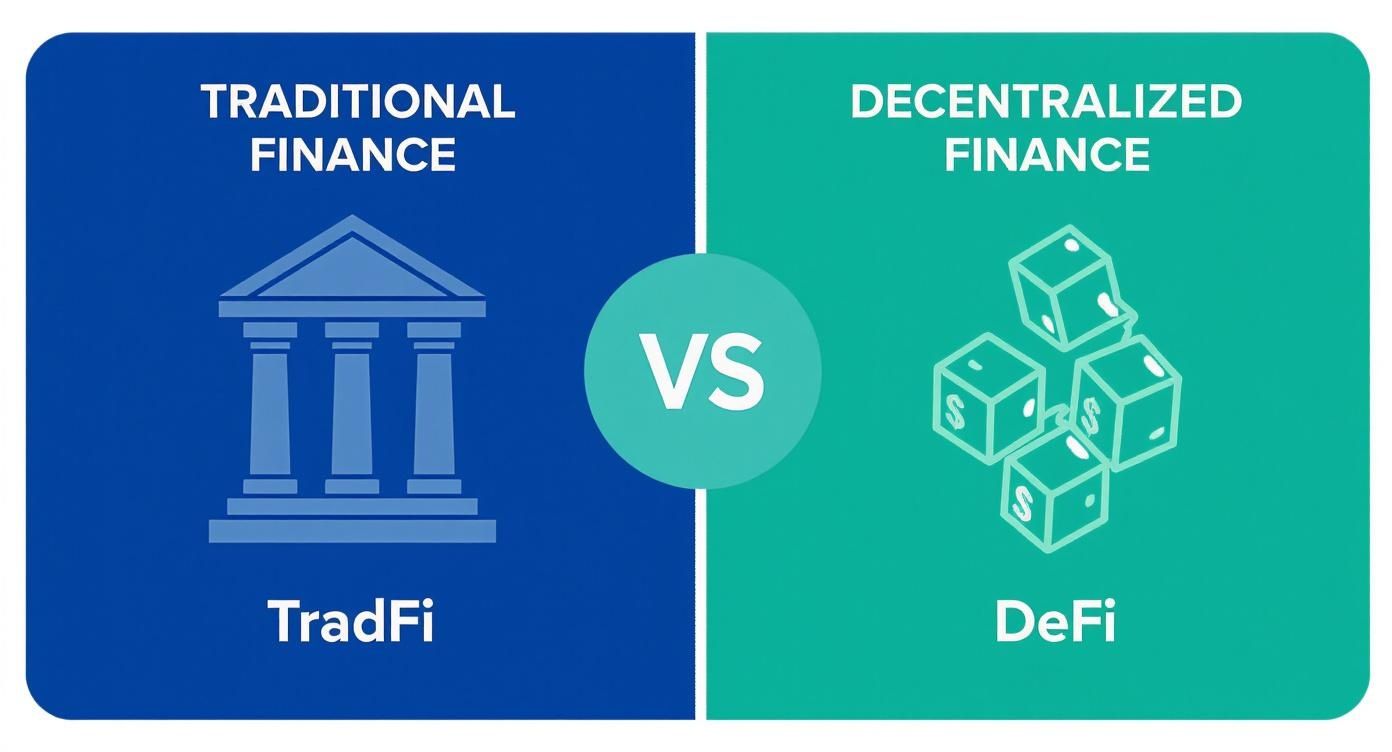
TradFi vs. DeFi A Quick Comparison
To really get what DeFi is all about, it helps to see it side-by-side with the old system it's trying to improve. The differences aren't just about technology—they're about a whole new philosophy for finance. And if you're looking to jump in, figuring out how to buy decentralized crypto is the perfect place to start.
Here's a quick look at how the two stack up.
Traditional Finance vs. Decentralized Finance
Feature | Traditional Finance (TradFi) | Decentralized Finance (DeFi) |
|---|---|---|
Control | Custodial—banks or institutions hold your assets. | Self-Custody—you have full control over your funds. |
Accessibility | Requires identity verification and bank approval. | Open and permissionless; anyone can participate. |
Transparency | Opaque; operations are internal and not public. | Fully transparent; all transactions are on a public blockchain. |
Operating Hours | Limited to business hours and weekdays. | 24/7/365; the system never sleeps. |
Speed | Transactions can take 1-3 business days to settle. | Transactions are near-instant, settling in minutes or seconds. |
Intermediaries | Relies on multiple intermediaries (banks, brokers). | Removes intermediaries in favor of smart contracts. |
As you can see, DeFi is a fundamental shift. It’s moving finance from a closed, centrally controlled world to an open, user-controlled one.
The Core Components That Power DeFi
To really get a handle on DeFi, it helps to break it down into its core building blocks. These are the fundamental pieces of tech that step in to do the jobs traditionally handled by banks, brokers, and stock exchanges. You can think of them like specialized robots in a new kind of financial factory, each performing a critical task perfectly without needing a human manager to look over its shoulder.
At the very bottom of this whole system, you'll find smart contracts. The best analogy is a digital vending machine. You put in a specific amount of money (the input), and the machine is programmed to automatically spit out your chosen snack (the output). There's no cashier to deal with, no haggling—just a simple set of rules written in code that executes exactly as promised when the right conditions are met.
A smart contract is the same idea, just for financial agreements. It's a self-executing contract where the terms of the deal are coded directly onto the blockchain. This makes the agreement transparent for all to see, irreversible once it runs, and unstoppable. For a deeper look at the underlying tech making this possible, check out our guide on understanding blockchain technology.
Decentralized Exchanges And Automated Market Makers
One of the coolest and most common uses for smart contracts is building Decentralized Exchanges (DEXs). In the old financial world, if you wanted to buy or sell a stock, you'd have to go through a central middleman, like the New York Stock Exchange, whose job is to match buyers with sellers. DEXs get rid of that middleman completely.
How? Through a seriously clever invention called an Automated Market Maker (AMM). Instead of trying to pair up individual buyers and sellers one-by-one, an AMM uses a big pool of assets that other users have supplied. A simple mathematical formula, often x * y = k, automatically figures out the price of an asset based on the balance of assets within that pool.
This visual from Ethereum.org does a great job of showing how all the different pieces of the DeFi puzzle fit together.
You can see how things like stablecoins, exchanges, and lending apps all interconnect to build a single, cohesive financial system.
Lending And Borrowing Protocols
DeFi doesn't just stop at trading; it also completely reimagines how lending and borrowing work. Protocols like Aave and Compound act like autonomous money markets. Here, you can either lend out your crypto to earn interest or borrow crypto against assets you already own.
The entire process is instant and managed by algorithms running on smart contracts.
Lenders (Suppliers): You can deposit your crypto assets into a lending pool and start earning interest right away. The interest rate you earn isn't fixed; it adjusts automatically in real-time based on how much demand there is for that asset.
Borrowers: You can deposit one crypto asset as collateral, then borrow a different asset against it. The amount you can borrow is capped at a certain percentage of your collateral's value, known as the loan-to-value (LTV) ratio.
The beautiful part is that this whole system works without credit checks, applications, or waiting for a loan officer's approval. The code is the law. As long as your collateral is sufficient, you can borrow. If the value of your collateral drops too low, the smart contract automatically sells it to repay the loan, making sure the lenders' funds are always protected.
The Fuel: Liquidity Pools And Yield Farming
You might be wondering, where do the assets for all these DEXs and lending protocols actually come from? The answer is: from users like you, through what are called liquidity pools. A liquidity pool is basically a big pot of crypto assets locked inside a smart contract. The people who contribute their assets to these pools are known as Liquidity Providers (LPs).
But why would anyone lock up their valuable assets? For the rewards, of course. In exchange for providing liquidity, LPs get a cut of the fees generated by the protocol. On a DEX, that means earning a piece of every single trade fee. On a lending platform, it's a share of the interest paid by borrowers.
This very concept is the heart of yield farming—the art of actively hunting for the best possible returns on your crypto. Yield farmers are constantly moving their funds between different pools and protocols, chasing the highest yields from trading fees, lending interest, and extra token rewards that protocols often offer as incentives.
These core components—smart contracts, AMMs, and liquidity pools—are the engine that makes DeFi work. They create an open and efficient financial system that's accessible to anyone with an internet connection. This global reach is a huge deal, especially when you consider that 1.4 billion adults worldwide still don't have access to traditional banking. While North America has been a major player in adoption with a market valued at USD 5.84 billion, the Asia Pacific region is actually the fastest-growing market on the planet.
Why Stablecoins Are Essential for DeFi

While the tech behind DeFi is a huge leap forward, the wild price swings of cryptocurrencies like Bitcoin and Ethereum are a massive hurdle.
Imagine taking out a loan where your collateral could crater by 30% in a single day. That kind of volatility makes it almost impossible to build financial services you can actually rely on.
This is exactly the problem stablecoins were built to fix. They're a special type of cryptocurrency designed to hold a steady value, usually by pegging it to a real-world asset like the U.S. dollar. Think of them as a stable bridge connecting the chaotic, fast-moving crypto world to the familiar ground of traditional money.
Taming Volatility for Practical Use
Stablecoins make DeFi usable for everyday financial stuff. When you lend, borrow, or earn yield, you want to count your profits in a currency you understand, not one that's bouncing all over the place. They provide a reliable yardstick, letting you interact with DeFi protocols without constantly worrying about market whiplash.
This stability is a game-changer for anyone trying to generate passive income. You can focus on finding the best returns without the nagging fear that your base capital will get cut in half overnight. Knowing where to look for those returns is crucial, and you can dig deeper into how to evaluate different stablecoin interest rates in our detailed guide.
By taking extreme price swings out of the equation, stablecoins turn DeFi from a speculator's playground into a functional, alternative financial system. They are the bedrock on which predictable and sustainable financial strategies are built.
Just look at the numbers. An estimated $146 billion worth of stablecoins are circulating through DeFi protocols right now. They're the lifeblood of the whole system, powering everything from trading to cross-chain transfers, which moved over $12.6 billion in the first half of last year alone. For a closer look at their central role, you can discover more insights about stablecoin market statistics.
The Different Flavors of Stablecoins
Not all stablecoins are the same, though. They hold their peg to the dollar using different methods, and understanding how they work is key to managing your risk.
Here are the main types you'll come across:
Fiat-Collateralized: These are the most straightforward. For every digital token out there, there's a real dollar (or other fiat currency) sitting in a bank account. Big names like USDC (USD Coin) and USDT (Tether) work this way. They get audited regularly to prove the reserves are really there.
Crypto-Collateralized: These stablecoins are backed by other cryptocurrencies. To mint a coin like DAI, a user locks up a volatile asset (like Ethereum) in a smart contract. Since the collateral itself is volatile, these systems demand over-collateralization—you have to lock up more value than the stablecoins you get in return.
Algorithmic: This is the most complex and, frankly, the riskiest type. Algorithmic stablecoins use smart contracts and code to manage their supply, automatically buying or selling tokens on the market to maintain the price peg without any direct collateral.
The screenshot below from Circle, the company behind USDC, shows the emphasis on trust and transparency that comes with a fiat-backed model.
This focus on regulatory compliance and proven reserves is why you'll find fiat-backed stablecoins like USDC integrated into 92% of top DeFi protocols. Their reliability makes them the go-to choice for developers and users who need a dependable asset for their financial activities.
Your First Steps to Earning Yield in DeFi
Moving from theory to practice is where DeFi really starts to click. Let's walk through one of the most common and rewarding things you can do in this whole ecosystem: earning yield on your stablecoins.
We'll use a real-world example of supplying USDC to a lending protocol on a low-fee network like Base, showing exactly how DeFi works in action. The whole thing breaks down into a few straightforward steps. It might seem like a lot at first, but each action is a logical building block that puts you in the driver's seat of your own finances.
Getting Your Wallet and Funds Ready
Before you can jump into any DeFi app, you need two things: a self-custody wallet and some crypto.
Set Up a Self-Custody Wallet: This is your personal key to the DeFi world. Wallets like MetaMask, Rabby, or Coinbase Wallet are popular picks. Think of it as your digital identity and bank account rolled into one, where you—and only you—control the keys.
Fund Your Wallet: The easiest way to get going is to buy crypto on a centralized exchange (like Coinbase or Kraken) and send it over to your new wallet address. You’ll probably start by buying some ETH to cover transaction fees, plus the stablecoins you plan to use.
Bridge to a Low-Fee Network: Ethereum mainnet is super secure, but the transaction fees (or "gas fees") can be painfully high. To save a ton of cash, you can use a "bridge" to move your assets to a more affordable Layer 2 network like Base or Arbitrum. This simple move can slash your costs from dollars to just a few cents.
Once your wallet is funded on a cheap network, you're all set to connect to a DeFi protocol and put your assets to work.
Supplying Liquidity to a Lending Protocol
Alright, time for the main event. You'll head over to a trusted lending protocol like Aave or Compound. These apps have slick interfaces that feel a lot like using your regular online bank.
You connect your wallet with a single click, which lets the app see your balances and suggest transactions. From there, you just pick the asset you want to supply—in our case, USDC—and type in the amount.
After a quick review, you'll approve two transactions from your wallet: one to let the protocol interact with your USDC, and a second to confirm the actual deposit.
And that's it. Your funds are now in the lending pool, instantly earning interest from borrowers all over the world.
The moment you supply your USDC, you start earning a variable interest rate paid out by borrowers. This yield comes from real economic activity—the demand for loans—and is paid directly to you. The protocol's smart contract acts as the totally transparent middleman.
Understanding Your Returns: APY vs. APR
As you start exploring different opportunities, you’ll see the terms APR and APY everywhere. They might seem similar, but the difference is huge when it comes to figuring out your actual earnings.
To clear things up, here's a quick breakdown of the most common metrics you'll encounter.
DeFi Yield Metrics Explained
Metric | What It Means | Key Consideration |
|---|---|---|
APR | Annual Percentage Rate. This is the simple, non-compounded interest rate you earn over a year. It doesn’t factor in the effect of earning interest on your interest. | APR is a straightforward measure of the base return before any compounding magic happens. |
APY | Annual Percentage Yield. This rate includes the effects of compounding, where your earnings are automatically reinvested to generate their own earnings. | APY will always be higher than APR (if compounded more than once a year) and reflects your true potential return. |
Most DeFi protocols automatically compound your earnings for you, so APY is often the more accurate metric to keep an eye on. Just remember, these rates are almost always variable, shifting with market supply and demand.
For anyone looking to really master these strategies, our in-depth DeFi yield farming guide offers a more detailed look at maximizing your returns.
By following these steps, you’ve officially dipped your toes into the world of DeFi, turning abstract ideas into tangible, yield-generating actions.
Understanding and Managing DeFi Risks

The incredible opportunities in DeFi come with a new set of responsibilities. There are no banks or central authorities to reverse a bad transaction or get your money back if something goes wrong. Security falls squarely on your shoulders, so understanding how DeFi works means being brutally honest about the potential dangers.
The good news is that by breaking these risks down, you can learn exactly how to protect yourself and jump in with confidence. The landscape is new, and it definitely rewards those who come prepared.
Smart Contract Risk
At the very heart of DeFi are smart contracts—the self-executing code that makes everything tick. This automation is what makes the system so powerful, but it’s also the biggest source of risk. A single bug or an overlooked vulnerability in a contract's code can be a golden ticket for a hacker, potentially draining all the funds locked inside.
This isn't just a scary story; hundreds of millions of dollars have been lost to these kinds of exploits. In DeFi, the code is law, and if that law has a loophole, you can bet someone will find it.
Before you even think about putting money into a protocol, you absolutely have to check if its smart contracts have been audited by a reputable security firm. An audit isn't a magical shield, but it proves the team takes security seriously and has had their code professionally kicked, prodded, and reviewed.
Market Risk and Impermanent Loss
Even with flawless code, you’re still exposed to the wild swings of the market. The most obvious one is simple asset volatility. The value of crypto can nosedive or skyrocket in a flash, which can wreck the value of your collateral in a lending protocol or your stake in a liquidity pool.
Then there's a trickier risk specific to liquidity providers: impermanent loss. This happens when the price of the tokens in a liquidity pool changes after you’ve deposited them. The more the prices of your two assets drift apart, the more likely it is that your share of the pool is worth less than if you had just held onto the original tokens. It's a complex idea, but you must wrap your head around it before getting into yield farming.
User Risk and Personal Security
The final risk category is probably the most common and, thankfully, the most preventable: user error. When you're in DeFi, you are your own bank. That also means you're your own head of security, and it's all on you to keep your funds safe.
This really boils down to protecting yourself from common online scams and knowing your tools inside and out.
Phishing Scams: Scammers build perfect clones of real DeFi websites to trick you into connecting your wallet and signing a transaction that drains your account. Always, always double-check URLs and bookmark the official sites you use.
Private Key Mismanagement: Your private key (or seed phrase) is the master key to your entire crypto kingdom. If you lose it, your funds are gone for good. If someone else gets their hands on it, they have total control. Never, ever share it with anyone or store it on your computer.
Best Practices for Protection:
Get a hardware wallet: Devices from Ledger or Trezor keep your private keys completely offline, making it practically impossible for hackers to steal them.
Start small: When trying a new protocol, don't ape in with your life savings. Start with an amount you’d be okay with losing just to learn the ropes safely.
Verify contract addresses: Use block explorers like Etherscan to make sure you're interacting with the official, legitimate smart contract for a protocol.
Navigating this world takes real diligence. But modern tools can help take a lot of that pressure off. AI-powered platforms like Yield Seeker are built to analyze protocol security and monitor market conditions, helping to slash the potential for human error and making the whole DeFi experience a lot safer for everyone.
Common Questions About How DeFi Works
As you start wrapping your head around the building blocks of decentralized finance, it's totally normal for a bunch of practical questions to pop up. This new financial world can feel a bit out there, but most of the core ideas click into place once you tackle the common hurdles head-on.
Let's dive into some of the most frequent questions people have when they're first figuring out DeFi. Nailing these down will solidify your understanding and give you the confidence to explore a little deeper.
Do I Need to Be a Programmer to Use DeFi?
Absolutely not. This is probably one of the biggest misconceptions holding people back. While the backbone of DeFi is some seriously intricate code running on the blockchain, actually using it has become surprisingly straightforward.
Most DeFi applications, known as dApps (decentralized applications), have polished web interfaces that look and feel a lot like your online banking portal. You interact with them through a crypto wallet like MetaMask. You just connect your wallet and click buttons to approve or reject transactions. It’s that simple.
You don't need to understand the programming language Solidity to use DeFi, just like you don't need to know how HTTP works to browse the internet. All you really need is a basic grasp of concepts like gas fees and wallet security to get started safely.
Where Does the Yield in DeFi Come From?
This is the big one. Unlike some traditional savings accounts where the returns are a bit of a black box, DeFi yield is generated from transparent, verifiable economic activity happening on-chain. There are three main places the returns come from.
Lending Fees: This is the most straightforward source. Borrowers pay interest on the crypto they borrow from a lending protocol. As a lender (or "supplier"), you get a slice of that interest as a reward for providing the capital.
Trading Fees: When you provide liquidity to a decentralized exchange (DEX), you're basically helping to facilitate trades for other users. In return, you earn a percentage of the fees generated every single time someone swaps between the two assets in your pool.
Protocol Rewards: Many DeFi protocols give out their own native tokens as an extra incentive to attract users and liquidity. This process, often called "liquidity mining" or "yield farming," can seriously boost your overall returns.
Ultimately, the yield comes from the real value these protocols provide—making loans and trades happen in a more open and efficient way.
What Is the Difference Between DeFi and FinTech?
This is a key distinction. At first glance, they might seem similar since both use tech to improve finance, but their core philosophies are worlds apart.
FinTech companies like PayPal, Venmo, or Robinhood are innovators working within the existing financial system. They build slicker user interfaces and more efficient services on top of the old rails of banks and clearinghouses. They make traditional finance easier to use, but they don't change the underlying structure.
DeFi, on the other hand, isn't just an upgrade to the old system; it's a brand new, parallel financial system being built from scratch on the blockchain. It completely cuts out the traditional middlemen and replaces them with code.
Put simply, FinTech is a better front door to the old bank. DeFi is a whole new bank.
Is DeFi Safe and Regulated?
The short answer is that DeFi is a high-risk, high-reward environment where safety and regulation are still playing catch-up. The regulatory landscape is a patchwork that changes from country to country, and policymakers are still figuring out how to approach this new frontier.
From a technical safety standpoint, the risk is very real. Because the entire system runs on code, a single bug or exploit in a smart contract can lead to a sudden and total loss of funds. Unlike a traditional bank account, there is no FDIC insurance to back you up if a protocol gets hacked.
This is exactly why security best practices are not optional in DeFi.
Only put in what you can comfortably afford to lose.
Stick to established protocols that have been thoroughly audited by reputable firms.
Always use a hardware wallet to keep your private keys safely offline.
Navigating this space requires caution, but the radical transparency of the blockchain also allows for a level of due diligence that's just not possible in the traditional world.
Manually tracking protocols, managing all these risks, and chasing the best yields can feel like a full-time job. Yield Seeker takes care of all of it for you. Our AI-powered platform automatically finds and invests in the safest, highest-yield opportunities for your USDC on the BASE network, so you can earn effortlessly. Get started in seconds at https://yieldseeker.xyz and let AI handle the heavy lifting.