Back to Blog
How to Set Stop Losses A Complete Trader's Guide
Learn how to set stop losses with our complete guide. Protect your capital, manage risk, and improve your trading strategy in any market, from crypto to stocks.
Oct 20, 2025
generated
When you set a stop loss, you’re essentially placing an automated sell order with your exchange or broker. It’s a simple instruction: "If the price drops to this specific level, sell my position." This defines your maximum acceptable loss before you even enter a trade.
This simple action is your most critical safety net. It protects your capital from catastrophic drops and, just as importantly, takes the emotion out of the equation when a trade goes against you.
Why Stop Losses Are Non-Negotiable for Smart Traders
Let's be real: a stop loss is your primary defense against the two biggest portfolio killers—fear and hope.
Without one, you're not trading; you're gambling. You're just hoping a losing position will magically reverse course. That's a recipe for disaster. Successful traders operate on logic and discipline, and the stop loss is the single most important tool for enforcing that discipline. It's your line in the sand, the absolute maximum you're willing to lose on any single idea.
This isn’t about being pessimistic or expecting to fail. It’s about preserving your capital so you can live to trade another day. Think of it as insurance for your entire trading account.
This infographic really drives home how a stop loss acts as a protective shield against crypto's notorious volatility.
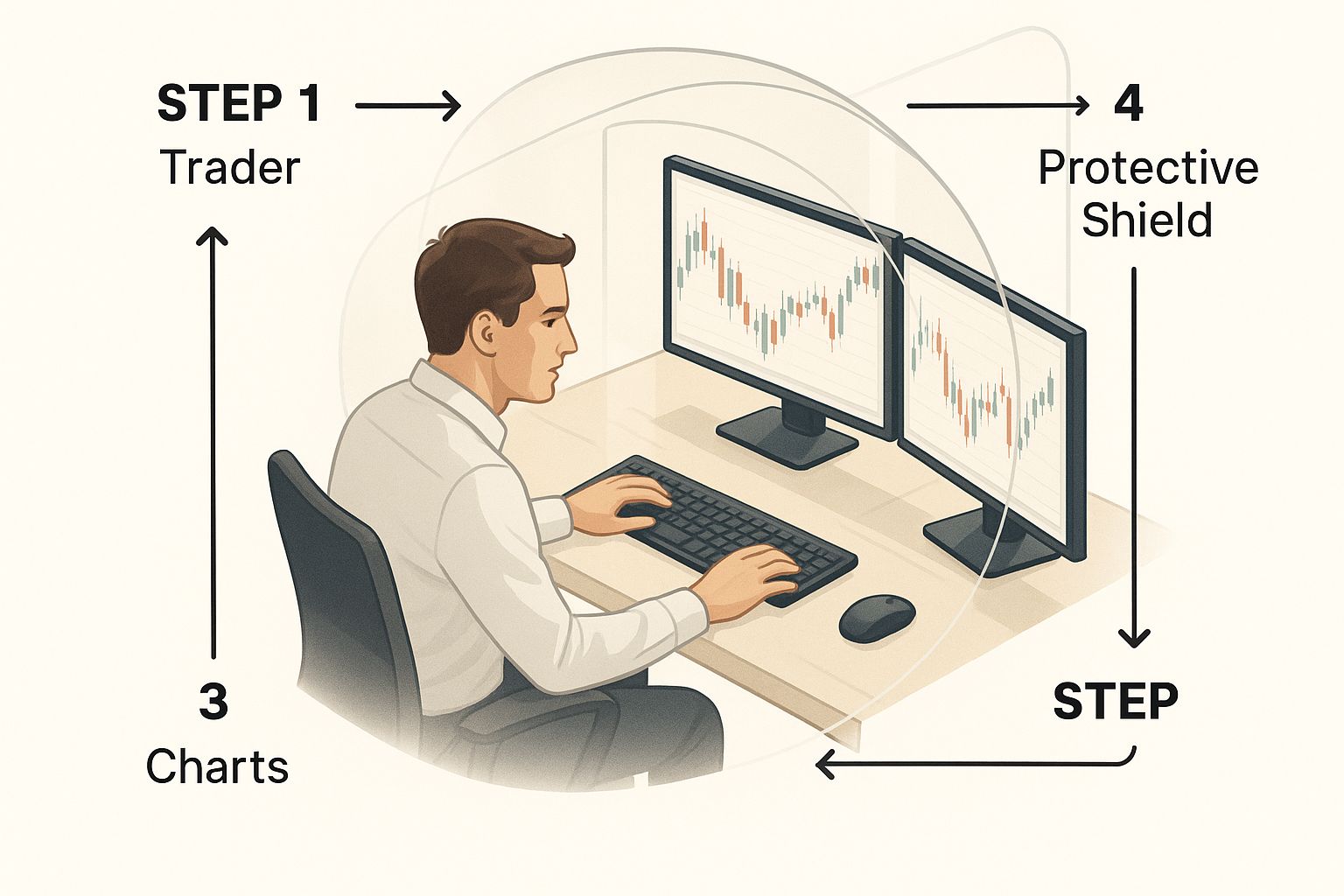
As you can see, it's a core component of a focused, strategic trading plan—not just some optional extra you tack on at the end.
The Psychology of Capital Preservation
The mental freedom that comes from setting a stop loss is massive. Once it’s in place, you’ve already accepted the risk. You can step away from the charts knowing your downside is capped.
This frees you from the anxiety of obsessively watching a losing trade, letting you focus your mental energy on finding the next great opportunity instead of stressing over a past mistake.
A trader's first job is not to make money, but to protect what they have. A stop loss is the practical application of this rule, ensuring one bad trade doesn't end your career.
This isn't just theory; the data backs it up. Early studies from the Chicago Mercantile Exchange showed that traders who consistently used stop-loss orders slashed their maximum drawdowns by 30-40%. Portfolios using stop losses capped their average loss at 5% per trade, while those without them saw losses balloon past 8%.
You can dive into a full analysis on risk management strategies to see the numbers yourself. The evidence is clear: disciplined exits are a cornerstone of long-term survival in these markets. By making stop losses a non-negotiable part of your process, you shift from a reactive, emotional mindset to a proactive, strategic one.
Choosing the Right Stop Loss Strategy
Let's be clear: there’s no single, magical formula for the perfect stop loss. Where you place it really depends on your personal trading style, the coin's specific personality (and trust me, they all have one), and how wild the market is at that moment.
I'm going to walk you through three battle-tested methods that real traders lean on every single day to keep their capital safe. Each one tackles risk from a different angle, so find the one that clicks with your own approach. The real secret? Pick one and stick with it. Consistency is what separates disciplined traders from the rest.
The Simple Percentage Method
This is the most direct route to defining your risk. You just decide on a fixed percentage you're willing to lose on any given trade, and that's that.
For instance, you could commit to a 5% stop loss on every position. If you buy Bitcoin at $60,000, your stop loss order gets placed at $57,000. Easy.
This is a fantastic starting point, especially for beginners, because it forces you to be disciplined. It takes the emotion and guesswork out of the equation, making your risk management clean and repeatable.
The downside, however, is that it completely ignores what the market is actually doing. A 5% dip might just be Tuesday for a volatile altcoin, but for a more stable asset, it could be a major red flag. This method can sometimes knock you out of a perfectly good trade right before it turns in your favor.
The Support and Resistance Method
Here's where we get a bit more sophisticated. Instead of picking a number out of thin air, you use the market's own structure to tell you where to place your stop. This technique hinges on technical analysis, specifically finding key support and resistance levels on a chart.
Going long (buying)? You'd set your stop just below a solid support level. The thinking here is simple: if the price crashes through that floor, your whole bullish idea is probably wrong.
Going short (selling)? Your stop goes just above a clear resistance level. If the price breaks through that ceiling, the bears have lost control.
This method is so powerful because it anchors your decision to areas where the price has historically reacted. To really nail this, you need to be comfortable reading charts. If you're new to that, our guide on how to read crypto charts will give you the foundation you need.
By placing your stop just beyond a key level, you’re making the market prove you wrong in a meaningful way before you exit. It’s a much smarter play than relying on an arbitrary percentage.
The Volatility-Based Method
This might be the most intelligent way to set a stop loss. It lets the market's current mood dictate your risk. Markets breathe—sometimes they're calm, other times they're thrashing around. A static, one-size-fits-all stop loss just can't keep up.
This is where a tool like the Average True Range (ATR) becomes your best friend. The ATR is an indicator that measures how much an asset's price has been moving, on average, over a set period. It gives you a real-time pulse on its volatility.
So, instead of a fixed percentage, you might set your stop at 1.5x or 2x the current ATR value below your entry.
In a quiet market: The ATR will be low, pulling your stop in for a tighter position.
In a chaotic market: The ATR will be high, giving your trade more breathing room to survive the violent swings.
This adaptive approach is a game-changer for avoiding getting "whip-sawed" out of a trade by normal market noise. A well-calibrated stop can be the difference between a small, controlled loss and a catastrophic one. Many traders stick to a rule of setting stops at 1-2 times the ATR to stay in sync with the market's rhythm. You can explore more about this concept in these additional insights on risk management strategies.
Alright, theory is great, but it’s useless if you don't know where to click. Putting a stop loss in place looks a little different depending on where you're trading, whether that's a big centralized exchange or you're deep in the weeds of DeFi.
Let's walk through the practical side of things so you can turn that knowledge into real-world capital protection.
Most of the big exchanges—think Binance, Coinbase, or Kraken—have a pretty similar feel. When you go to place a trade, you'll see a few different order types. The ones you’re looking for are “Stop-Limit” or “Stop-Market.” These are your tools for setting a clean exit.
Placing Stops on Centralized Exchanges
Let's play out a real scenario. Say you want to buy some Ethereum (ETH) at $3,500. Your game plan says to set your stop loss just under a key support level at $3,395.
This is where you have a critical choice to make:
Stop-Market: This is the no-fuss option. You just set a Stop Price of $3,395. If ETH drops to that price, the exchange triggers a regular market sell order. It'll get you out of the trade immediately at whatever the best available price is. It’s a guaranteed exit, but you might get some slippage if the market is dumping hard.
Stop-Limit: This one gives you a bit more control. You set the Stop Price at $3,395 and also a Limit Price, maybe something like $3,390. When the price hits your stop, it places a limit order to sell, but only if it can get a price of $3,390 or better. This saves you from a terrible fill, but there's a small risk your order won't get filled at all if the price gaps down past your limit.
Of course, picking the right exchange is half the battle when you're just starting out. If you need a hand finding a platform with an easy-to-use interface for placing these orders, our guide on the best cryptocurrency exchanges for beginners is a great place to start.
Here's a look at what the order screen typically looks like on a major exchange like Binance.
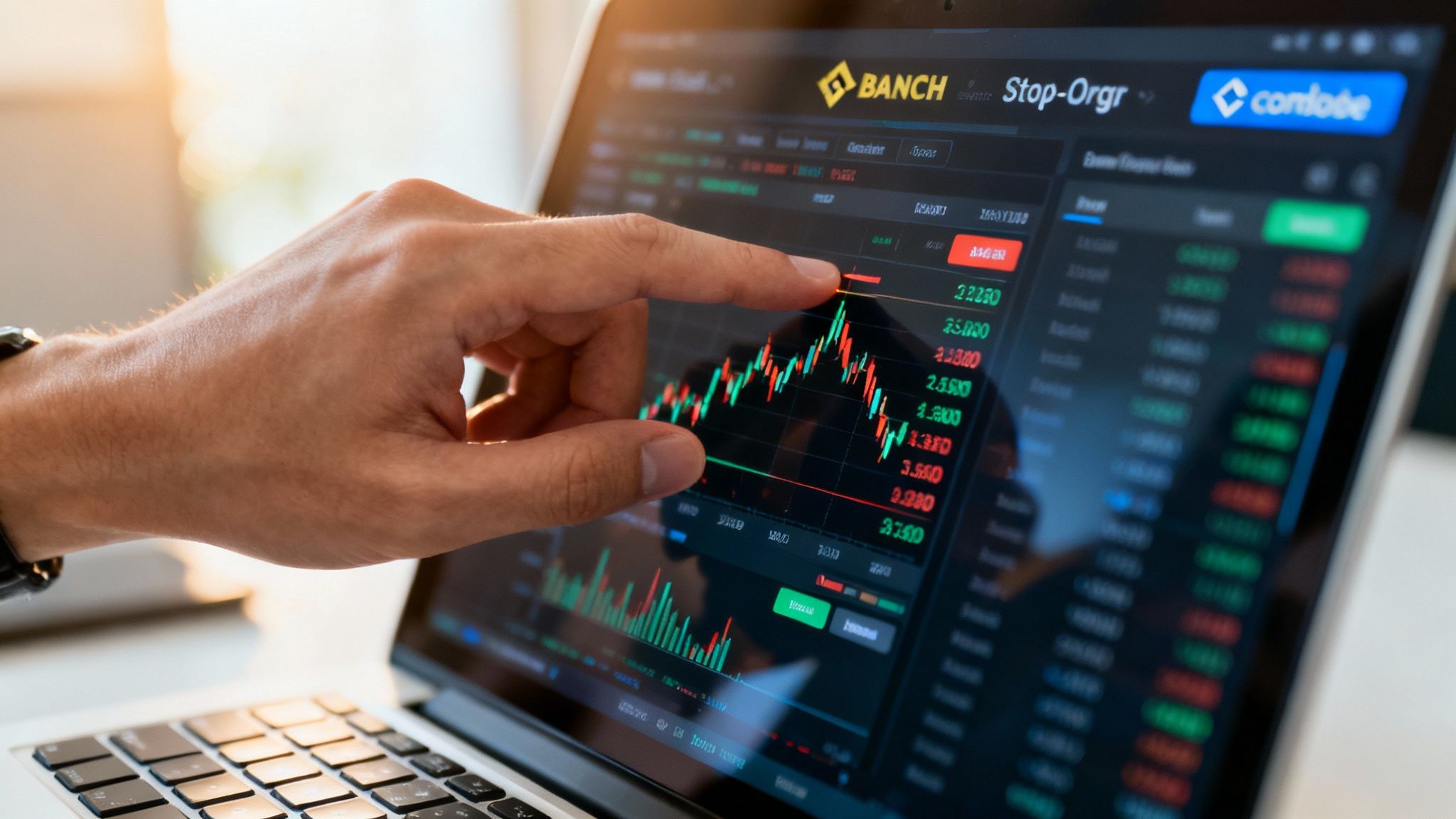
You can see the separate fields for "Stop," "Limit," and "Amount." This is exactly where you’ll plug in your price triggers and how much you're selling.
Navigating Stop Losses in DeFi
Trying to set a stop loss in DeFi is a whole different ball game.
Decentralized exchanges (DEXs) are basically just a bunch of smart contracts, so they don’t have the traditional server-side order books that CEXs use for things like stop-loss orders.
But the space moves fast. Newer platforms built for perpetuals trading, like GMX or dYdX, now have this functionality baked right into their interfaces. When you open a position, you'll usually see an option to set both a "Take Profit" and a "Stop Loss" trigger price right away.
Pro Tip: Remember that in DeFi, every single action—including placing or triggering a stop loss—costs a gas fee. You absolutely have to factor these network costs into your trading plan. On a congested network, they can eat into your profits fast.
For other DeFi protocols, you'll probably need to lean on third-party automation tools. Services like Gelato Network or certain smart contract wallets let you create automated instructions. Think: "if my Uniswap LP position value drops by 10%, automatically trigger a transaction to pull my liquidity."
It’s definitely more of a technical setup, but it’s a solid way to manage risk in an environment that wasn't built for it. Just be careful—this means giving permissions to smart contracts, so stick with trusted, well-audited services.
Advanced Stop Loss Techniques for Winning Trades
Once you’ve nailed the basic stop loss, you've learned how to play defense. That's job number one for any trader: protecting your capital from those nasty, account-wrecking hits.
But now it’s time to learn how to play offense. We're going to shift from simply avoiding big losses to actively managing your winners and squeezing every last drop of profit out of them. These advanced techniques aren't about taking on more risk; they're about giving your good trades room to breathe while you methodically lock in gains along the way.
Using Trailing Stops to Ride the Trend
Picture this: you're in a great trade, and the price just keeps climbing. The absolute last thing you want is to sell too early and watch it rocket another 50% without you. This is exactly where the trailing stop becomes your best friend.
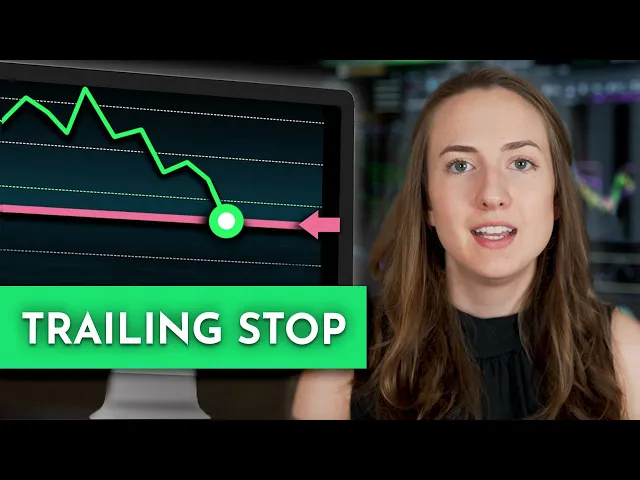
A trailing stop is a dynamic stop loss that automatically follows the price up. Instead of setting a fixed price, you set a specific percentage or dollar amount below the current market price.
Here's how it plays out:
You buy Solana (SOL) at $150 and decide on a 10% trailing stop.
Your initial stop loss is automatically placed at $135 (which is 10% below your entry).
SOL starts to run and hits $180. Your stop loss doesn't stay at $135; it automatically trails the price up, moving to $162 (always 10% below the new high).
The rally continues to a peak of $200, pulling your stop up to $180. Then, the momentum fades, and the price dips back down.
The moment it touches $180, your position is automatically sold, locking in a solid $30 per SOL profit.
The beauty of this is that it takes all the emotion and guesswork out of knowing when to sell a winner. You just let the trend do its thing, and your stop loss handles the exit for you, securing more and more profit as the trade moves in your favor.
The Art of Taking Partial Profits
Another technique straight from the pros' playbook is taking partial profits at pre-planned targets. This whole strategy is about reducing your risk while keeping some skin in the game for more upside. You don't just slam the "close" button on your entire position at once; you scale out of it, piece by piece.
This approach gives you the best of both worlds. You bank tangible gains—paying yourself as the trade works—but you also leave a chunk of your position open to catch that next leg up.
One of the most effective ways to use this is to sell a portion of your position at your first profit target, then immediately move the stop loss on the remaining amount to your original entry price. This creates what traders call a "risk-free" trade.
From that moment on, you literally cannot lose money. The worst possible outcome is breaking even, but you've already booked some profit and still have a "runner" in the trade with the potential for a massive win. This single tactic can do wonders for both your bottom line and your trading psychology. You're no longer sweating whether a winning trade will turn back into a loser.
Common Stop Loss Mistakes That Wreck Accounts
Knowing the mechanics of setting a stop-loss is one thing. Actually using them to protect your capital is another game entirely. The real battle is avoiding the psychological traps and tactical blunders that trip up even seasoned traders.
These mistakes are the silent account killers. They turn small, manageable risks into catastrophic losses. It doesn't matter how good your tools are if you're still making rookie errors. Let's be frank about these pitfalls—understanding them is critical for long-term survival.
Setting Stops Way Too Close
This is probably the most common mistake I see. A trader places their stop-loss incredibly tight to their entry price, thinking they're being super cautious. In reality, they're just setting themselves up to get knocked out by normal market "noise"—the tiny, random price swings that happen every minute.
Imagine you buy an altcoin at $1.00 and set your stop at $0.99. On paper, a 1% risk looks smart. But crypto is volatile. The coin could easily dip to $0.985 for a few seconds before ripping up to $1.20. Your tight stop gets triggered, and you're left on the sidelines, watching a winning trade take off without you. Frustrating, right?
Key Takeaway: You have to give your trades room to breathe. Use a tool like the Average True Range (ATR) to get a feel for an asset's typical volatility. Then, set your stop outside that normal range of price action.
Moving Your Stop on a Losing Trade
Don't do this. Ever. This is the cardinal sin of trading discipline.
Your initial stop-loss is your pre-planned exit. It's the maximum amount of pain you decided you were willing to take on that trade before you put your money on the line. Moving that stop further down when the price goes against you isn't a strategy; it's just wishful thinking.
It's a purely emotional decision, a desperate hope that the market will magically reverse. You're basically admitting you were wrong, but instead of taking the small, planned loss, you're now gambling on being proven right. More trading accounts have been blown to pieces by this one mistake than any other.
Placing Stops at Obvious Psychological Levels
Big, round numbers are magnets for stop orders. Think $50,000 for Bitcoin or $1.00 for a smaller altcoin. Here's the problem: institutional players and their trading algorithms know this.
These areas become "stop hunt" zones, where large players can push the price just enough to trigger the massive cluster of retail stop orders waiting there. It's easy liquidity for them and a painful exit for you.
To avoid being cannon fodder, set your stops based on technical levels, not just pretty numbers. Place your stop slightly below a key support level or just a bit above a resistance line. This forces the market to make a truly significant move to knock you out. You'd be surprised how a few cents can make all the difference. And remember, during these volatile moments, you also have to account for things like what slippage is in trading, which can affect your final exit price.
The core principle here isn't new. Early research from the CME showed how a well-placed stop-loss prevents devastating losses, a lesson that’s as true today as ever. If you're interested in the broader context, you can read the full research on risk management.
Got Questions About Stop Losses?
Even when you think you've got the basics down, putting stop losses into practice in the real world can throw up some curveballs. Let's run through a few of the most common questions I hear from traders to get you feeling more confident.
What’s the "Best" Percentage for a Stop Loss?
Honestly, there's no magic number that fits every single trade.
You'll hear people talk about the "1% rule," which is a fantastic way to manage your overall portfolio risk—basically, don't risk more than 1% of your total trading capital on any single idea. But applying a fixed percentage like, say, 5% to the asset itself is a recipe for getting stopped out unnecessarily.
Think about it: a 5% dip is just Tuesday for a volatile new altcoin. For something like Bitcoin, a 5% drop could be a major crack in its market structure. A much smarter way to do it is to look at the chart. Place your stop just below a clear support level or use a volatility indicator like the Average True Range (ATR) to let the market's current behavior dictate your stop.
Can My Stop Loss Fail?
Yes, and it’s critical you understand why. This is called slippage, and it usually bites you during moments of insane volatility or when you're trading a coin with very little liquidity. The price can just "gap" down so fast that it blows right past your stop price without a single trade happening at that level.
If you're using a stop-market order, it will still trigger, but it's going to fill at whatever the next available price is. This could be way, way worse than you planned.
If you're using a stop-limit order, it might not fill at all if the price gaps past your limit and never comes back up. That can leave you stuck in a trade that's bleeding value.
This is exactly why you need to check a coin's liquidity before you even think about trading it.
Never assume your stop loss is a perfect shield. It's an essential risk management tool, but it's not invincible when the market truly goes wild.
Is It Ever Okay to Move My Stop Loss?
Absolutely—but only in one direction.
You should definitely move your stop loss up to lock in profits. Once a trade is nicely in the green, a classic move is to slide your stop up to your entry price. Boom, you've now got a "risk-free" trade.
What you should never, ever do is move your stop loss further away from your entry just to give a losing trade "more room to breathe." That’s not a strategy; it's a prayer. It completely demolishes your original game plan and is the fastest way I know to wipe out a trading account.
Ready to grow your stablecoin returns without the constant stress of market watching? Yield Seeker uses an AI Agent to find and manage the best yield opportunities in DeFi for you. Start earning smarter at https://yieldseeker.xyz.