Back to Blog
Mastering Stablecoin Yield Optimization
Discover proven stablecoin yield optimization strategies. Learn to manage risk, deploy capital, and leverage AI to maximize your DeFi returns safely.
Dec 12, 2025
generated
At its core, stablecoin yield optimization is all about actively managing your stablecoins across various DeFi protocols. The goal? Squeeze out the highest possible returns for whatever level of risk you're comfortable with. It’s a constant cycle of analyzing, executing, and monitoring—a world away from passive, "set it and forget it" strategies.
What Is Stablecoin Yield Optimization
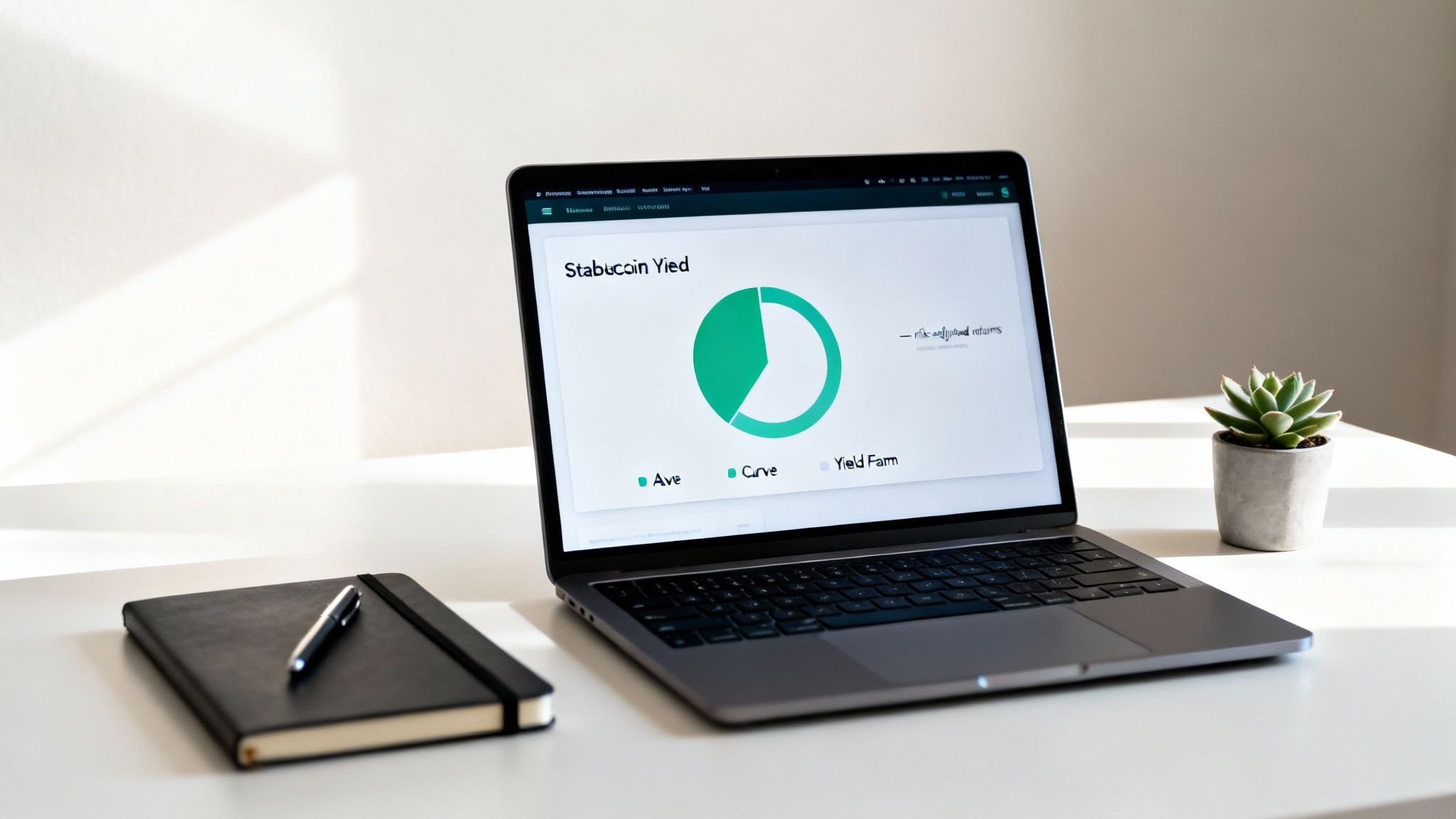
Think of it like this: you're turning your static digital dollars into an asset that actually works for you. Instead of letting stablecoins like USDC or DAI just sit in your wallet collecting dust, you put them to work in the DeFi ecosystem to earn rewards. This is much more than just chasing the highest advertised Annual Percentage Yield (APY); it’s about having a real strategy.
The concept isn't exactly new. Yield optimization has been a game-changer in traditional industries for decades. Just look at the hospitality industry—big hotel chains like Marriott and Hilton boosted their revenue per room by an average of 15-20% between 2005 and 2007. They did this by implementing systems to dynamically adjust prices based on demand.
The Core Strategies in DeFi
In the DeFi world, you have a few primary ways to make your stablecoins work for you. Each one offers a different balance of risk and potential reward, and they are the building blocks of any solid, diversified strategy.
Lending: This is the most straightforward route. You deposit your stablecoins into a lending protocol like Aave or Compound, where other people can borrow them against their own crypto collateral. In return, you earn a variable interest rate paid by those borrowers. Simple as that.
Providing Liquidity: Here, you supply stablecoins to a liquidity pool on a decentralized exchange (DEX) like Curve or Uniswap. These pools are what make trades happen, and as a provider, you earn a slice of the trading fees from every transaction in that pool.
Staking and Farming: This is a bit more involved. It often starts with providing liquidity, but then you "stake" the LP (liquidity provider) tokens you receive. By staking them in a "farm," you can earn extra rewards, which are usually paid out in the protocol's native governance token.
The real art of yield optimization isn't just finding the highest number. It's about understanding the risk-adjusted return—the yield you earn in relation to the risks you're taking on. A 20% APY from an unaudited, brand-new protocol is vastly different from a 7% APY on a battle-tested platform.
Automating The Process
Constantly moving your funds around manually to catch the best rates is a massive headache. It's time-consuming, and gas fees can eat into your profits pretty quickly. This is where automation tools, often called yield aggregators, come into play.
These platforms are designed to constantly scan the DeFi landscape for you, automatically shifting your funds to the most profitable and secure opportunities. If you're curious about the mechanics, you can explore our guide to understand how a crypto yield aggregator works in more detail. This automation not only saves you a ton of time but also cuts down on human error, making what was once a complex manual chore a much more manageable process.
To give you a clearer picture, let's break down the common strategies you'll encounter.
Core Components Of Stablecoin Yield Strategies
This table summarizes the main ways to generate yield with stablecoins, giving you a quick look at how they work and what you can expect in terms of risk and returns.
Strategy | How It Works | Risk Level | Typical APY Range |
|---|---|---|---|
Lending | Depositing stables into a protocol for others to borrow, earning interest. | Low | 2% - 10% |
Liquidity Providing | Adding stables to a DEX pool to facilitate trades, earning trading fees. | Low to Medium | 5% - 25% |
Yield Farming | Staking LP tokens to earn additional protocol tokens as rewards. | Medium to High | 15% - 100%+ |
Delta-Neutral | Balancing long and short positions to earn funding rates, aiming to be market-neutral. | Medium | 10% - 40% |
Each of these strategies serves a different purpose. Lending is your bread and butter—stable and reliable. Liquidity providing offers a bit more upside but introduces risks like impermanent loss. And yield farming is where you can find those eye-popping numbers, but it comes with the highest risk. Knowing the difference is key to building a strategy that fits your goals.
Before you put a single dollar to work, we need to have an honest chat about risk. Those juicy high yields in DeFi don’t just appear out of thin air; they’re your compensation for taking on specific, and often hidden, dangers. A truly great yield optimization strategy isn't just about chasing the highest numbers—it's about understanding the potential downsides and actively managing them.
Let's cut through the generic warnings and look at the real risks you’ll be up against.
Smart Contracts: The Code That Can Cost You
First up is the big one: smart contract risk. This is the risk that the code running a protocol has a bug or vulnerability just waiting to be exploited. Even protocols built by brilliant, well-meaning teams can have tiny flaws that a sharp-eyed attacker can use to drain millions.
History is littered with cautionary tales of costly exploits. These events aren't just headlines; they're reminders to only engage with protocols that have been through multiple, reputable third-party audits. Audits aren't a bulletproof guarantee, but they are the absolute minimum bar for any platform you're considering.
Platform and People Problems
Beyond the code itself, you’ve got platform risk. This is a catch-all for everything from blatant scams—like "rug pulls" where developers just vanish with the funds—to more subtle failures in governance. How a protocol makes decisions can directly threaten your capital.
Imagine a scenario where a few massive token holders vote to change the rules to benefit themselves, leaving smaller users in the dust. This isn't theoretical; it's a real risk. Always dig into a project's token distribution and governance model before you deposit. If a tiny group holds most of the tokens, that’s a massive red flag.
The name of the game is due diligence. Never invest more than you're willing to lose, especially in newer, unproven protocols. Spreading your capital across several battle-tested platforms is one of your best defenses.
If you want to go deeper, our full overview of DeFi risk management provides a structured approach to building a more resilient portfolio. Getting these concepts down is step one.
The Sneaky Ways The Market Can Bite You
Finally, we have market risk, which can be surprisingly sneaky, even with stablecoins. The most obvious danger is a stablecoin de-pegging event, where a coin like USDC or USDT loses its 1-to-1 peg to the dollar. If the stablecoin you're farming suddenly drops to $0.80, that shiny APY becomes completely meaningless.
Then there’s the subtle but corrosive risk of impermanent loss (IL). This hits you when you're providing liquidity, even for stablecoin pairs. If one stablecoin in your pair wobbles even slightly off its peg, the automated market maker (AMM) will rebalance your position, leaving you holding more of the less valuable asset. It's often small with stables, but during volatile periods, it can quietly eat away at your real returns.
Managing risk isn't some new DeFi invention. Traditional finance has been doing it for decades. A 2016 study on equity portfolio optimization found that a 10-year optimized portfolio could hit a 13.1% expected return while keeping downside risk as low as 3.4% in bad markets—proving how powerful smart risk management is.
Understanding high-level strategies for risk control and thinking about potential downsides is just as important in DeFi as it is on Wall Street.
Before you jump into any new DeFi protocol, it pays to run through a quick mental checklist. Asking the right questions upfront can save you a world of trouble later.
Risk Mitigation Checklist For DeFi Investors
Risk Type | Key Questions To Ask | Mitigation Tactic |
|---|---|---|
Smart Contract | Has the protocol been audited by multiple reputable firms? When was the last audit? | Only use protocols with recent, public audits from firms like Trail of Bits or OpenZeppelin. |
Platform | Who are the founders? Is the team anonymous? How is the governance token distributed? | Favor projects with transparent teams and well-distributed governance to avoid centralization risk. |
Stablecoin De-Peg | What backs this stablecoin? Is it fully collateralized? How has it performed during market stress? | Diversify holdings across different types of stablecoins (e.g., fiat-backed, crypto-backed). |
Impermanent Loss | How tightly correlated are the assets in the liquidity pool? | Stick to highly correlated pairs (like USDC-USDT) to minimize potential IL. |
Governance | Can a small group of wallets push through major protocol changes? | Review governance proposals and voter distribution on platforms like Tally. |
This isn't meant to scare you off. It’s meant to empower you. By knowing where the landmines are, you can build a smarter, tougher yield optimization strategy that's built to last.
Alright, theory's one thing, but getting your hands dirty is where you really learn. This is the part where we move from just understanding risk to actually making a calculated move. I'm going to walk you through the entire process, from spotting a solid opportunity to deploying your very first stablecoin strategy.
Think of this as a repeatable workflow. Once you get the hang of it, you can use these same steps to size up and jump into new positions with confidence. This is the bread and butter of your yield optimization game.
Laying the Groundwork: Your Secure Wallet
Before you can even think about touching a DeFi protocol, you need a non-custodial wallet. This is your personal bank vault in the crypto world—you hold the keys, nobody else. MetaMask is the crowd favorite and a perfect place to start, but others like Rabby or Coinbase Wallet are just as good.
Setting one up is pretty simple. Download the browser extension or app, create a new wallet, and—this is the most critical part—write down your secret recovery phrase. Get it on paper, store it somewhere safe, and never, ever save it on your computer or share it. That phrase is the master key to your funds.
With your wallet set up, you'll need to load it up with some stablecoins (like USDC or DAI) and a bit of the network's native coin (like ETH for Ethereum or Arbitrum) to pay for transaction fees, or "gas." The easiest way is to buy them on a big exchange and just send them over to your new wallet address.
Finding and Vetting the Good Stuff
Wallet funded? Great. Now the real hunt begins.
Your best friend for this is a DeFi analytics platform like DeFiLlama. It gives you a no-fluff, comprehensive look at pretty much every protocol out there, across all the major chains.
Here’s a practical way to sniff out a promising liquidity pool:
Pick a Chain: First, filter for a blockchain with low transaction fees. Think Arbitrum, Optimism, or Base. No point in having your yield eaten up by gas costs.
Find the Blue Chips: Head to the "Yields" section and zero in on liquidity pools from the big, established decentralized exchanges (DEXs). I'm talking about places like Uniswap, Curve, or Balancer.
Stick to Stables: Filter for pools that only have tightly-pegged stablecoins, like a USDC/DAI or USDT/USDC pair. This is how you sidestep the headache of impermanent loss.
Check the Vitals: Found a pool you like? Now, dig in. You want to see a high Total Value Locked (TVL)—it’s a sign of trust and means there’s plenty of liquidity. Also, look for healthy trading volume, since that’s what generates the fees you'll be earning. A pool with $50 million in TVL is a whole lot safer than one with $500,000.
A huge part of yield optimization is learning to ignore the shiny objects. You'll see pools on brand-new protocols screaming about triple-digit APYs. It's tempting, I know. But those often come with massive smart contract risk. For your first few moves, stick with platforms that have been around the block and have been thoroughly battle-tested.
A Real-World Walkthrough: USDC/DAI on Arbitrum
Let's put this into practice. Say you've found a USDC/DAI pool on a major DEX on the Arbitrum network. The APY looks good, the TVL is solid, and the protocol has a squeaky-clean security record. It's go-time.
First, you'll go directly to the protocol’s website, find that specific pool, and connect your MetaMask wallet. This just lets the site see your public address and what you're holding; it doesn't give it permission to spend anything yet.
Next, you'll punch in the amount of USDC and DAI you want to deposit. Many modern DEXs will even let you deposit just one of the assets (like only USDC), and the protocol will handle the swap to balance it out for you, usually for a tiny fee.
Before the deposit, you have to give the protocol's smart contract permission to use your stablecoins. This is a standard DeFi security check called an "approval." You'll sign a quick transaction in your wallet that sets a spending limit.
Once that approval is confirmed on the blockchain, you’re on the final step: the deposit. You'll sign one last transaction to actually send your funds into the liquidity pool. As soon as it's confirmed, you’re officially a liquidity provider! You’ll get LP (liquidity provider) tokens back in your wallet, which are basically a receipt for your share of the pool.
The diagram below gives you a simple mental model for managing risk through this whole thing.
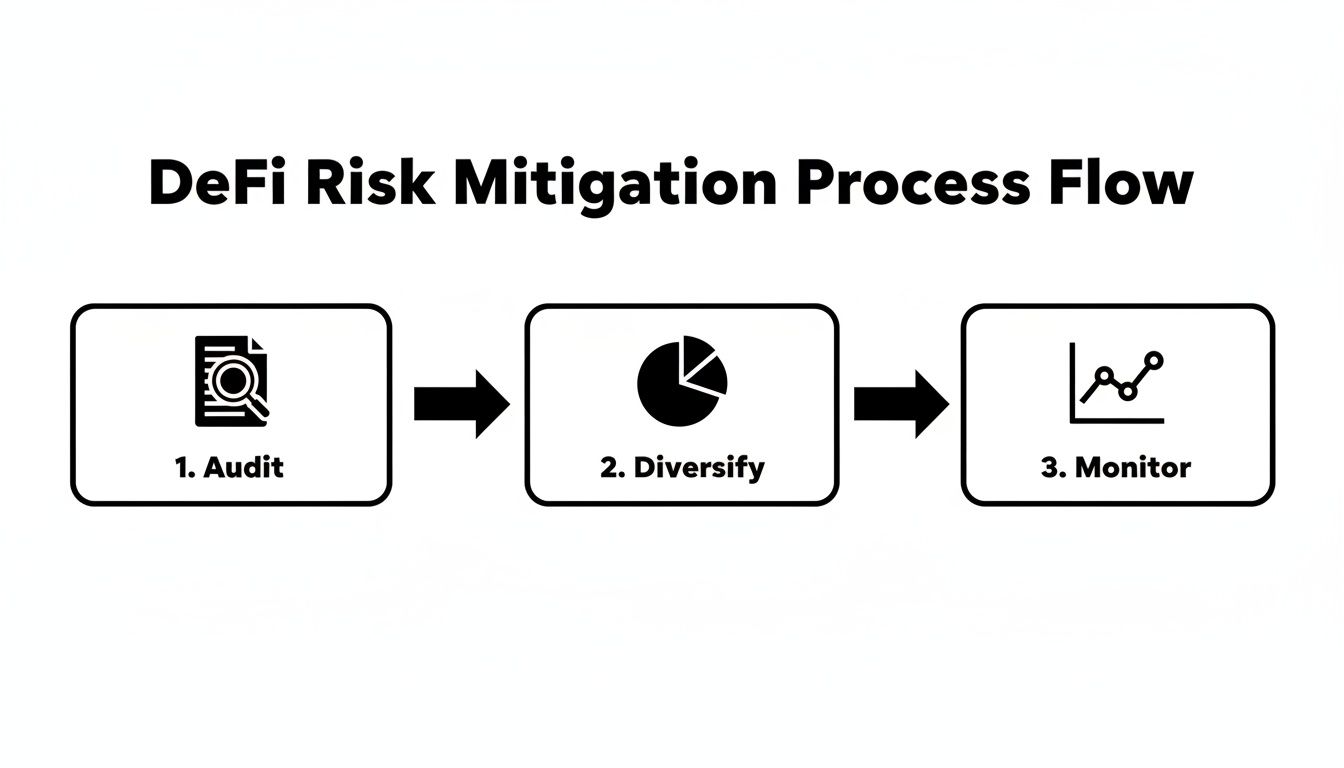
This flow—Audit, Diversify, Monitor—isn't a one-time deal. It’s a cycle you should constantly be running to make sure you're not just throwing capital out there, but actively managing your exposure.
And that's it! You've successfully deployed your first stablecoin strategy. Your money is now out there earning trading fees. The job now shifts to keeping an eye on performance and knowing when to make adjustments—the next crucial phase of smart yield optimization.
Using AI to Automate Your Yield Optimization
Let's be honest: manually tracking APYs across dozens of DeFi protocols and multiple chains is a full-time job. One day a liquidity pool on Arbitrum is the hot ticket; the next, a lending market on Base is offering a much better deal.
This constant churn is exactly where AI-powered platforms come in and completely change the game for yield optimization.
These aren't just glorified dashboards. Think of them as automated agents, constantly scanning the entire DeFi landscape for the best risk-adjusted returns on your behalf. It’s like having a market analyst who never sleeps, crunching thousands of data points every second to find the most efficient place for your capital.
This isn't just about convenience; it's a fundamental shift in how you can approach earning yield. The benefits are pretty immediate and powerful.
You get your time back. We're talking countless hours you'd otherwise spend glued to screens doing tedious research and manual transactions.
Fewer costly mistakes. Automation removes the risk of human error, like sending funds to the wrong address or miscalculating transaction fees. We've all been there.
Access to smarter strategies. An AI can execute complex strategies that would be a nightmare to manage by hand, like auto-compounding rewards or rotating funds between protocols at just the right moment.
How These AI Agents Actually Work in DeFi
At their core, these AI systems run on a simple but powerful loop: analyze, decide, and execute. They tap into a wide array of audited DeFi protocols, pulling in real-time data on everything—interest rates, trading fees, liquidity depth, and token rewards.
The AI then stacks up all these opportunities against your personal goals and risk tolerance. For instance, you could tell it to only interact with protocols that have over $50 million in total value locked (TVL) and have been audited at least twice. The agent takes those rules and hunts down the best strategy that fits inside your comfort zone.
From there, it handles all the heavy lifting—approving contracts, depositing your funds, and rebalancing as the market shifts. This constant, data-driven adjustment is the secret sauce to maintaining a competitive yield without the manual grind. If you're curious about the bigger picture, you can dig into the role of AI in crypto investing in our detailed guide.
The real superpower of AI in yield optimization is its ability to process information at a scale and speed no human ever could. It can spot a fleeting high-yield opportunity that might only last for a few hours and pounce on it instantly, capturing value that manual users would completely miss.
Setting Up Your First AI Strategy
Getting started with an AI agent like Yield Seeker is designed to be pretty painless. The whole process is about defining your big-picture parameters and then letting the tech do its thing.
First up, you’ll connect your wallet and deposit your stablecoins (like USDC) into the platform. This initial deposit is what funds your AI agent, giving it the capital it needs to start working for you.
Next, you define your strategy. This is less about hand-picking specific pools and more about setting your high-level preferences. You might choose a "conservative" profile that sticks to blue-chip lending markets or a "balanced" approach that mixes in some well-established liquidity pools. The AI uses this as a guide to narrow down its universe of potential investments.
Once you’ve set your preferences, the agent is off to the races. It allocates your capital to the best-fitting opportunities and kicks off the continuous cycle of monitoring and optimizing. You can just sit back and track your earnings through a clean interface, without ever needing to worry about the nitty-gritty transactions happening under the hood.
This whole idea of optimizing yield isn't unique to crypto, by the way. Look at retail media networks (RMNs), where U.S. ad spend is projected to hit $50 billion by 2025. Walmart's RMN optimized its ad yields by using its first-party data, leading to a 25% jump in ad revenue per impression in 2024. They did it by funneling ad inventory to the highest-demand channels—a process very similar to what a yield agent does in DeFi.
By handing over the complex, repetitive tasks to an AI, you free yourself up to focus on what really matters: your overall financial strategy.
How To Monitor And Rebalance Your Portfolio

Getting your capital deployed is a great feeling, but that's just the starting line. The real work in yield optimization is what happens next. Earning the yield is only half the battle; protecting and growing it requires a sharp eye and a clear plan for when to make a move.
The goal here isn't to get addicted to checking your portfolio every five minutes. It's about setting up a rhythm—a consistent way to check in on key metrics and know exactly what triggers a decision to rebalance. Let's dig into what you should actually be watching.
Key Metrics Beyond The APY
That big, juicy APY you see advertised? It's the headline, not the full story. To really get a feel for the health of your position, you have to look under the hood. A high yield can easily hide some nasty risks, so adding a few more data points to your dashboard is non-negotiable.
Here’s what I keep an eye on:
Total Value Locked (TVL) Trends: Is the protocol's TVL climbing steadily, or is it dropping off a cliff? A rising TVL is a good sign of trust and stability. A sudden, sharp decline is a massive red flag—it means other people are pulling their money out, and you need to figure out why.
Reward Token Performance: If your yield is paid out in the protocol's native token, its price is everything. A collapsing token can completely erase your gains, even if the APY number looks great. You have to track its price and liquidity to make sure your rewards are actually worth something.
Protocol Health and Governance: Jump into the protocol's Discord and governance forums. Are there heated debates over sketchy proposals? Has the core team gone quiet? The vibe in the community is often a leading indicator of a project's future.
To see everything in one place, a good portfolio tracker is essential. I use tools like Zapper or DeBank to pull all my assets across different chains into a single view. It saves a ton of time.
Knowing When To Make A Move
Rebalancing shouldn't be a gut decision. It needs to be a calculated move based on specific triggers. Remember, every time you move funds, you're paying gas and taking on new smart contract risk, so you better have a good reason. A big part of this is just understanding what portfolio rebalancing is and how to apply it to your stablecoin strategy.
Here are the common triggers that get my attention:
A Significant Yield Drop: If the APY on your position tanks and doesn't recover, your capital might be better off somewhere else.
A Superior Opportunity Emerges: A new, well-audited protocol might pop up offering a much better risk-adjusted return. It happens all the time.
Protocol Red Flags Appear: This could be anything from a security vulnerability announcement to a key developer leaving the team or a sketchy governance vote passing.
The decision to rebalance always comes down to a simple cost-benefit analysis. Ask yourself: "Does the potential upside here clearly outweigh the gas fees and my time?" For smaller portfolios, it often makes more sense to wait for a few triggers to align before you pay to move anything.
The Practicalities Of Gas Fees
Gas fees are just a fact of life on-chain, and they can absolutely wreck your yield optimization efforts if you're not smart about them. On a network like Ethereum, a single rebalancing transaction could set you back $30-$50 during busy times.
This makes frequent adjustments totally impractical unless you're managing a massive portfolio.
That's exactly why Layer 2 networks like Arbitrum or Base are such a game-changer. When transactions cost less than a dollar, you have so much more freedom to make small, frequent tweaks. It lets you compound rewards and fine-tune your positions without watching all your profits get burned on fees.
Always check a gas tracker before you hit "confirm," and try to make your moves during off-peak hours. It's a simple habit that will save you a lot of money over time.
Common Mistakes And Pro Tips
Successfully navigating DeFi yield optimization usually means learning from the costly mistakes others have already made. A few classic pitfalls consistently trip up newcomers, and even seasoned pros can benefit from tightening up their approach. Dodging these is the name of the game if you want to protect your capital and build a strategy that lasts.
One of the biggest blunders is blindly chasing the highest advertised APY. That 500% APY you see on some obscure, anonymous protocol? That’s a classic trap. These "opportunities" are almost always packed with extreme smart contract risk or unsustainable tokenomics, making them more like a casino bet than a real investment.
You're far better off prioritizing consistency and security over flashy, unbelievable numbers. A steady 8% yield from a battle-tested protocol like Aave or Curve is infinitely more valuable than a speculative yield that could disappear overnight—along with your principal.
Understanding The True Costs
Another common error is totally underestimating the bite that gas fees can take out of your returns, especially if you're working with a smaller portfolio.
Executing a multi-step strategy on Ethereum during peak hours can easily run you $100 or more in transaction fees. If you're starting with just $1,000, those fees have already wiped out a huge chunk of your potential gains before you've even started.
Always, always factor in gas costs before you make a move. For smaller amounts, it makes way more sense to stick to Layer 2 networks like Base or Arbitrum, where fees are often just a fraction of a cent. This is how you make sure your yield is real and not just an illusion getting eaten by network costs.
Similarly, failing to actually research the rewards token is a critical oversight. If a protocol is paying you in its own native token, you have to understand what it's for and how much sell pressure it's under. If everyone is just farming and instantly dumping their rewards, that token's price is going to collapse, and the real value of your yield will go down with it.
Pro Tip: Create a personal security checklist you run through before putting money into any new protocol. My personal filter includes verifying at least two independent audits, checking that the TVL is over $20 million, and confirming the team is public and active on socials. This simple process weeds out the vast majority of sketchy, high-risk projects.
Advanced Risks To Watch For
For the more experienced DeFi users, a common misstep involves getting too aggressive with leveraged strategies, often called "looping." This is where you deposit collateral, borrow against it, redeposit the borrowed funds, and repeat the process to amplify your yield.
While it can be a powerful tool, it dramatically increases your liquidation risk. A sudden market swing can completely wipe out your position before you have a chance to react.
If you decide to explore leverage, start small. Never push your loan-to-value (LTV) ratio to the absolute maximum. You need to maintain a healthy buffer to ride out market volatility. True yield optimization is a marathon, not a sprint to the bottom.
Got Questions About Stablecoin Yield?
Let's tackle some of the most common questions that pop up when you start digging into stablecoin yield. I'll give you some quick, no-nonsense answers to help you shape your own strategy.
What Kind of Returns Are Actually Possible?
This is the big one, right? And the honest answer is: it varies wildly. It all comes down to market conditions and how much risk you're willing to stomach.
If you stick to the blue-chip, battle-tested platforms, you're probably looking at a 3-8% APY. It's not going to make you rich overnight, but it's a solid, conservative play.
Feeling a bit more adventurous? You could chase yields on newer protocols and potentially see 15-25% or even higher. But—and this is a big but—that extra return comes with a hefty dose of extra risk. Just remember, a higher yield is always compensating you for taking on more uncertainty, like smart contract bugs or protocol meltdowns.
How Much Do I Need to Get Started?
You don't need a huge bankroll to get in the game. You can honestly start with as little as $50 or $100.
The real catch is transaction fees. On a network like Ethereum, gas fees can easily wipe out any gains you'd make on a small investment. But on cheaper networks like Polygon or Base, starting small is much more practical. It's always a good idea to start with an amount you wouldn't be devastated to lose while you're still figuring things out.
Your starting capital has to make sense against the transaction costs. A $10 gain is completely meaningless if you burned $30 in gas fees to get it. Always think about efficiency.
How Often Should I Be Rebalancing?
This really depends on your strategy and how active you want to be.
If you're in a low-risk lending pool, a quick check-in once a week is probably fine. Things don't change that fast.
But if you're deep in higher-risk yield farming, things can shift in a heartbeat. For those strategies, you'll want to be checking in daily to keep an eye on APY swings and the overall health of the protocol. The golden rule is to only rebalance when the potential gain is clearly bigger than the transaction costs and any new risks you'd be taking on.
Ready to put your stablecoins to work without all the manual legwork? Give Yield Seeker a try and let our AI agent hunt down the best risk-aware yield for you.