

You bought some crypto months ago. Maybe it was ETH, maybe it was a stack of stablecoins parked after a sale, maybe it was treasury funds your team didn’t want sitting idle. Now those assets are just sitting there, and the obvious question is simple. Should they be earning something?
That question usually leads people to staking. Not trading, not hunting the next token. Staking is one of the clearest ways crypto holders try to turn passive balances into productive assets. It matters because it’s no longer a niche side activity for power users. The staking industry reached an all-time high of just under $15 billion in annualized staking rewards in Q1 2022, up 57% from the prior year, even during weak market conditions, according to Staked’s State of Staking.
That number is useful for one reason. It tells you staking became a real part of crypto’s financial plumbing, not just a technical feature buried inside blockchains.
But staking is also misunderstood. Beginners often hear “earn yield on your crypto” and stop there. In practice, staking is a choice about asset exposure, liquidity, operational risk, and complexity. If you stake ETH, you’re not just earning rewards. You’re accepting ETH price exposure, validator design constraints, and sometimes delayed access to your capital.
That’s why staking is worth learning even if you eventually decide it’s not your best path. It helps you separate two very different goals: growing a volatile crypto position, or generating steadier income from cash-like assets. If you want a broader primer on passive income in crypto before going deeper, this guide to generating passive crypto income is a good companion.
Your Crypto Is Sitting Idle Now What
You open your wallet, see ETH or stablecoins sitting there, and the obvious question is not “how do I get yield?” It’s “what am I signing up for to earn it?”
Don’t treat all yield the same. Yield from staking comes from helping secure a blockchain. Yield from stablecoin strategies usually comes from lending, market-making demand, or protocol incentives. Those are different engines with different failure modes.
That distinction matters because the asset usually decides the menu.
If you hold ETH or another Proof-of-Stake asset, staking is the first path to evaluate. You already own the token, and staking lets that token participate in the network’s security model. The upside is straightforward. You keep exposure to the asset and earn protocol rewards on top. The trade-off is just as real. If the token drops 20%, your staking yield does not protect you from that loss.
If you hold stablecoins, the job is different. Stablecoin users are often trying to preserve dollar value while earning something on idle capital. In that case, staking is usually irrelevant or unavailable, and the better comparison is across lending vaults, market-neutral strategies, and automated yield tools. A broader guide to generating passive crypto income can help if you want to map those options before choosing one.
Idle assets are a portfolio decision
Staking is not just a yield feature. It is a position sizing and liquidity decision.
A staked ETH position says: “I want to keep owning ETH, I can tolerate volatility, and I’m willing to accept some lockup, validator, or smart contract risk to improve my return.” A stablecoin yield position says something else: “I care more about capital stability, easier accounting, and faster access to funds than I do about upside from a volatile token.”
Neither choice is universally better. They solve different problems.
Practical rule: Don’t ask “What has the highest APY?” first. Ask “Which asset am I comfortable holding, and how quickly might I need this capital back?”
Why this choice matters early
Beginners often frame the decision too narrowly. They compare headline yields and skip the part that determines whether the strategy fits their goals.
A 4% to 6% return on a volatile asset and a 4% to 6% return on stablecoins are not equivalent. One comes with token price risk and network-specific rules. The other usually comes with counterparty, protocol, or liquidity-pool risk. Same number on the screen. Different behavior when markets get messy.
That is why staking deserves a separate evaluation instead of being thrown into a generic “passive income” bucket.
Key questions for beginners
Start with these questions before comparing platforms or APYs:
Do I want long-term exposure to this token, or do I mainly want yield on idle capital?
Can I handle price swings while my funds are staked?
Will I need quick access to this money, or can I accept unbonding periods and withdrawal delays?
Am I comfortable relying on a validator, exchange, liquid staking protocol, or vault manager?
Do I want the simpler logic of staking a token I already own, or a more hands-on stablecoin strategy with different sources of risk?
Answer those thoughtfully and the path usually gets clearer. If you want to grow a conviction position in a PoS asset, staking often makes sense. If you want steadier, cash-like yield with less exposure to crypto price swings, stablecoin strategies may be the better fit.
What Is Staking and How It Secures Networks
Staking makes more sense when you stop thinking about it as interest and start thinking about it as collateral-backed work.
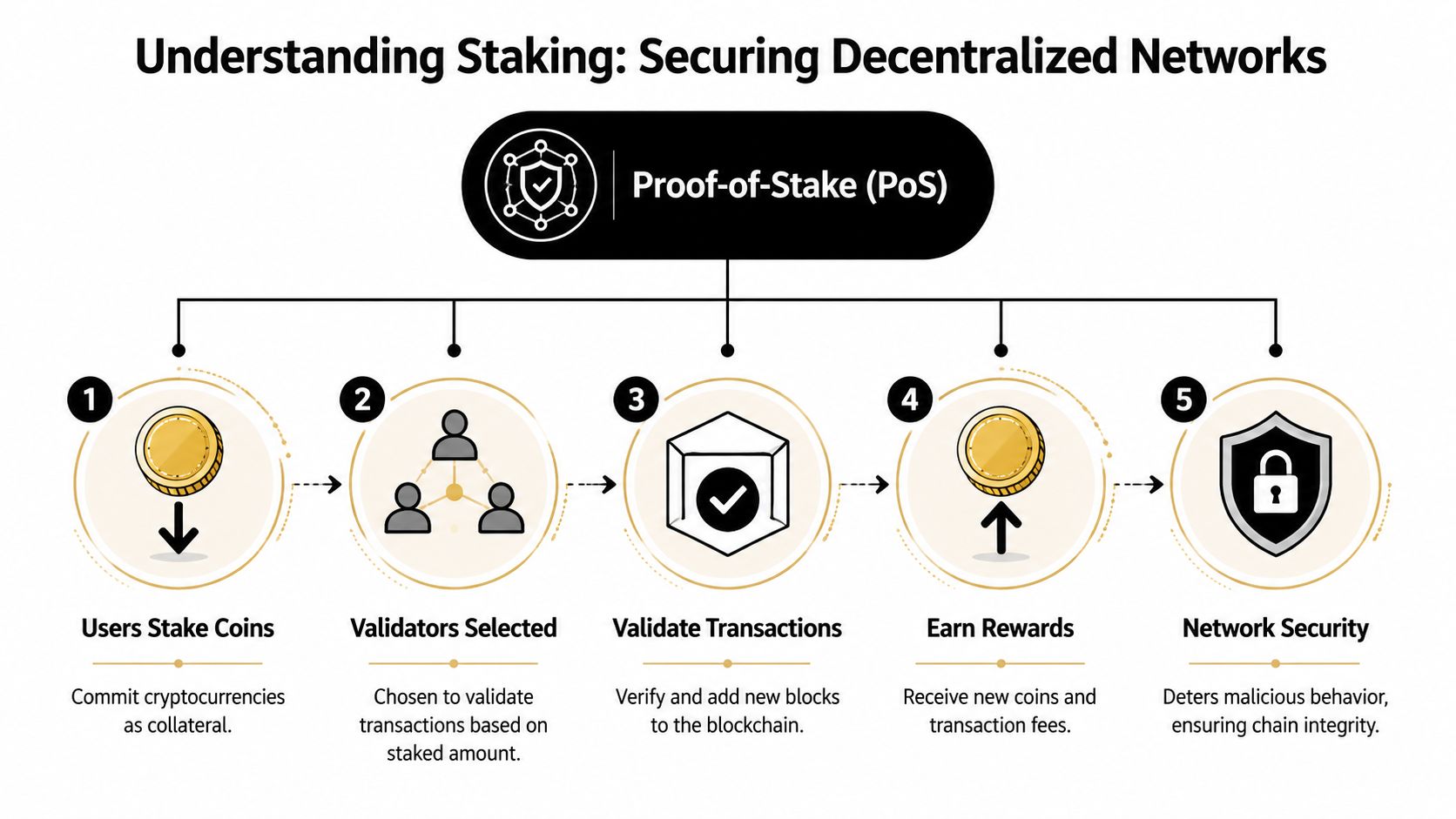
In a Proof-of-Stake network, users commit coins to help the network choose who gets to verify transactions and add new blocks. Those participants are called validators. The network rewards them because they’re part of the system keeping records honest.
A plain-English model
A useful analogy is a digital bank with no central operator. People deposit funds as a sign of commitment. The system then selects approved operators to process activity. If those operators do the job correctly, they earn rewards. If they break rules or fail badly enough, the system can punish them.
That’s the core of staking.
Here’s the simplified flow:
You lock or delegate coins Your stake acts as economic skin in the game.
A validator participates in consensus The validator proposes or attests to blocks, depending on the network.
The network checks behavior Honest participation earns rewards. Bad behavior can lead to penalties.
Rewards accrue over time These rewards come from protocol issuance, fees, or both.
You eventually withdraw Timing depends on the network and the staking method you used.
Why networks want staking
Proof-of-Stake replaced the old mining model on major chains because it changes both cost structure and network design.
Ethereum’s transition to Proof-of-Stake, known as The Merge, cut network energy consumption by 99%, according to Bitwise’s overview of staking as a service. That same shift also introduced a different operational reality. Validators now face risks such as slashing penalties and withdrawal queue delays that didn’t exist in the same form under Proof-of-Work.
The validator lifecycle matters
On Ethereum, staking isn’t a single on-off switch. It follows a lifecycle:
Validator setup and deposit
Pending queue activation
Active validation
Exit queue
Withdrawable status
Each phase creates different trade-offs. Before activation, your capital is committed but not yet productive. During active validation, rewards are available but operational performance matters. During exit and withdrawal, your funds may not be instantly available.
Staking isn’t free yield. It’s compensation for locking capital into a system with rules, delays, and penalties.
Where beginners get confused
Many beginners think they are “staking with Ethereum” directly, when they’re often using a layer on top of Ethereum. That layer might be an exchange, a liquid staking protocol, or a custodial service. The underlying economics come from the network, but the user experience and risk profile come from the wrapper.
That distinction matters because two products can both say “ETH staking” while exposing you to very different kinds of risk.
Exploring the Four Main Types of Staking
The decision isn’t whether to stake. It is how to stake.
That choice is where the practical trade-offs show up. Convenience, liquidity, custody, and complexity all change depending on the route you take.

Solo staking
Solo staking is the cleanest version conceptually. You run your own validator and keep direct control over the operation.
That gives you maximum alignment with the network and removes some third-party dependence. It also means you are responsible for uptime, key management, maintenance, and monitoring. If something breaks, there’s no support desk to save you.
This path suits technically capable users who want direct participation and are willing to treat staking like infrastructure, not a passive app setting.
Exchange or custodial staking
This is the easiest on-ramp. You hold assets on an exchange or with a custodian, click a staking option, and the provider handles the validator side.
The trade-off is obvious. Ease goes up, but so does counterparty risk. You depend on someone else’s custody, withdrawal processes, operational standards, and sometimes opaque fee structure. If the platform freezes activity, changes terms, or suffers an internal issue, your “simple yield” suddenly doesn’t feel simple.
For beginners, this route is often fine as a starting point. It’s just important to admit what it is: outsourced staking with platform risk attached.
Liquid staking
Liquid staking tries to solve one of the biggest frustrations in staking, which is lost liquidity. You deposit a token such as ETH into a protocol, and the protocol gives you a receipt token representing the staked position plus accrued rewards.
That receipt token can often be used elsewhere in DeFi while the underlying asset remains staked. This is why liquid staking became so central to the market’s evolution.
By early 2026, over $58 billion in total value was locked in liquid staking protocols, with Lido at $27.6 billion TVL representing 47.41% of all staked ETH, according to Amina Group’s research on institutional staking adoption. The same research notes that liquid staking on Ethereum has scaled across roughly 300,000 validators through Lido, compared with around 65,000 solo stakers.
That doesn’t mean liquid staking is always better. It means the market strongly values transferable liquidity.
Restaking
Restaking adds another layer. A staked asset, or a liquid staking token, can be used to help secure additional services or protocols beyond the base chain.
In plain language, you’re trying to get more out of the same economic base. That’s attractive because it can improve capital efficiency. It’s also more complex because you’re stacking assumptions on top of assumptions.
Amina’s 2026 research found $19.63 billion deployed in restaking protocols in addition to liquid staking’s larger pool. That tells you discerning capital is willing to take on extra moving parts when the structure looks worthwhile.
More layers can improve yield, but each new layer introduces a new place for assumptions to fail.
A quick side-by-side view
Method | Best for | Main advantage | Main drawback |
|---|---|---|---|
Solo staking | Technical users | Direct control | Operational burden |
Exchange staking | Beginners | Convenience | Custody and platform risk |
Liquid staking | Active DeFi users | Better liquidity | Smart contract and peg risk |
Restaking | Advanced users | Capital efficiency | Added complexity and layered risk |
What works in practice depends on your goal. If you want simplicity, exchange staking may be enough. If you want composability, liquid staking is more useful. If you want direct control, solo staking is the cleaner route. If you don’t already understand the base layer, restaking is usually too much complexity too early.
The Real Risks and Rewards of Staking
The reward side of staking is easy to market. The risk side is where people make expensive mistakes.

What the reward actually is
A staking reward is payment for taking part in consensus and tying up capital. It can feel like passive income, but it’s not equivalent to holding cash in a bank product. Your reward depends on network rules, participation levels, fees, and the wrapper you choose.
And if you’re staking a volatile asset, the token price can dominate the result. A decent staking yield won’t protect you from a sharp move down in the underlying asset.
The four risks that matter most
Slashing risk Validators that break consensus rules or behave incorrectly can lose a portion of stake. If you stake through an operator, their mistakes can still affect you.
Liquidity risk Some staking setups delay withdrawals or use queues. That’s manageable until you need funds quickly.
Smart contract risk Liquid staking and restaking add contracts, integrations, and token wrappers. Every extra contract expands the surface area for bugs or bad design.
Counterparty risk If an exchange or custodian controls access to your assets, you rely on that company’s processes and solvency, not just the protocol’s rules.
APY can hide the wrong question
People often compare staking opportunities by headline yield. That’s usually the wrong first filter.
A better checklist is:
Who controls the keys or withdrawal process?
Can I exit when I need to?
What new risks did this wrapper add?
Am I comfortable holding the underlying asset through volatility?
If you can’t answer those four, the APY is decoration.
A short explainer helps here:
What usually works
Simple setups with clear custody and understandable exit mechanics tend to age better than stacked yield structures you can’t fully explain.
What usually doesn’t work is chasing extra yield through layers you haven’t stress-tested mentally. If you need three tabs open to understand where the return comes from, you probably need to size the position smaller.
Staking vs Stablecoin Yield Strategies
This is the fork in the road for a lot of users.
Staking is usually the right lens if you already want to own a Proof-of-Stake asset like ETH for its long-term upside. Stablecoin yield strategies are usually the right lens if your priority is cash-like positioning with on-chain income.
Two goals that look similar but aren’t
When you stake ETH, you are making two bets at once. You’re betting the network stays healthy, and you’re accepting ETH price exposure while earning rewards.
When you deploy USDC into a stablecoin yield strategy, you’re usually trying to avoid the large price swings of volatile tokens. You still face protocol risk and market structure risk, but you’re not relying on ETH appreciation to make the position feel worthwhile.
That difference changes how you evaluate outcomes. A staker may happily tolerate temporary illiquidity if they’re accumulating more ETH. A stablecoin holder may care much more about redemption access and capital preservation.
Why active systems have an edge
Ethereum research shows solo stakers are about 10% more responsive to yield changes than the average staker base, with a supply elasticity of 1.184 for solo stakers versus 1.078 for all stakers, according to Ethereum Research’s framework for the staking market. The same analysis argues that solo stakers don’t have the same access to MEV or adjacent yield streams that larger operators can use.
That matters beyond staking itself. It shows a broader pattern in crypto yield: individual users often rely on the visible base rate, while larger systems can combine multiple revenue sources more effectively.
Active allocation becomes more relevant than passive staking if your focus is stablecoin income rather than validator economics. For a deeper look at that side of the market, see this stablecoin yield guide.
Staking vs Stablecoin Yield At a Glance
Attribute | Crypto Staking (e.g., ETH) | Stablecoin Yield (e.g., USDC via DeFi) |
|---|---|---|
Primary goal | Earn network rewards while holding the asset | Earn on-chain income while staying in a cash-like asset |
Asset exposure | Volatile | Designed to stay stable relative to fiat |
Yield source | Protocol rewards, fees, sometimes related staking flows | Lending demand, liquidity provision, protocol incentives, routing |
Liquidity profile | Can involve queues, lockups, or receipt tokens | Often better for users who want easier access, depending on protocol |
Main risks | Token volatility, slashing, validator issues, wrappers | Smart contract risk, protocol risk, stablecoin-specific risk |
User complexity | Low to high depending on method | Low to high depending on strategy and tooling |
Best fit | Users already bullish on the network token | Users prioritizing steadier income and flexibility |
If you want more of the same token, staking is coherent. If you want income without taking on that token’s price swings, stablecoin strategies are usually the better frame.
How to Choose Your Path to Passive Income
A lot of guides pretend this is a yield-ranking exercise. It isn’t. It’s a fit exercise.
The key trade-off is usually liquidity versus reward structure. Many users get pushed into a bad decision because they chase higher yield without being honest about how often they may need the money back.

Ask yourself these three questions first
1. Do you want exposure to the underlying token?
If the answer is yes, staking may fit naturally. If the answer is no, stablecoin strategies usually make more sense because they separate the income goal from directional token risk.
2. How quickly might you need your funds?
This matters more than many investors admit. Blockworks’ guide to staking trade-offs highlights a gap in yield education: users are often forced to choose between locking capital for stronger returns or accepting lower returns for liquidity.
3. How much operational complexity can you tolerate?
If monitoring validators, wrapped tokens, and protocol changes sounds annoying, that’s useful information. A strategy you won’t maintain properly is usually the wrong one.
Matching common user profiles
Long-term ETH holder Staking often fits because the user already wants ETH exposure and doesn’t mind earning more ETH over time.
Treasury manager with uncertain cash needs Liquidity usually matters more. Locking capital can create operational problems even if the yield looks attractive.
DeFi-native user who likes active positioning Liquid staking or more advanced strategies can work, but only if the user understands the extra layers.
Busy beginner Simpler, more automated systems tend to beat hand-built strategies abandoned after two weeks.
One practical filter that saves time
When evaluating any path, ask whether the structure is helping you solve a real need or just adding complexity for a marginal improvement you may never realize.
That’s also true when you choose where to research and execute. If you’re comparing centralized venues or checking how exchanges fit into broader crypto workflows, a directory-style resource like Evaluate Binance for AI projects can be useful for context before you make operational decisions.
Choose the strategy you can explain clearly, exit cleanly, and stick with through dull market conditions.
Generally, the best passive income setup isn’t the one with the most moving parts. It’s the one that matches their liquidity needs, risk tolerance, and available attention.
The Future of Yield Is Automated
Open three DeFi tabs after a volatile week and the problem shows up fast. Rates moved, incentives changed, one pool no longer justifies the smart contract risk, and the "passive" strategy now needs active work.
That gap between passive income and active maintenance is where yield products are headed. The next wave is not about inventing a new base primitive. It is about building systems that monitor conditions continuously, reallocate faster than a manual routine, and keep capital pointed at a defined goal, whether that goal is long-term token accumulation or liquid dollar-denominated yield.
Staking will remain a core tool because it does a specific job well. It gives holders a way to support a network and earn from that exposure. But many users are not trying to optimize for more ETH or another volatile asset. They want stable purchasing power, daily liquidity, and less operational overhead. For that group, automation matters more than another dashboard full of manual choices.
The standard is changing. Users will increasingly expect yield systems to handle monitoring, rotation, and risk controls in the background, the same way they already expect wallets to abstract away raw transaction data. The winners will be products that make good decisions consistently, keep the strategy legible, and let users exit cleanly when their needs change.
That is the problem Yield Seeker is built to solve. If your goal is hands-off stablecoin yield rather than staking exposure, its system automates allocation across DeFi without lockups, withdrawal fees, or constant protocol hunting. The broader shift is already underway, and AI yield optimization for stablecoin strategies is a practical version of what many users will soon treat as the default.